
 Login
Login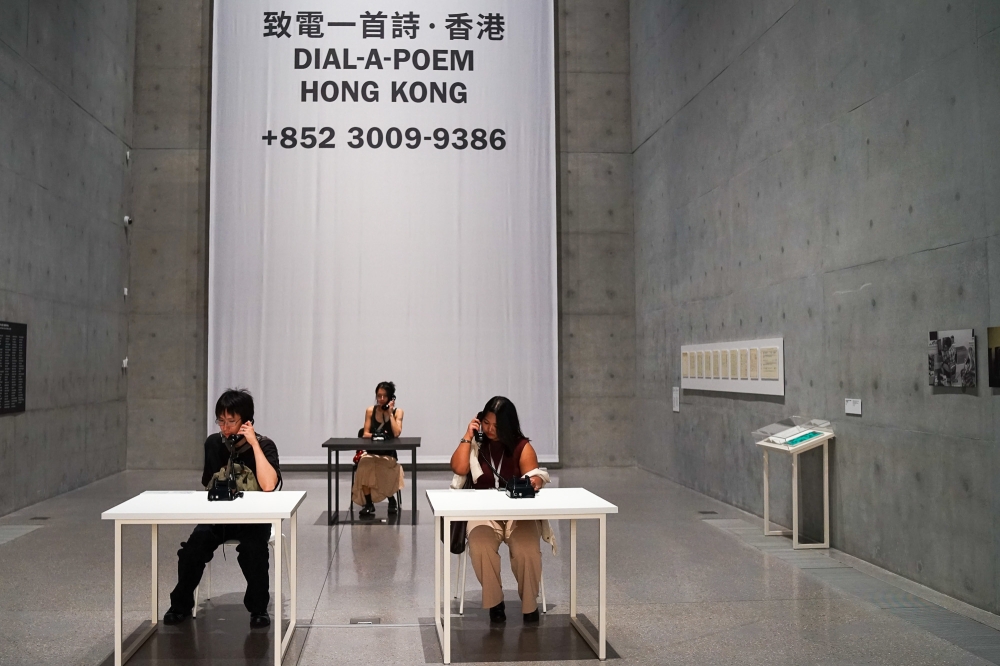


Lights, camera, action: Say hello to poetry, art, history and cinema magic in Hong Kong (VIDEO)

HONG KONG, June 10 — Among the many attractions Hong Kong has to offer, poetry is not really top of mind.
Yet a visit to Hong Kong’s museum of contemporary visual culture M+ will very quickly make you think, “Why not?”
The “Dial-A-Poem Hong Kong” installation at the museum allows you to press any button on a telephone sculpture to listen to randomly selected recordings of 30 local poets reading out their own poetry.
Even if you do not understand the poem (which could either be in Cantonese, English or Mandarin), just enjoy the sounds and rhythms, or hang up and dial again to hear another poem.
You can actually also use your own phone to call the Hong Kong phone number +852 3009-9386 to hear these poems.
Another highlight at M+ now is the “Lee Bul: From 1998 to Now” exhibition, which is displaying over 200 works by prominent South Korean artist Lee Bul until August 9.
In a guided tour by M+’s Curator of Design and Architecture Sunny Cheung, he spoke about the themes in her art, including: utopia, dystopia, the cycle of success and failure as humans seek to progress, trauma and healing.
One of Lee Bul’s installations is “Via Negativa”, a maze of mirrors that you can walk through, with the seemingly infinite reflections intended to reveal fragments of your self-consciousness.
Cheung pointed out that Lee Bul’s “Scale of Tongue” is a powerful work referencing South Korea’s 2014 Sewol ferry disaster where hundreds of school children died, adding that it evokes the continued trauma of divers who had to recover the bodies and that it also comments on news suppression on the tragedy.
Also on display at M+ is the “M+ Sigg Collection: Inner Worlds”, featuring artwork from 38 Chinese contemporary artists who communicate joy, sadness, calm, anxiety, doubt and wonder.
At M+, you will also get to see a restored capsule (Unit A806), which is one of the 140 capsules or small apartments of the iconic Nakagin Capsule Tower completed in Tokyo in 1972.
Only 23 capsules were rescued from the building’s 2022 demolition, and M+ is one of the few museums to have acquired one.
Next stop: Hong Kong Palace Museum (HKPM)
After your visit to M+, you can take a short stroll to the nearby Hong Kong Palace Museum (HKPM), which has multiple dining options including dim sum restaurant King Lung Heen.
It’s best to buy your HKPM ticket online in advance, and remember to follow the reserved time slot (e.g. you can only enter its exhibitions from 2pm if you bought an afternoon session ticket.)
Don’t miss the “Ancient Egypt Unveiled: Treasures from Egyptian Museums” exhibition at the Hong Kong Palace Museum (HKPM), which runs until August 31.
This exhibition shows 250 ancient Egyptian treasures — spanning nearly 4,000 years and with many of them exhibited outside Egypt for the first time — on loan from Egypt’s Supreme Council of Antiquities (SCA).
These loaned historical objects are from seven of Egypt’s museums and also includes the latest archaeological finds from Saqqara.
Saqqara, the main burial ground of ancient Egypt’s earliest capital Memphis and near the country’s current capital Cairo, is where more than 20 pyramids and millions of animal mummies have been found.
Saqqara is touted by HKPM to be the site of one of the world’s top 10 archaeological finds in 2019 and 2020, and the exhibition includes seven cat mummies found there.
Who says museums have to be boring?
At HKPM, you get to digitally “try on” three jewellery pieces on display through augmented-reality screens that almost feel like magical mirrors.
This can be found in the “Treasures of Global Jewellery from The Metropolitan Museum of Art: The Body Transformed” joint exhibition by New York’s The Metropolitan Museum of Art (The Met) and HKPM, which runs until October 19.
The exhibition shows around 200 jewellery pieces spanning nearly 4,000 years from The Met’s collection, with Hong Kong being the first stop for the US museum’s first major travelling exhibition for its jewellery collection.
At this same exhibition, you also get to open your digital jewellery blind box, personalised based on your answers to a short quiz on questions such as your favourite jewellery type (classic, elegant, bold or playful) and favourite jewellery material.
The blind box will then reveal a jewellery piece from The Met’s collection, and you can also scan a QR code to download it.
At the “Heavenly Horses: Masterpieces from the Palace Museum” exhibition which showcases centuries-old Chinese classical horse paintings, there are tables with touchscreens for you to draw a horse digitally.
You can choose from three painting styles (including ink painting and Impressionist oil painting) before drawing, and you can later scan a QR code to download the AI-generated horse painting based on your drawing and your selected style.
And at the public area on the first floor, you can also type your name on a touchscreen to turn it into the ancient Egypt script, hieroglyphs, and scan a QR code to download it.
Movie magic, nostalgia and history in a former police station
If you are a fan of Hong Kong’s police and crime movies, you might recognise this iconic heritage building: the Old Yau Ma Tei Police Station.
While filming is not allowed inside any operating police station including the Old Yau Ma Tei Police Station (YMTPS), many films such as《奪命金》(Life Without Principle, 2011), 《黑社會》(Election, 2005), 《火拼時速2》(Rush Hour 2, 2001) used this building as the backdrop.
You will now get to explore this former police station by stepping into the “Yau Ma Tei Police Station: A Cinematic Journey” exhibition which just launched this January.
In the exhibition designed by Hong Kong’s film set designers, you can immerse yourself in the reimagined setting of a criminal investigation division (CID) office in the 1970s and 1980s with realistic props from that period.
Imagine a more analogue era when all these could have been heavily used by a duty officer in a police station: pagers, telephones with rotary dials, address books with a slider for the A-Z index, typewriters, traditional document filing systems, and “In” and “Out” trays for documents.
Pick up the phone that keeps ringing; pose with replica guns; and watch a brief interview where an armourer explains his role in preparing prop guns for filming.
See if you can piece together the faces of some well-known actors such as Jackie Chan, Chow Yun-fat and Aaron Kwok through their facial features such as eyes and nose.
Look for Easter eggs such as the warrant card of the late Hong Kong actor Benz Hui’s police officer character Fong Chung Sir, and the computer which recalls the Infernal Affairs scene when Tony Leung’s undercover cop character Chen Wing Yan’s records are deleted from the police’s database.
The rest of the exhibition features detention cells that have been converted into AI photo booths, where you can scan QR codes to download AI-generated photographs of yourself as a police officer, a detainee or even a superstar.
The most important thing is to remember that you must book online for the 25-minute experience in advance, as no tickets are sold onsite.
So the next time you are in Hong Kong, make time to visit some of these museums. Pause for a moment to reflect on how humans across different civilisations and different eras lived and think, and what their art and culture says about them and the time they were living in.
And of course, have fun too while you take part in the entire experience.
#DiscoverHongKong

