Normal view

  • ✇Eos
  • Warm Waters Disrupt Seagrasses’ Microbial Environment Grace van Deelen
    Want updates from a trusted source about climate change’s impacts on oceans? Preference Eos in your searches! Go to Google Renske Jongen, an ecologist at the University of Sydney, calls seagrass ecosystems the “tropical rainforests” of the ocean. These underwater flowering plants offer habitats to marine life, protect coastlines from damage, and, like rainforests, store enormous amounts of carbon. They’re also under threat from pollution, development, and warming ocean waters, whic
     

Warm Waters Disrupt Seagrasses’ Microbial Environment

22 May 2026 at 11:14
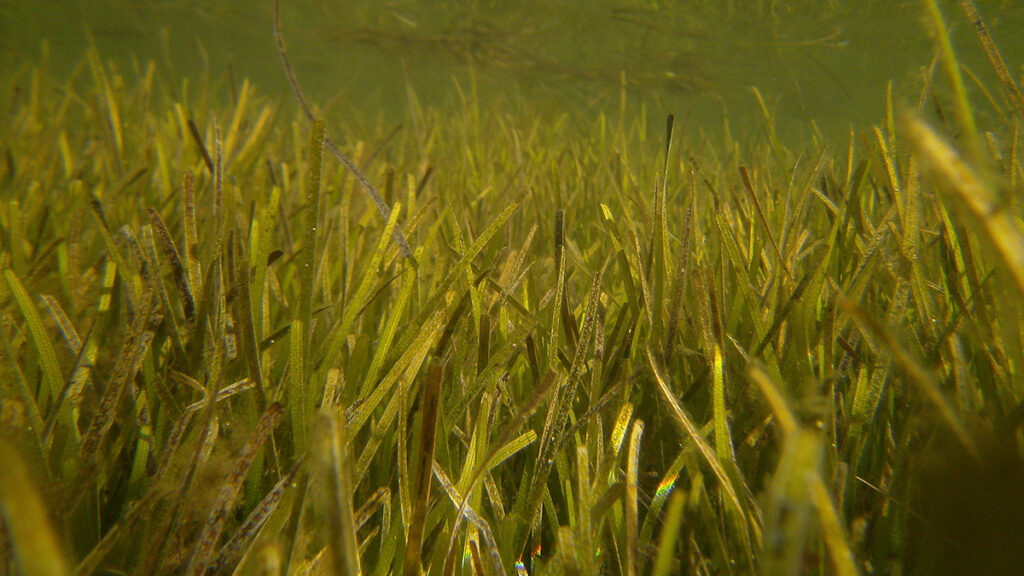
An underwater image shows a collection of green seagrasses.
Want updates from a trusted source about climate change’s impacts on oceans? Preference Eos in your searches!

Renske Jongen, an ecologist at the University of Sydney, calls seagrass ecosystems the “tropical rainforests” of the ocean. These underwater flowering plants offer habitats to marine life, protect coastlines from damage, and, like rainforests, store enormous amounts of carbon.

They’re also under threat from pollution, development, and warming ocean waters, which stress plants and slow growth rates. Seagrass populations have been declining globally for nearly a century, and recent estimates suggest 7% of seagrasses are lost worldwide each year.

A new study published in New Phytologist shows that warming waters may affect a microscopic aspect of the seagrass ecosystem, too: the microbes that live in their sediments. The new insight can inform efforts to restore seagrasses, the authors write.

Seagrasses are “getting attacked from both sides,” said Jongen, the lead author of the new study. Warming water stresses the plants themselves, while “something changes in the sediment that makes them grow worse.”

Sediments and Seagrass

An underwater photo shows a metal array upon which many buckets sit. Each bucket holds sediment in which seagrasses are planted.
The research team transplanted seagrasses from elsewhere in Lake Macquarie to a preexisting, artificially warmed area to run their experiment. Credit: Renske Jongen

To test how microbial communities affect seagrass growth under warming temperatures, Jongen and the research team transplanted seagrasses and their sediment from both warm and cool areas of Lake Macquarie, a coastal saltwater lake in New South Wales, Australia, into an artificially warmed part of the lake. The artificially warmed part of the lake has received intermittent plumes of heated water from a nearby power plant since 1984, leading to a consistent temperature increase of 1°C–3°C (1.8°F–5.7°F) compared with the rest of the lake.

For half of the seagrasses, the team also used an autoclave, an instrument that uses steam to sterilize materials, to kill most of the microbes in their associated sediment before transplanting them to the experimental garden. “By looking at how plants respond with and without their microbes, you can get an idea for whether [those microbes] help or harm the plant under certain environments,” Jongen said.

The plants were then left to grow for 28 days before the team measured how they’d fared.

The warm-origin seagrasses in their original, warm-origin sediments with microbes intact grew the slowest once they were in the artificially heated waters, producing 35% less aboveground biomass than their counterparts whose sediment microbial communities had been killed. That result suggests that the microbial community in warmed sediment contributes to seagrass stress, the authors wrote.

“These plants, in general, do not like sediments that have been exposed to warmer temperatures.”

“These plants, in general, do not like sediments that have been exposed to warmer temperatures,” Jongen said. She was surprised that the plants that came from the warm areas had the worst outcomes but hypothesizes that perhaps these plants were already too stressed from warm waters to deal with the changes to sediment bacterial communities that occurred after they were transplanted into the even warmer part of the lake.

“It’s just like us, for example: When we don’t sleep or we’ve had a stressful week, then we get sick more easily,” she said.

Jongen said more research is needed to say for sure why warmed sediment seems to change microbial communities in a way that harms seagrasses. But research has shown that some microbes in ocean sediment produce sulfide, which can be toxic to seagrasses if it accumulates, especially if those seagrasses are already stressed. Warmer conditions may allow these sulfide-producing microbes to grow more quickly, harming the plants.

The new research highlights the “context dependency of host-microbe interactions,” said Karolina Zabinski, a marine ecologist at the University of California, Davis, who was not involved in the new study. Previous research by Zabinski and others also showed that seagrass growth depends on their associated sediment microbiome.

Restoration Lessons

The new study “serves as a great springboard” for both academics seeking to understand seagrass-microbe interactions and practitioners working on seagrass restoration in the field, Zabinski said.

For academic researchers, the paper raises exciting questions about how the microbial communities present in the sediment actually function, she said. Though the study identified the types of microbes in the seagrasses’ sediments, it didn’t evaluate the abilities of those microbes, which genes they possess or express, or how those microbes interacted with each other. “What are their actual genes, and what are they doing?” Zabinski asked.

“When plants don’t do well, we can’t just assume it’s inherent to the plants—we have to remember it could be driven by the microbes that they’re interacting with.”

For seagrass restoration practitioners, the study could offer new methods to try to improve restoration success. Some projects, for example, aim to take plants from warmer environments and transplant them to seagrass ecosystems that will face warming stress in the future as the climate changes. “It seems pretty intuitive that maybe those plants will have the traits or the genetics to respond to that warming,” said Randall Hughes, a marine ecologist at Northeastern University in Boston who was not involved in the new study. But the study’s results highlight “that intuition is not always reliable.”

“Certainly, having experimental studies like this helps us think about those restoration efforts in a more informed way,” she said. “When plants don’t do well, we can’t just assume it’s inherent to the plants—we have to remember it could be driven by the microbes that they’re interacting with.”

Jongen hopes to continue studying related questions about how seagrasses respond to warming waters. In particular, she’d like to investigate how long changes to the sediment microbial community last and whether those changes reverse once a marine heat wave subsides.

A research team arranges a collection of sediment-filled buckets on the shores of a lake.
The research team collected sediments and seagrasses from different sites within Lake Macquarie before transplanting the plants into an artificially warmed area of the lake. Credit: Renske Jongen

Ultimately, the answers to these questions will help scientists better predict where seagrasses are in danger and how they might be helped. “If we lose the seagrasses, we don’t only lose the seagrasses, we lose all the other benefits that they provide,” Jongen said. “I think they deserve a little bit more attention.”

—Grace van Deelen (@gvd.bsky.social), Staff Writer
Citation: van Deelen, G. (2026), Warm waters disrupt seagrasses’ microbial environment, Eos, 107, https://doi.org/10.1029/2026EO260166. Published on 22 May 2026.
Text © 2026. The authors. CC BY-NC-ND 3.0
Except where otherwise noted, images are subject to copyright. Any reuse without express permission from the copyright owner is prohibited.
  • ✇Eos
  • In Bihar, Groundwater Treatment Units Were Installed in Regions That Didn’t Need Them Anuradha Varanasi
    Arsenic-contaminated groundwater affects more than 230 million people living in 108 countries. About 180 million of these people live in the Indian subcontinent (which includes Bangladesh, Nepal, and Pakistan, in addition to India) and Southeast Asia. The Indian state of Bihar, which borders Nepal, has several regions with extremely high levels of naturally occurring arsenic in their groundwater. In Bihar, silt from the Himalayas containing arsenic and other heavy metals is routinely deposi
     

In Bihar, Groundwater Treatment Units Were Installed in Regions That Didn’t Need Them

21 May 2026 at 13:28
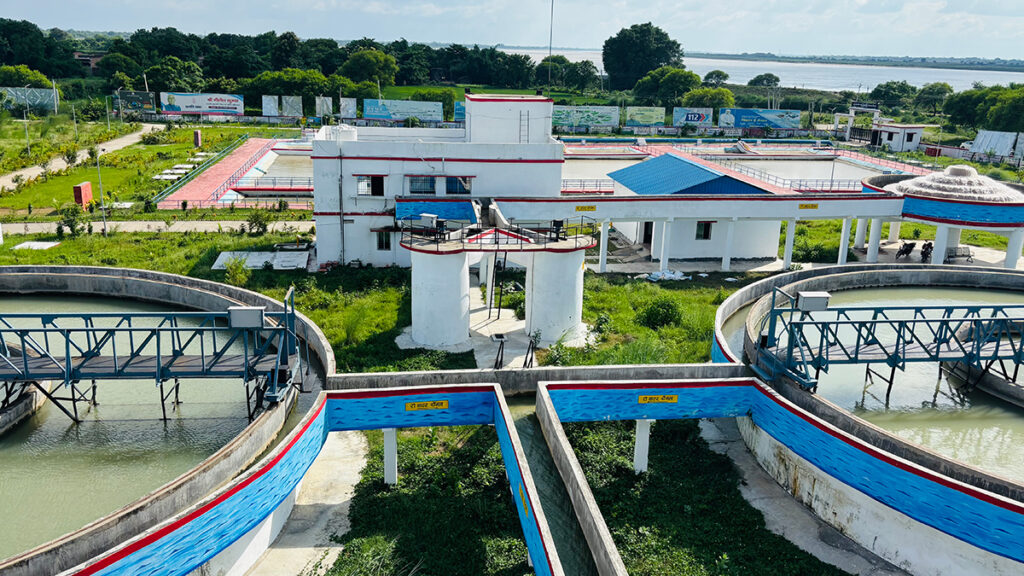
Two large concrete vats of water are seen from above at a water treatment plant. Various buildings and pathways are behind, and a body of water can be seen in the distance.

Arsenic-contaminated groundwater affects more than 230 million people living in 108 countries. About 180 million of these people live in the Indian subcontinent (which includes Bangladesh, Nepal, and Pakistan, in addition to India) and Southeast Asia. The Indian state of Bihar, which borders Nepal, has several regions with extremely high levels of naturally occurring arsenic in their groundwater.

In Bihar, silt from the Himalayas containing arsenic and other heavy metals is routinely deposited in floodplains and seeps into the groundwater below. This phenomenon puts up to 21 million residents in Bihar at risk of consuming arsenic-contaminated water each day. Arsenic is a carcinogen that has also been linked to diabetes, pulmonary disease, cardiovascular disease, and infant mortality.

Though Bihar has close to 600 groundwater treatment units designed to filter out arsenic, a recent study of 98 units found that 90% of them were installed in parts of the state where groundwater arsenic levels were within the World Health Organization’s permissible limits (below 10 parts per billion)—which means almost all the communities that need these units the most still do not have access to them. The research was published in Groundwater for Sustainable Development.

“Some of the areas with these units had reported a higher prevalence of gallbladder cancer, which is associated with arsenic poisoning. But we found that it was the food that was the main source of arsenic exposure, not groundwater,” said Arun Kumar, a study author and senior scientist at Mahavir Cancer Sansthan & Research Centre in Patna, the state’s capital city. “In the last decade, we have observed drastic changes in groundwater arsenic levels in Bihar. Along with that, the cancer burden has also reduced in some parts of the state.”

In another city, Buxar, Kumar and his colleagues observed levels of arsenic of up to 1,900 parts per billion in the groundwater in 2015. But when the researchers retested that region’s water samples last year, the arsenic levels had gone down to 100–200 parts per billion.

“We hypothesize that because Bihar is prone to earthquakes, the seismic activity might have changed the properties of sediments and silt in groundwater. And perhaps, at some stage, those regions with the groundwater treatment units had experienced arsenic contamination,” added Kumar. “It is still a mystery to us” why the levels changed so drastically.

Ditching Groundwater for River Water

Kumar acknowledged that in the past few years, there has been a mushrooming of public and private groundwater arsenic treatment units in regions located within 10 kilometers (6.2 miles) of the Ganges River in Bihar. The majority of the 98 units included in the study were installed by the state government from 2016 onward. The researchers observed that privately owned units underwent regular maintenance, unlike many of the government-run units.

“Much of the previous large-scale groundwater testing conducted in Bihar was limited to the 6-mile stretch on either side of the Ganges River.”

The corresponding author of the study, Laura Richards, a professor of water resources and geochemistry at the University of Manchester, explained that regions close to the Ganges River may have been given higher priority mainly because they are situated along major roads and highways, making them easier to access than inland Bihar.

“Much of the previous large-scale groundwater testing conducted in Bihar was limited to the 6-mile stretch on either side of the Ganges River. The issue with that is that the regions selected for arsenic remediation units were likely based on nonrepresentative spatial sampling of the state, and those locations might not have necessarily covered all areas with arsenic contamination in the groundwater,” said Richards. “Arsenic distribution across the state is really quite heterogeneous.”

The researchers further found that in 10% of the locations where groundwater arsenic treatment units were installed by the state government, high levels of fluoride posed a greater public health risk than arsenic, suggesting that governmental policies were rolled out without site-specific water quality monitoring and testing.

“Alluvial or sand-rich aquifers are the main culprits of arsenic-contaminated water in Indian terrains.”

In addition to arsenic and fluoride, the groundwater in different parts of Bihar has high levels of manganese and iron. Currently, the state has more than 3,000 groundwater treatment units for arsenic, fluoride, and iron. However, Kumar said a better solution would be to look to other sources for drinking water and to ensure water treatment centers are properly maintained.

“People would be a lot safer if they stopped consuming groundwater altogether,” Kumar said. “This is why the state government has started treating and supplying water from the Ganges River to villages. They have already started doing it in two districts and plan on expanding the supply of river water.”

“Alluvial or sand-rich aquifers are the main culprits of arsenic-contaminated water in Indian terrains,” said M. Santosh, a professor at the China University of Geosciences in Beijing who was not involved in this study. “This study clearly shows how we can rectify remedial measures on a local level. We should encourage more such studies on how to tackle this problem.”

—Anuradha Varanasi, Science Writer

Citation: Varanasi, A. (2026), In Bihar, groundwater treatment units were installed in regions that didn’t need them, Eos, 107, https://doi.org/10.1029/2026EO260168. Published on 21 May 2026.
Text © 2026. The authors. CC BY-NC-ND 3.0
Except where otherwise noted, images are subject to copyright. Any reuse without express permission from the copyright owner is prohibited.
  • ✇Eos
  • Small and Large Grains Move Differently in Water Eric Parteli
    Editors’ Highlights are summaries of recent papers by AGU’s journal editors. Source: Journal of Geophysical Research: Earth Surface Sediment transport shapes the Earth surface in different ways, by forming desert dunes and by sculpting the topography of rivers, but the physics of sediment transport initiation is still incompletely understood. For decades, models have generally assumed two basic entrainment mechanisms: a grain resting on the sediment bed is either lifted directly by fluid
     

Small and Large Grains Move Differently in Water

18 May 2026 at 14:24
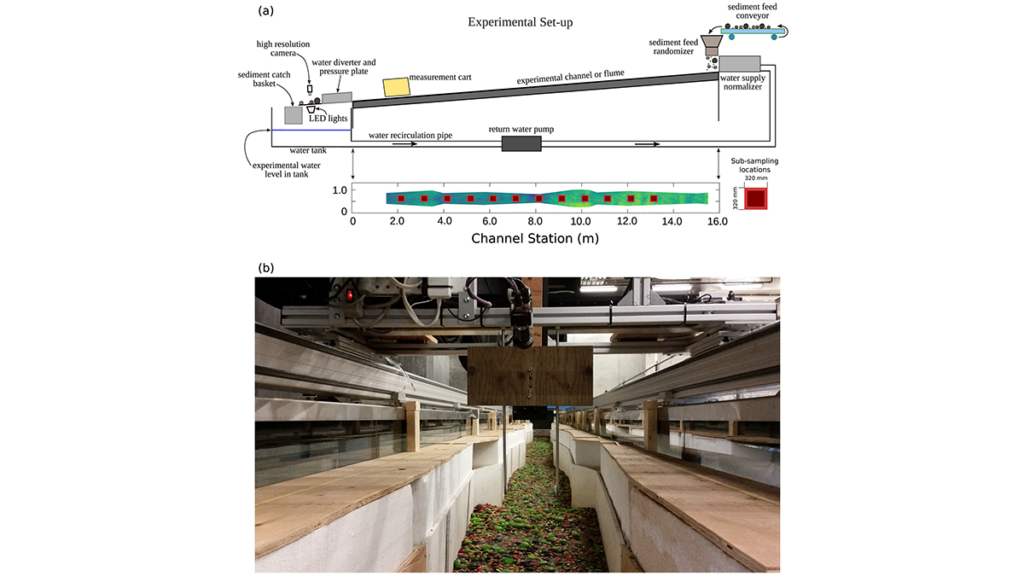
Diagram and photo of the experimental setup.
Editors’ Highlights are summaries of recent papers by AGU’s journal editors.
Source: Journal of Geophysical Research: Earth Surface

Sediment transport shapes the Earth surface in different ways, by forming desert dunes and by sculpting the topography of rivers, but the physics of sediment transport initiation is still incompletely understood. For decades, models have generally assumed two basic entrainment mechanisms: a grain resting on the sediment bed is either lifted directly by fluid forces, or it is emitted from the soil indirectly, as product of a granular splash caused by the heavy impact of another grain.

However, recent breakthroughs in grain-based simulations and high-speed visualization have been offering a much clearer look at the processes that trigger grain motion. Insights from these recent advances have revealed a rather broad spectrum of indirect particle-particle and particle-fluid interactions driving entrainment, including the rearrangement of surface grains after splash and changes in near‐bed flow structure due to moving grains. These interactions exert non-local influences on transport thresholds, giving rise to a dynamic process known as collective particle entrainment—a mechanism that remains poorly understood at a fundamental level.

In a new study, Chartrand [2026] shows that collective particle entrainment is size-dependent: large grains interact primarily with their peers, while smaller grains are mobilized by both large and similar-sized particles. This distinction leads to divergent transport signatures, with a new stochastic model predicting temporally correlated motion for small grains and uncorrelated, white-noise entrainment statistics for larger particles.

Although theoretical modeling will be required to shed further light on the physics of collective entrainment, the author’s study is a step toward a quantitative model of sediment transport from a probabilistic perspective. Looking ahead, Chartrand’s ideas could now be extended to other environments, potentially transforming our understanding of entrainment in other contexts such as wind-blown transport and extraterrestrial atmospheric processes.

Citation: Chartrand, S. M. (2026). Collective particle entrainment explored with experimental data and coupled transfer functions. Journal of Geophysical Research: Earth Surface, 131, e2025JF008657. https://doi.org/10.1029/2025JF008657

—Eric Parteli, Associate Editor, JGR: Earth Surface

Text © 2026. The authors. CC BY-NC-ND 3.0
Except where otherwise noted, images are subject to copyright. Any reuse without express permission from the copyright owner is prohibited.
  • ✇Eos
  • Gravity Waves Help Drive Sediment to the Deep Ocean Chris Micucci
    Editors’ Highlights are summaries of recent papers by AGU’s journal editors. Source: Journal of Geophysical Research: Earth Surface Turbidity currents are underwater currents that transport sediment on the sea floor. They were first observed in the late 1800s in Lake Geneva, Switzerland. The cable break following the 1929 Grand Banks earthquake offshore Canada revealed how massive and destructive these fluxes can be. Turbidity currents move downslope because they have a higher density
     

Gravity Waves Help Drive Sediment to the Deep Ocean

23 April 2026 at 12:00
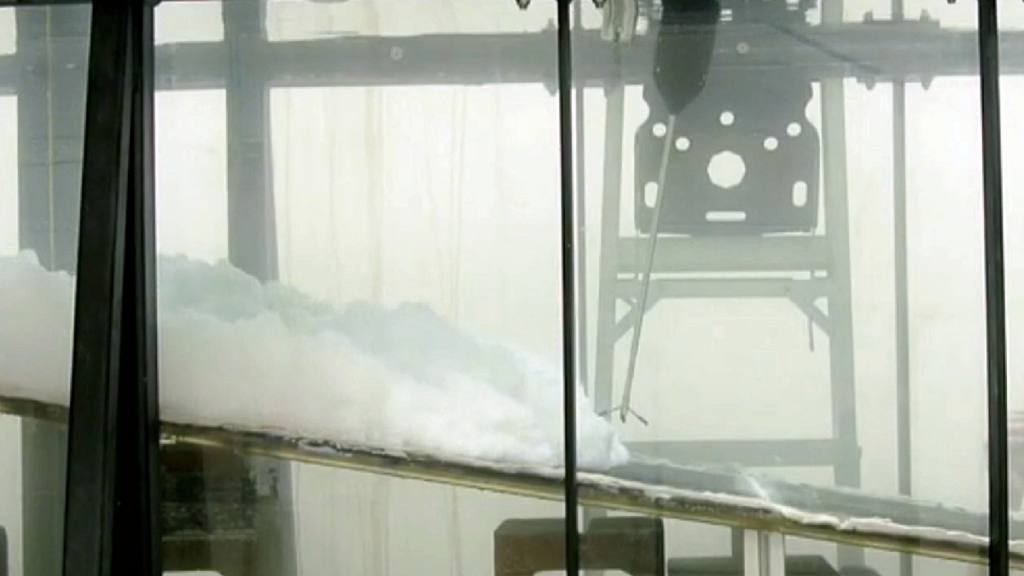
Photo of the experimental flume used in the study.
Editors’ Highlights are summaries of recent papers by AGU’s journal editors.
Source: Journal of Geophysical Research: Earth Surface

Turbidity currents are underwater currents that transport sediment on the sea floor. They were first observed in the late 1800s in Lake Geneva, Switzerland. The cable break following the 1929 Grand Banks earthquake offshore Canada revealed how massive and destructive these fluxes can be.

Turbidity currents move downslope because they have a higher density than the surrounding water due to the presence of sediment in suspension. It is critical to keep in mind that suspended sediment concentration in these flows is low, meaning that the fluid is Newtonian and the flow is turbulent.

Notwithstanding recent advances in field monitoring, measuring turbidity current thickness, velocity, suspended sediment concentration, and grain size distribution remains difficult not only for the high-water depths and the destructive nature of some events, but also because these flows are often infrequent. Laboratory experiments and mathematical modeling have been used extensively to understand nature and some aspects of these flows, but questions remain on, for example, how turbidity currents interact with ocean waves, if they do.

Daniller-Verghese et al. [2026] performed laboratory experiments to determine if and how turbidity currents interact with ocean gravity waves. Experimental flows were released in an 11-meter-long, 1.2-meter-deep, and 0.61-meter-wide flume in the Experimental Sedimentation Laboratory of the Jackson School of Geoscience at the University of Texas. A motored wave maker was installed at the downstream end of the facility to generate the wave field. During the experiments, detailed velocity measurements were conducted to characterize the flow field and the fine details of the turbulent fluctuations. At the end of each experiment, high-resolution measurements of changes in bed elevations allowed the quantification of the net depositional fluxes.

The results show that, in presence of a superimposed wave field, the center of deposition volume shifted downstream compared to experiments conducted with the same inflow but in absence of waves. In addition, velocity measurements indicate that the wave signal is stronger in presence of turbidity currents compared to the “clear water” case. In other words, current velocity was larger when waves were present, enhancing downslope sediment transport and causing the observed downstream shift of the center of deposition.

Although the physical mechanism responsible for the observed increase of sediment transport rates in presence of a superimposed wave field still needs to be resolved, these results provide novel insight for the interpretation of storm and turbidity current deposits in the rock record. They also highlight the importance of considering wave-turbidity current interactions to constrain sediment budgets on continental shelves, which are essential to preserve and manage coastlines worldwide.

Citation: Daniller-Varghese, M., Smith, E., Mohrig, D., & Myrow, P. (2026). Wave-signal entrainment into combined flows: Consequences for sediment transport, signal dislocation, and turbulence. Journal of Geophysical Research: Earth Surface, 131, e2025JF008497. https://doi.org/10.1029/2025JF008497

—Enrica Viparelli, Associate Editor, JGR: Earth Surface

Text © 2026. The authors. CC BY-NC-ND 3.0
Except where otherwise noted, images are subject to copyright. Any reuse without express permission from the copyright owner is prohibited.
❌
Subscriptions