The fantasy genre is a fan-favorite and a crucial part of cinematic history. Dating back to the first-ever fantasy movies that came out throughout the 1910s and '20s, the genre has evolved, experiencing several milestones throughout the subsequent one hundred years of cinema. Among the greatest highlights are 1939's The Wizard of Oz, 1946's It's a Wonderful Life, 1987's The Princess Bride, and 2001's The Lord of the Rings: The Fellowship of the Ring, to name just a few.
The fantasy genre is a fan-favorite and a crucial part of cinematic history. Dating back to the first-ever fantasy movies that came out throughout the 1910s and '20s, the genre has evolved, experiencing several milestones throughout the subsequent one hundred years of cinema. Among the greatest highlights are 1939's The Wizard of Oz, 1946's It's a Wonderful Life, 1987's The Princess Bride, and 2001's The Lord of the Rings: The Fellowship of the Ring, to name just a few.
Dóres posted a photo:
Wooden basin decor for newborn studio photoshoot filled with knitted blanket closeup. Infant baby photo furniture and flower bouquet
You spend about a third of your life in your bedroom, and the air quality there could be quietly harming your health. A 2025 study in the Journal of Allergy and Clinical Immunology: Global, which looked at data from 3,399 U.S. adults, found that higher levels of bedroom allergens were strongly linked to trouble sleeping, diagnosed sleep disorders, snoring, and the use of sleep medication. These allergens aren’t coming from outside; they’re already present in your mattress, curtains, and the air
You spend about a third of your life in your bedroom, and the air quality there could be quietly harming your health. A 2025 study in the Journal of Allergy and Clinical Immunology: Global, which looked at data from 3,399 U.S. adults, found that higher levels of bedroom allergens were strongly linked to trouble sleeping, diagnosed sleep disorders, snoring, and the use of sleep medication. These allergens aren’t coming from outside; they’re already present in your mattress, curtains, and the air you breathe.
Dust mites, pet dander, mold spores, and volatile organic compounds (VOCs) are some of the most common bedroom pollutants. Unlike outdoor allergens that come and go with the seasons, these are problems all year long. Because they build up right where you sleep for seven to nine hours each night, their effect on your sleep is much greater than daytime exposure. Here’s what research shows now and what you can do about it.
The Allergen-Sleep Connection Is Worse Than Most People Know
A 2024 review in Nature and Science of Sleep explained how this works: exposure to allergens causes nasal inflammation, which narrows the nasal passages, disrupts airflow, and leads to more brief awakenings during sleep. People with allergic rhinitis are also much more likely to develop obstructive sleep apnea, not just snoring. In one controlled study, patients with allergies were almost four times more likely to have serious REM-stage sleep problems than those without allergies.
The effects go beyond just feeling tired. Sleep problems caused by allergens are linked to weaker immune function, higher cortisol levels, and greater risk for heart problems, and these issues add up over time. Lowering the amount of allergens in your bedroom isn’t just a nice idea—it’s important for your health.
Mind Your Mattress
The highest concentration of allergens in most bedrooms is found right where you sleep. The American College of Allergy, Asthma & Immunology says dust mites are one of the most common indoor allergens in the U.S. They thrive in the warm, humid environment of bedding and mattresses. These tiny creatures, which are related to spiders, feed on dead skin cells and produce allergen proteins (Der p 1, Der p 2) that can trigger immune reactions.
The solution is physical, not chemical. The American Academy of Allergy, Asthma & Immunology strongly recommends using allergen-proof covers for mattresses and pillows. These tightly woven covers block dust mite allergens from reaching you while you sleep. Washing sheets and pillowcases in hot water every week is also advised. The water temperature is less important than once believed, but drying at high heat (130°F or above) is very effective at killing any remaining mites.
If your pillows can’t be washed, replace them every two years. After that, the amount of allergens inside is high, even if you use covers. When it’s time to get a new mattress, choose one that is certified organic or low in VOCs to avoid adding chemical emissions to the mix of allergens.
Humidity is the Key Variable
Dust mites don’t drink water; they absorb it from the air. When relative humidity (RH) is above 50%, dust mites reproduce more quickly. The EPA recommends keeping indoor humidity between 30% and 50% to control both dust mites and mold. Keeping RH below 50% lowers mite survival, and staying below 35% for most of the day can almost wipe them out.
A digital hygrometer, which costs less than $15 at most hardware stores, is an easy way to monitor bedroom humidity. If your bedroom often measures above 50%, which is common in coastal areas, during humid summers, or in older homes, a dehumidifier or a well-maintained air conditioner can help a lot. High humidity also speeds mold growth, worsening the allergen problem.
Add a HEPA Air Purifier
New research has made the benefits of air purifiers clear. A 2024 review in Indoor Air found that using HEPA filters in bedrooms led to real improvements in allergy symptoms and quality of life, especially for airborne allergens like pet dander and pollen. Dust mite allergens are harder to remove because they stick to larger particles that settle quickly, but a HEPA purifier still lowers the total amount of allergens in the air, which is important when you’re breathing it all night.
When buying a bedroom air purifier, choose one with a True HEPA (not “HEPA-type”) certification, a CADR rating that matches your room size, and a sleep mode that keeps noise below 30 dB. If you have new furniture or recently painted walls, pick a model that also has an activated carbon filter to help with VOCs.
Clean Up Your Curtains — or Replace Them
Soft window coverings collect allergens easily. Fabric curtains hold onto dust, mold spores, and outdoor pollen that comes in through open windows, and they release these particles whenever they’re moved. If you use fabric curtains, wash them once a month during allergy season and keep windows closed when pollen counts are high. You can check local pollen levels on AirNow.
If you have allergies, hard-surface window coverings are often a better choice. Blinds or shades made from wood, aluminum, or wipeable fabric can be cleaned with a damp cloth instead of needing to be washed. They give you the light control you want for sleep without collecting as many allergens as fabric curtains.
Avoid VOCs in the Sleep Space
Volatile organic compounds (VOCs) from paint, particleboard furniture, and foam mattresses aren’t technically allergens, but they can cause similar breathing problems and make things worse if your airways are already irritated by other allergens. The EPA says particleboard, carpet glue, and regular paint are major indoor sources of these chemicals.
Here are some practical steps:
Pick solid wood furniture instead of composite or MDF when you can. Secondhand solid wood from thrift stores is often cheaper than new particleboard.
Choose low- or zero-VOC paints, and let new furniture air out in a well-ventilated area for a few days before moving it into your bedroom.
If you’re buying a new mattress, look for certifications like GOLS (Global Organic Latex Standard) and GOTS (Global Organic Textile Standard), which mean less chemical off-gassing.
Keep Pets Out of the Bedroom
This advice is tough for pet owners, but the science is clear. Pet dander, which is made up of tiny flakes of skin from cats, dogs, and other animals, is a strong and long-lasting allergen. It sticks to surfaces and can stay in the air for hours. The 2025 NIH bedroom allergen study found that pet allergens were among the top exposures linked to sleep disorders. Even if you start keeping pets out of the bedroom, leftover dander can remain for months unless you clean thoroughly.
If you can’t keep pets out of the bedroom all the time, run a HEPA air purifier nonstop, wash your bedding every week, and vacuum floors and furniture with a HEPA vacuum at least twice a week.
Steps You Can Take: An Anti-Allergen Checklist
Encase your mattress and pillows in allergen-impermeable covers rated for dust mite protection
Wash sheets and pillowcases weekly; dry at 130°F or higher
Replace non-washable pillows every two years
Monitor bedroom humidity with a hygrometer; keep it between 35–50%
Use a dehumidifier or AC if needed to stay below 50% RH
Add a True HEPA air purifier sized for your room and run it continuously
Replace fabric curtains with wipeable blinds or hard-surface shades, or wash curtains monthly
Keep windows closed on high pollen and high mold-count days
Keep pets out of the bedroom, or at minimum off the bed
Choose low-VOC paint and solid wood furniture over particleboard for the sleep space
Vacuum with a HEPA-rated vacuum at least twice per week
You can’t control allergens everywhere, but your bedroom is where you spend the most time breathing the same air. Making improvements there can have a big impact on how well you sleep and how you feel in the morning.
You don’t have to read too much about health to understand the importance of a good night’s sleep. As the National Institutes of Health puts its it, “Getting inadequate sleep over time can raise your risk for chronic (long-term) health problems. It can also affect how well you think, react, work, learn, and get along with others.”
In short, it’s really important. And with an eye toward that, we present this gallery of people getting some much-needed shut eye in a wide variety of situations, i
You don’t have to read too much about health to understand the importance of a good night’s sleep. As the National Institutes of Health puts its it, “Getting inadequate sleep over time can raise your risk for chronic (long-term) health problems. It can also affect how well you think, react, work, learn, and get along with others.”
In short, it’s really important. And with an eye toward that, we present this gallery of people getting some much-needed shut eye in a wide variety of situations, including some truly difficult ones.
In this gallery we see American soldiers napping on a transport vehicle after a fight during the Vietnam war. An image from World War II shows an American soldier sleeping on a pile of rocks during a campaign toward Rome. Also from World War II we see a child asleep in a Naples cave after having taken refuge there from the attacks on his city.
We also see people dozing in much more innocent circumstances—sometimes unintentionally. For instance, we see a U.S. Secretary of State, Christian A. Herter, and a U.S. Ambassador to the United Nations, James J. Wadsworth, nodding off during a speech at the General Assembly.
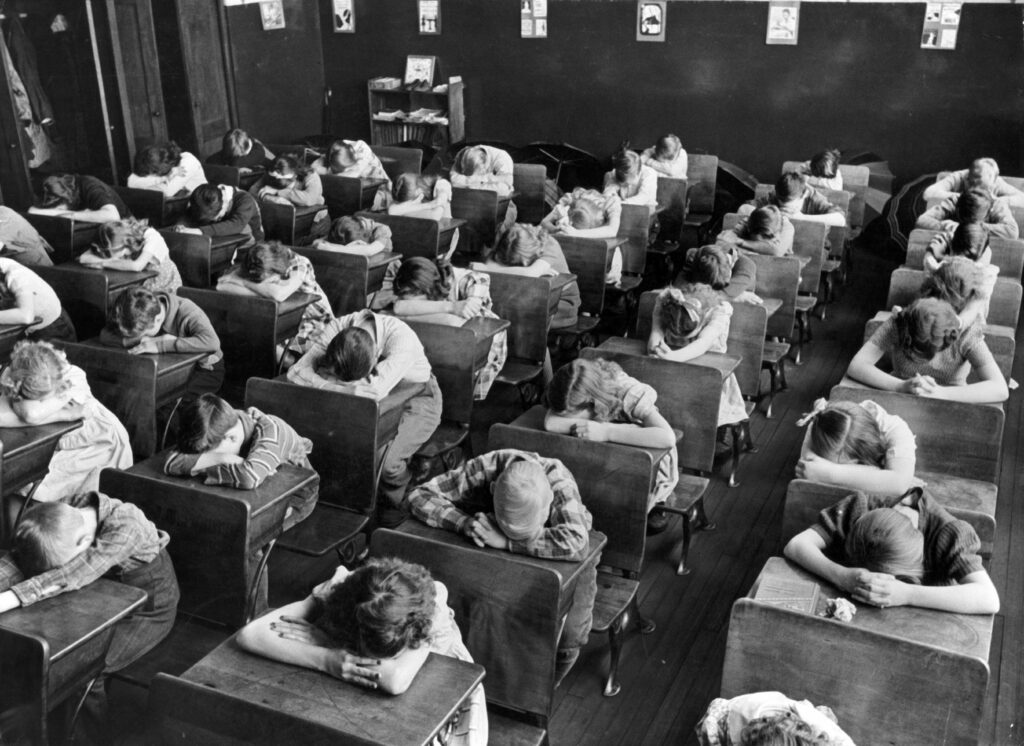
We also see several photos of children asleep during a school’s naptime. Two of those photos are from the U.S. and another is from Russia. A recent Penn study found that children who nap regularly are happier, behave better and are more likely succeed academically.
Boxer Billy Arnold knew the value of a nap—we see him catching one before a fight. Violinist Alexander Schneider, once described “as one of the most unquenchably energetic figures in the public musical life of the USA,” in shown sleeping on a sofa between concerts.
If seeing all these photos makes you think about getting a better night’s sleep, here’s a story with some helpful advice. One of the tips is to nap when you need to—a command many of the people in these photos were ready to obey.
Elementary school children took a rest period in classroom in the coal mining town of Nanty Glo, Pennsylvania, April 1943.
Alfred Eisenstaedt/Life Picture Collection/Shutterstock
Children napped during the school day, 1939.
Hansel Mieth/Life Picture Collection/Shutterstock
Naptime at a Russian kindergarten, 1960.
Carl Mydans/Life Picture Collection/Shutterstock
U.S. Secretary of State Christian A. Herter (front left) and Ambassador to the U.N. James J. Wadsworth (front right) dozed during speech at United Nations General Assembly, 1960.
Ralph Crane/Life Picture Collection/Shutterstock
Democratic presidential candidate George McGovern, next to his wife, Eleanor, slept on his campaign plane, 1972.
Bill Eppridge/Life Pictures/Shutterstock
Boxer Billy Arnold napped before a fight, New York City, 1944.
Alfred Eisenstaedt/Life Picture Collection/Shutterstock
Violinist Alexander Schneider napped between performances of the Budapest String Quartet in Seattle, 1957.
Gjon Mili/Life Picture Collection/Shutterstock
Author W. Somerset Maugham napped in a hammock while summering on Cape Cod, 1944.
Alfred Eisenstaedt/Life Picture Collection/Shutterstock
Racing fans at the Indianapolis 500 in 1939.
Alfred Eisenstaedt/Life Picture Collection/Shutterstock
Spectators at Cape Kennedy, Florida dozed atop of cars awaiting the takeoff of the Apollo 11 mission to the moon, 1969.
Bill Eppridge/Life Picture Collection/Shutterstock
Boys slept on subway car during a family trip to New York City, 1959.
Stan Wayman/Life Picture Collection/Shutterstock
American Marines of 7th Regiment took the chance to sleep in an amphibious landing vehicle following intense fighting in the area around Cape Batangan during the Vietnam War, 1965..
Paul Schutlzer/Life Picture Collection/Shutterstock
An American soldier slept on a pile of rocks during the drive towards Rome, 1944.
Carl Mydans/Life Pictures/Shutterstock
Members of Provincial National Police Chief “Tiger” Kim Chong Yon’s police volunteers slept before he sent them out to guard supply routes from attacks by North Korean-inspired Communist guerrillas that attack their farms and villages, 1952..
Margaret Bourke-White/Life Picture Collection/Shutterstock
A man napped in Hyde Park, 1951.
Cornell Capa/Life Picture Collection/Shutterstock
A child slept in a large cave in Naples, Italy where many had taken refuge from air attacks during World War II, September 1943.
Margaret Bourke-White/Life Picture Collection/Shutterstock
A child in a home filled with modern furniture found a place to sleep, 1948.
Joseph Scherschel/Life Picture Collection/Shutterstock
A United Fruit worker in Guatemala napped on a bench with his infant son, 1953.
Cornell Capa/Life Picture Collection/Shutterstock
A model posed for a story about proper sleep habits, 1943.

 Login
Login