MAY 17 — We watch distant wars on our phones while sipping kopi-o, convinced that the chaos belongs to someone else.
We wait for the storm to pass. This time, the storm will not pass. It will come for our wallets, our factories, and our ringgit.
And when the oil price spikes past US$150 (RM592) a barrel as the US-Iran war continues, Malaysia will discover that “tumultuous” is a polite word for economic surgery without anaesthesia.
When the war erupted, oil spiked to more than US$100. And here is the cruel irony that we miss: Malaysia is not Saudi Arabia. We are a marginal exporter.
Yes, Petronas will book higher revenues. But the other half of our economy — manufacturing, electronics, palm oil refining, tourism —runs on cheap fuel.
The US$10 billion we save in lower fuel subsidies will be dwarfed by the US$50 billion in economic losses from every other sector grinding to a halt.
Worse, the ringgit will not be spared. Global investors, terrified of the war, will flee every emerging market currency.
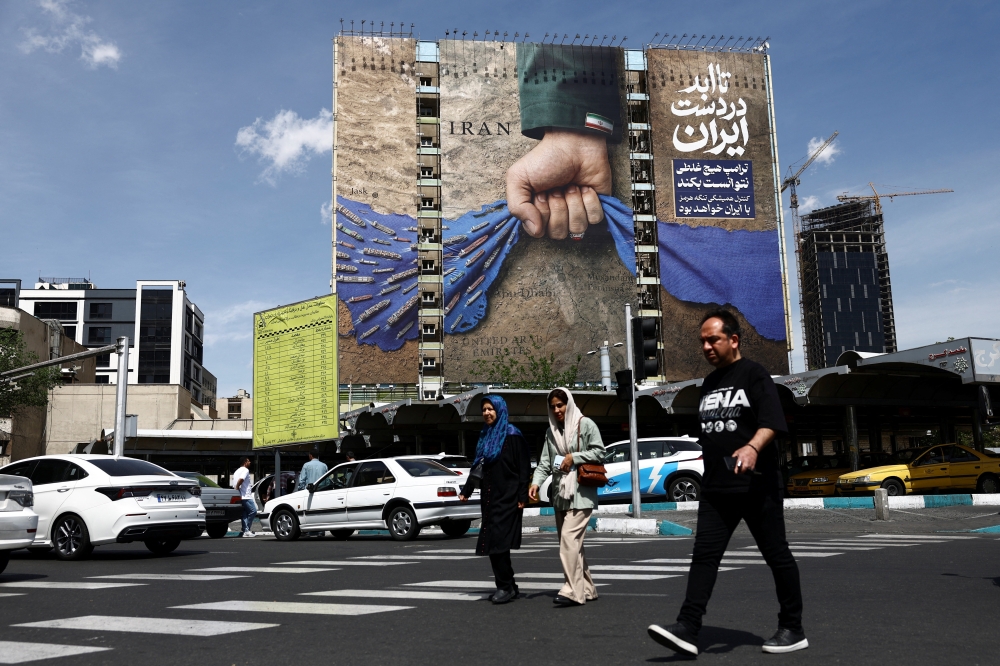
People walk past a billboard with a graphic design about the Strait of Hormuz on a building in Tehran on April 27, 2026. — Reuters pic
They will buy US Treasuries and gold. The ringgit could tumble against the greenback.
Suddenly, every imported machine part, every medicine vial, every laptop becomes a luxury item.
Imported inflation will hit us like a freight train — and our central bank, Bank Negara, will be trapped.
Raise rates to defend the ringgit, and crush local businesses. Do nothing, and watch your savings evaporate.
Here is our national shame. For decades, we have used fuel subsidies like a narcotic. RON95 at the pump? Artificially cheap. Diesel? Heavily cushioned.
The logic was always political — protect the masses, buy votes, quiet the streets. But at US$150 oil, that bill becomes impossible.
The government’s subsidy tab would explode from RM50 billion to nearly RM150 billion overnight. That is almost half our annual operating budget. Schools, hospitals, roads — all sacrificed to keep petrol cheap.
So we will be forced to do what no administration dares: floating fuel prices. Overnight, RON95 jumps from RM2.05 to RM4.50.
A lorry driver moving vegetables from Cameron Highlands to Selangor sees his diesel cost triple. The political fallout? Street protests. Factory layoffs.
A quiet, seething anger that no amount of government aid can soothe. We built our social contract on cheap fuel. War will burn that contract to ash.
The optimists will point to palm oil. “Commodity prices rise during war,” they will say. “Malaysia will profit.” Do not believe them.
Yes, crude palm oil futures will spike — first to RM5,000 a tonne, then higher. But war in the Gulf means two things: shipping insurance through the Strait of Hormuz becomes impossibly expensive, and global demand collapses because Europe, China, and America are all in recession.
Who buys your palm oil when factories are idle and consumers are hoarding?
Our refineries in Johor and Port Klang rely on imported solvents and packaging materials — all petroleum-based. Those costs explode.
Our export volumes fall even as headline prices rise. The net effect? A paper boom followed by a real bust.
Plantation workers will keep their jobs, but the logistics crews, the truck drivers, the port operators — they will be laid off by the thousands.
The quiet killer, though, is China. Before the war, China was already stumbling — property developers defaulting, youth unemployment above 20 per cent, deflation taking root.
An Iran war ends any hope of a Chinese recovery. Beijing will divert all resources to securing oil supplies, not buying Malaysian electronics or assembling iPhones in Penang.
Our semiconductor industry, the pride of the northern corridor, depends on Chinese and American demand. Both will be in freefall.
The RM400 billion E&E export sector could shrink by a third. Factories in Batu Kawan will go dark. Engineers will drive Grab.
Malaysia has survived crises before — 1997, 2008, Covid. But survival requires honesty, not slogans.
We must do three things: First, accelerate the subsidy rationalisation. Take the political pain early, so we are not forced into a panicked, brutal cut during wartime.
Second, negotiate ringgit swap lines with China and Singapore — a currency lifeline when dollar funding dries up.
Third, admit that our manufacturing-heavy model has a fatal energy vulnerability. The future is not competing with Vietnam on cheap assembly. The future is food security, renewable energy components, and regional services.
The US-Iran war is not our war. But it will be our recession. The only question is whether we face it with our eyes open — or whether we wake up one morning to find that US$150 oil has already decided our fate, and we were too busy arguing about which coalition rules Putrajaya to notice.
The kopi-o has gone cold. The storm is here.
* Professor Datuk Dr Ahmad Ibrahim is affiliated with the Tan Sri Omar Centre for STI Policy Studies at UCSI University and is an Adjunct Professor at the Ungku Aziz Centre for Development Studies, Universiti Malaya. He can be reached at ahmadibrahim@ucsiuniversity.edu.my.
** This is the personal opinion of the writer or publication and does not necessarily represent the views of Malay Mail.

 Login
Login