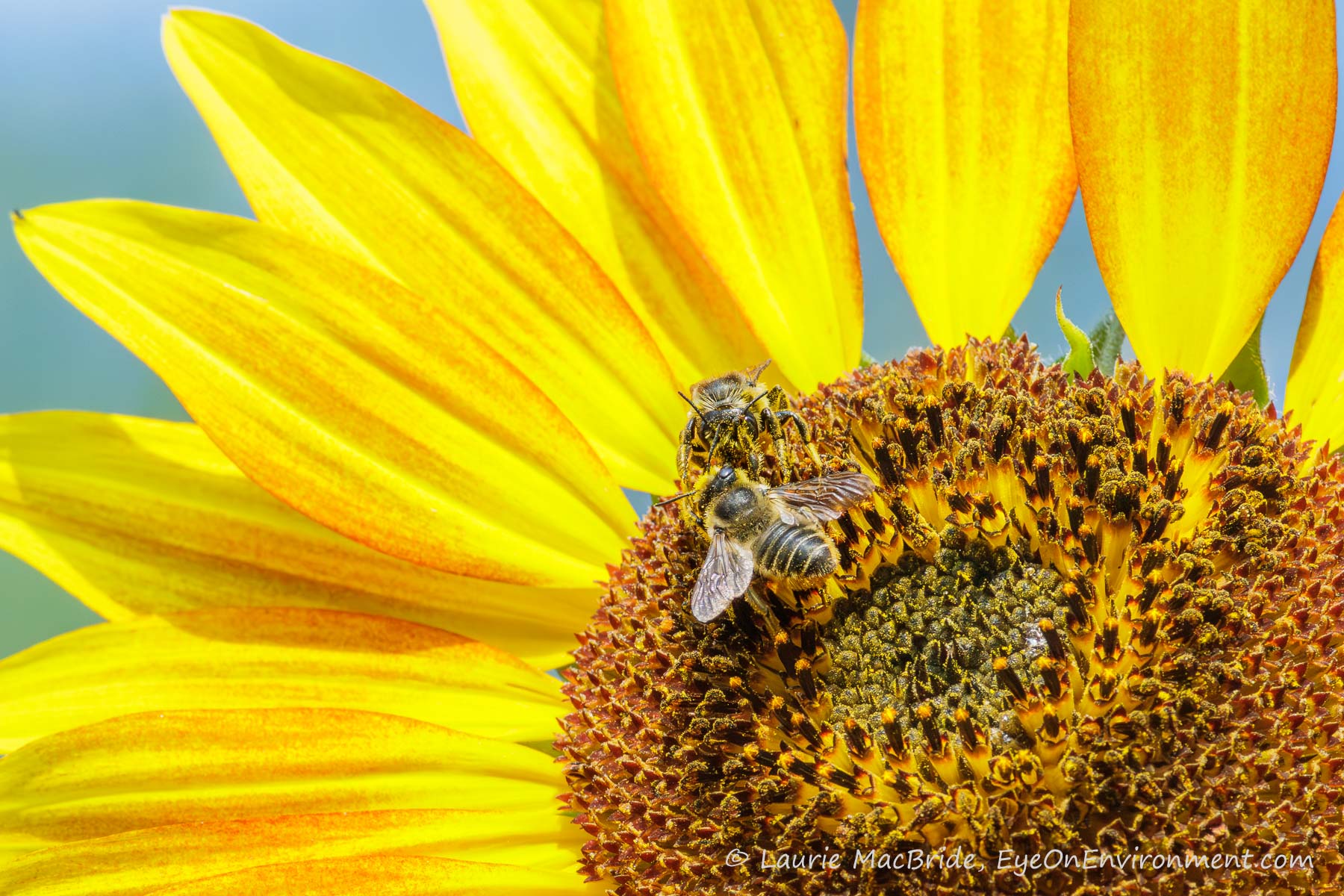
Bees have been plentiful and active in our garden all summer, though almost always moving too quickly for me to photograph. But the other day, when I had my camera conveniently in hand, I noticed that high up on the now-very tall sunflowers, bees were moving ever so slowly. I watched through my telephoto lens […]
Bees have been plentiful and active in our garden all summer, though almost always moving too quickly for me to photograph. But the other day, when I had my camera conveniently in hand, I noticed that high up on the now-very tall sunflowers, bees were moving ever so slowly. I watched through my telephoto lens […]
It’s just a memory now, but what a spectacular one! The plant in the photo above began life as a volunteer in our garden last spring. I wasn’t sure what it was at first and almost yanked it out, since it was growing fast and taking up precious space that could be used for food […]
It’s just a memory now, but what a spectacular one! The plant in the photo above began life as a volunteer in our garden last spring. I wasn’t sure what it was at first and almost yanked it out, since it was growing fast and taking up precious space that could be used for food […]
While every bumble bee colony has a queen, the process for becoming that queen bee may be a bit more democratic than monarchical. The worker bees appear to select which baby will be queen one day, according to a new study published in the journal Insect Biochemistry and Molecular Biology.
The key to this selection process lies in the juvenile hormone. This hormone in insects is responsible for their development, molting, and eventual reproduction. When the team gave the juvenile hormone to wo
While every bumble bee colony has a queen, the process for becoming that queen bee may be a bit more democratic than monarchical. The worker bees appear to select which baby will be queen one day, according to a new study published in the journal Insect Biochemistry and Molecular Biology.
The key to this selection process lies in the juvenile hormone. This hormone in insects is responsible for their development, molting, and eventual reproduction. When the team gave the juvenile hormone to worker bees, they passed it along to all of the larvae in the colony through feeding. The more juvenile hormone the larvae received, the more likely they were to become queen.
According to the team, this is the first study to show that bumble bee caste is determined by the workers and shifts our understanding of bee colony dynamics. Instead of a top-down hierarchy, the colony appears to be a more decentralized system, where the caregivers and workers can alter the future of baby bees.
Less like Mean Girls?
Understanding the fate of the bee larvae is key to understanding their social behavior. Their whole system relies on a division of reproductive labor—some females will reproduce, while the others help.
“Since all these females share the same DNA, it’s a striking example of how the same genotype can produce very different forms,” Etya Amsalem, a study co-author and entomologist at Penn State, said in a statement. “It’s also a practical question since bumble bees are important for pollination, so knowing how to produce queens could improve commercial breeding and management.”
In addition to their different social roles, queen bees and worker bees are also very different physically. Bumblebee queens are larger, live longer lives, and will reproduce. Worker bees are smaller in stature and do not reproduce or live as long.
While it was clear that hormones were involved in how workers determine the queen, the exact mechanisms behind it were more vague.
“A single female egg in bumblebees holds the blueprint for two completely different life paths: the giant, reproductive queen or the small, sterile worker,” added study co-author and postdoctoral researcher Seyed Ali Modarres Hasani. “We wanted to understand what triggers the change in the female life trajectory, when does it happen and who controls the process.”
A matter of hormones
In the study, the team used three worker bees and a cluster of larvae. They applied juvenile hormone at different doses and times, and administered it either to workers or directly to larvae. They then traced the hormone’s movement, measuring larval mass and recording which individuals became queens or workers.
“Every colony will produce many new queens at the end of the season,” Amsalem said. “These queens will leave the colony, mate and go into winter diapause, and then each queen will start a new colony in the next spring. In that sense, producing as many queens—and males—at the end of the season is the ultimate purpose of the colony.”
When the juvenile hormone was applied directly to the larvae, not only did they not turn into queens, but the worker bees ended up eliminating most of these larvae.
When the workers were treated with the juvenile hormone, they put it into the food that they make for the larvae. These larvae then ingested the hormone, and were heavier and much more likely to become queens.
“We also determined that larvae are only sensitive to this hormone on days seven and eight of their development,” Hasani said. “By tracing the juvenile hormone, we saw that the workers pass the hormone into the food they make from nectar and pollen.”
Queen development and the colony’s future
These results suggest that queen production is linked to how the colony progresses through the summer’s warmer months until it eventually collapses in the fall.
“Bumblebee workers do not reproduce when the colony is young, but they can activate their ovaries and produce males as the colony ages, which causes an increase in juvenile hormone levels,” Amsalem said. “As a result, over time, they feed larvae more of the hormone. When enough workers do this simultaneously, usually towards the end of the season, larvae receive doses that are high enough during the critical window to develop into queens.”
These results could help improve bee colony management at a hormonal level, explain how complex insect societies evolve, and how hormonal signals interact to shape colony structure.
In Ava Roth’s sculpture practice, a finished piece is the result of careful planning and tending, but the outcome can only be predicted so much. Whether creating wooden frameworks or organic embroideries, the artist leaves it to bees to create the ultimate form.
Roth has long invited the honeycomb-building insects to play a role in her work, often adding wonderfully bulbous constructions that occasionally disrupt the artist’s carefully placed boundaries. Wooden pieces are mandala-like and
In Ava Roth’s sculpture practice, a finished piece is the result of careful planning and tending, but the outcome can only be predicted so much. Whether creating wooden frameworks or organic embroideries, the artist leaves it to bees to create the ultimate form.
Roth has long invited the honeycomb-building insects to play a role in her work, often adding wonderfully bulbous constructions that occasionally disrupt the artist’s carefully placed boundaries. Wooden pieces are mandala-like and take on the quality of low reliefs once the bees have done their part. Recently, she leapt into the three-dimensional realm via ceramics and a time-honored tradition of repair in her series Kintsu-Bee.
The new body of work is a play on the Japanese word kintsugi, which describes a traditional method of repairing ceramics with metallic lacquer. The process embraces the nature of the breakage itself, mending the vessel yet highlighting the cracks as a way of embracing the object’s history rather than trying to camouflage it. In Roth’s iteration, bees are invited to reconstruct the missing parts, guided around forms to create the missing handle of a mug or fill in the fissures of a dinner plate.
“Mirroring the philosophy of kintsugi, the unique architecture of the comb acts both as a restorative measure and as a visual memory of the past,” says a statement. “When extracted, the delicacy and complexity of the composite objects—half human and half insect—tell a story not just of human violence but of the earth’s capacity for repair.”
With National Volunteer Week now underway, it’s an ideal time to reflect on the role people play in protecting Ontario’s biodiversity. Community science is one meaningful way to get involved. And as spring returns to Ontario, pollinators begin to reappear in fields, forests, wetlands, and gardens making them a natural group of species to observe for community science programs.
While these sightings may feel routine, they are becoming less predictable for many species. Pollinator populations ar
With National Volunteer Week now underway, it’s an ideal time to reflect on the role people play in protecting Ontario’s biodiversity. Community science is one meaningful way to get involved. And as spring returns to Ontario, pollinators begin to reappear in fields, forests, wetlands, and gardens making them a natural group of species to observe for community science programs.
While these sightings may feel routine, they are becoming less predictable for many species. Pollinator populations are declining due to habitat loss, pesticide exposure (especially neonicotinoids), disease, invasive species, and climate change. These threats are reshaping where species can survive and fragmenting habitats that once supported stable populations. Getting involved as a volunteer observer is one of the most direct ways to support pollinator conservation in Ontario.
Pollinators — such as bees, butterflies, moths, and even birds — are important indicators of ecosystem health. They support plant reproduction and help sustain food webs across the province and country. Because many species depend on specific plants or habitats, even small environmental changes can have significant impacts.
This also makes pollinators especially valuable for community science. Each observation helps researchers track biodiversity changes across Ontario over time.
Pollinators at Risk in Ontario
Under the Endangered Species Act, 2007, many species at risk received legal protection. However, Ontario’s new Species Conservation Act, 2025, introduced through Bill 5, changes how species are protected and may reduce protections for some, including certain pollinators.
Monarch (Endangered in Canada / Special Concern in Ontario)
Herbicides and insecticides reduce milkweed, a crucial piece of the Monarch’s breeding habitat. Their long-distance migration also exposes them to threats such as habitat loss and declining wildflower availability.
Rusty-patched Bumble Bee (Endangered)
Once common in southern Ontario, this species has declined sharply. The last confirmed observation records in Canada come from two Ontario Parks, Pinery Provincial Park (2009) and St. Williams Conservation Reserve (2000).
Mottled Duskywing (Endangered)
This butterfly depends on rare oak woodlands and plants such as the New Jersey Tea and Prairie Redroot. These habitats are limited and fragmented, making populations vulnerable.
An early spring pollinator of wild plants and crops such as blueberries and apples. This bumble bee’s abundance has decreased in Ontario and is associated with habitat loss, pesticide exposure, climate change, and disease.
Contribute your Sightings
If you spot these or other species, you can contribute to community science projects:
You can also join the global community of iNaturalist users to share and verify observations. The Natural Heritage Information Centre has a Rare Species of Ontario project.
The Ethics of Observation
Observe wildlife responsibly to avoid disturbance and ensure useful data. Follow A Nature Viewer’s Code of Ethics and be aware that many species are protected under Ontario’s Fish and Wildlife Conservation Act and Canada’s Species at Risk Act.
Every observation matters. Whether you notice pollinators in your garden, birds overhead, or frogs in a wetland, your sightings contribute to a better understanding of Ontario’s ecosystems—and how they are changing.

 Login
Login