
Normal view

  • ✇Ontario Nature Blog
  • Rabbits and Hares: The Unsung Heroes of Ontario’s Ecosystem Erin Kobayashi
    Rabbits and hares are often overlooked, even though they are a crucial part of our ecosystems serving as a key food source for many species and even an indicator of climate change. “Poor rabbits. It’s the exact reason I started rehabbing them, because I felt sorry for them,” says Tallulah, founder of My Wildlife Rescue, the only authorized wildlife custodian in Ontario that specializes in rehabilitating neonatal and juvenile wild rabbits and hares. “Other animals have the ability to defend the
     

Rabbits and Hares: The Unsung Heroes of Ontario’s Ecosystem

2 April 2026 at 16:24

Rabbits and hares are often overlooked, even though they are a crucial part of our ecosystems serving as a key food source for many species and even an indicator of climate change.

“Poor rabbits. It’s the exact reason I started rehabbing them, because I felt sorry for them,” says Tallulah, founder of My Wildlife Rescue, the only authorized wildlife custodian in Ontario that specializes in rehabilitating neonatal and juvenile wild rabbits and hares. “Other animals have the ability to defend themselves.”

snowshoe hare, lagomorph, winter pelt, camouflage, adaptation, northern species
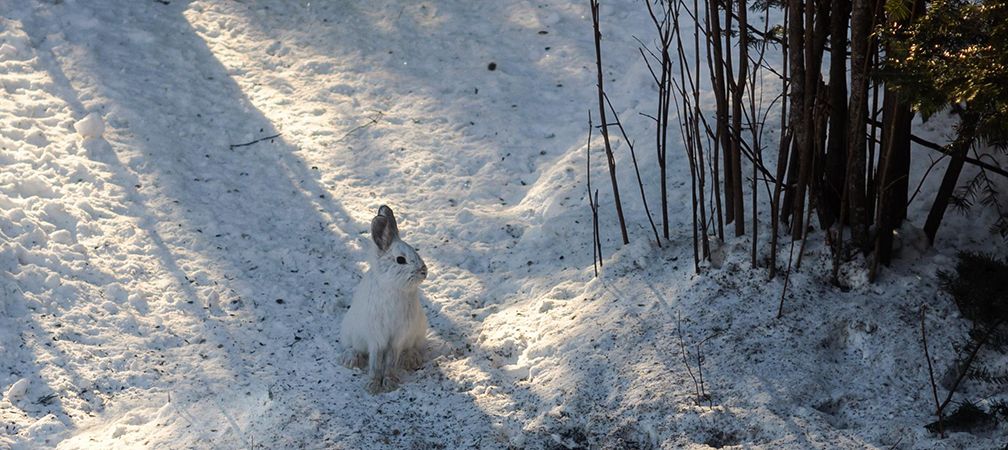
Snowshoe hare © TheRealKam75 CC BY-SA 2.0

Tallulah, who opened her rescue in 2018, suggests there are two reasons that rabbits and hares are underrated animals: people see rabbits as common and often assume wild native rabbits and domestic rabbits are similar, so they lose interest in learning about wild ones. “Basically, they are just seen as common, and you can just get [a domestic] one in the store,” she says.

And unlike bears, lynx and wolves, “They aren’t charismatic megafauna…Humans like to learn about predators, I don’t know why, but it seems like something we can relate to,” Tallulah hypothesizes, “They are also very hard to study because they are small, quiet and active at dusk and dawn.”

Although largely understudied in Ontario, Tallulah argues that native rabbits and hares are sensitive indicators of climate change. Droughts, for example, can drastically reduce rabbit litters mid-summer, as extreme heat stresses mothers, limits food, and increases mortality among kits. “Last year, we had loads of babies in the spring, then nothing in the middle of the summer, and it picked up again in the fall,” says Tallulah, reflecting how a summer drought directly affects rabbit populations.

Snowshoe hares face another challenge: their fur changes colour based on day length, not snow cover. With winters arriving later and ending earlier, the white hares stand out against snowless ground, making them more vulnerable to predators. Changes in populations and survival rates of these animals reflect the broader impacts of shifting weather patterns.

cottontail rabbit, lagomorph, rodent, prey species, herbivore
Cottontail rabbit © Peter Ferguson

Because wild rabbits and hares are often not seen as having economic value, rescues that care for them tend to receive limited public or government support and fewer donations. This is unfortunate, as species like the snowshoe hares form a crucial part of the food web. “They basically feed everybody. For example, the Canada lynx lives and dies by the cycle of the snowshoe hare. If there are very few hares, there will be very few lynx because that’s usually what they eat.”

At her Ottawa-based rescue, Tallulah cares for two of Ontario’s most common young rabbits (kits) and hares (leverets): Eastern cottontails and snowshoe hares. In total, Ontario is home to five species, including the white-tailed jackrabbit, Arctic hare in the far north, and the non-native European hare, which was introduced over a century ago but is rarely seen today. Chances are that the Eastern cottontail and snowshoe hare are the two you’ll most likely spot in the wild.

The Main Difference Between Rabbits and Hares

If you come across a young rabbit or hare, these key differences can help you identify them:

Rabbits are born blind, hairless, and completely helpless. They grow fur and open their eyes around seven to eight days old. Eastern cottontail rabbits build small nests, shallow indentations in the grass lined with fur and vegetation.

Hares are born with fur, with their eyes open, and are ready to move. Snowshoe hares do not burrow; instead, their leverets are born in the open. Within a day, the young start exploring and hiding, though they remain near the birthplace because the mother returns twice daily to feed them, similar to Eastern cottontails. Additionally, mature hares fur changes colour with seasons, helping them blend into their environment.

How to Help Rabbits and Hares

“Everybody can do something [to help rabbits and hares this spring],” says Tallulah. Here’s what she recommends:

  • Let grass grow the entire season, from early spring until late fall. Avoid mowing certain areas as tall grass provides food, cover and nesting spots. Mowing grass risks destroying nests and hurting or killing the kits and leverets.
  • Protect their habitat. Join a local conservation group to support their environment.
  • Observe respectfully. Watch from a distance or use a trail cam.
  • For adult rabbits and hares living in the wild, provide clean water, not food. Never feed or attempt to tame wild rabbits and hares.
  • Plant native vegetation. Include extra vegetables in your garden for the rabbits instead of chasing them or letting pets harass them. “They don’t have a grocery store they can go to. Be kind,” says Tallulah.
  • Keep pets in check: Leash dogs and keep cats indoors or build a catio to protect wildlife.
  • Avoid rodenticides. Hire professionals that use humane ways to capture animals and keep harmful chemicals out of the food chain.
  • For wild rabbits and hares that need help, contact a wildlife centre that takes in rabbits. Tallulah also warns that domestic rabbits should never be released into the wild. Their bright colours make them easy targets for predators, and they lack the camouflage, instinct and hardiness of wild rabbits and hares. Additionally, they are too friendly towards humans and pets and the harsh climate is fatal for them. Released domestic rabbits often die quickly from starvation, predation or disease. Contact a rabbit rescue like https://rabbitrescue.ca/ or use this rabbit rescue resource page https://wabbitwiki.com/wiki/Ontario to rehome an unwanted pet.
  • ✇Ontario Nature Blog
  • Canada’s First Tuscarora Emerald Moth Recorded at Sydenham River Nature Reserve Allanah Vokes
    “How about doing a moth survey at Sydenham?” “A moss survey?” Asked Roberta Buchanan, local property steward for Sydenham River Nature Reserve, who didn’t quite hear me while we were walking outside. “No, moths. Like a nocturnal equivalent to the butterfly survey. Who knows what we’ll find?” It was 2023. I knew how unique the reserve was through my involvement with the annual butterfly and breeding bird surveys, and I suspected this oasis of biodiversity had fantastic potential for moths. C
     

Canada’s First Tuscarora Emerald Moth Recorded at Sydenham River Nature Reserve

5 March 2026 at 16:29

“How about doing a moth survey at Sydenham?”

“A moss survey?” Asked Roberta Buchanan, local property steward for Sydenham River Nature Reserve, who didn’t quite hear me while we were walking outside.

“No, moths. Like a nocturnal equivalent to the butterfly survey. Who knows what we’ll find?”

It was 2023. I knew how unique the reserve was through my involvement with the annual butterfly and breeding bird surveys, and I suspected this oasis of biodiversity had fantastic potential for moths.

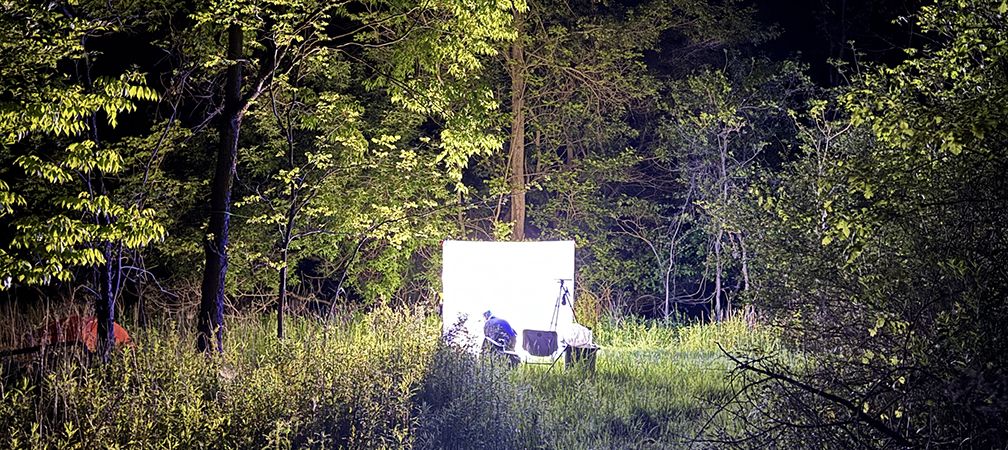
Compared to their diurnal counterparts, moths are relatively under-surveyed. Most species are nocturnal and inconspicuous, and documenting them requires specialized survey techniques – sheets and live traps baited with light or food. It also requires dedicated surveyors willing to stay up all night!

Moth sheet setup at Sydenham River Nature Reserve, biodiversity, pollinator, insects, Carolinian, southwestern Ontario
Moth sheet setup at Sydenham River Nature Reserve © Allanah Vokes

On the evening of June 24, 2024, a team of volunteers (Roberta Buchanan, Mark Buchanan, Paul Carter, Pete Chapman, Scott Connop, Deryl Nethercott, Dale Buchner, and myself) from Lambton Wildlife set up two light sheets and two traps across the Sydenham River Nature Reserve property. We documented hundreds of individual moths well into the night, and even more when we opened the traps the following morning. Then came the real fun: sorting through thousands of photos and identifying every moth.

Identifying all these moths is no trivial task. There are over 3,000 species of moths in Ontario, so field guides include only the most common species. Encountering moths that aren’t in the guide is common, and several groups of moths are notoriously hard to identify, even for experienced moth-ers. My approach is to photograph every moth, upload these photos to iNaturalist with my tentative ID, and wait for confirmation by a moth expert. For those who don’t know, iNaturalist is an online platform where you can post photos or recordings of an organism and crowdsource identifications from experts all over the world.

Moth trap, Sydenham River Nature Reserve, biodiversity, pollinator, insects, Carolinian, southwestern Ontario, luna moth
A moth trap in use, Sydenham River Nature Reserve © Allanah Vokes

To keep track of the growing species list, I created an iNaturalist project which automatically consolidates all the moth observations from the property. The strength of this approach is that it stays current, as taxonomic changes and revised identifications will update the species list automatically. This makes it more reliable over time than a static checklist, which inevitably becomes outdated. As of 2026, we have documented 196 species of moth that first night, 13 of which are considered vulnerable at some level. After a second survey in May 2025, the total moth species count at Sydenham River Nature Reserve stands at 328, including 30 vulnerable species.

Fast forward to July 2025. I was checking my iNaturalist and saw there was a comment on one of my moth observations from the 2024 survey. Someone disagreed with my identification of what I believed to be a common white-fringed emerald, suggesting instead a species I hadn’t heard of – a Tuscarora emerald.

I quickly checked the range map, and my excitement spiked: this was a very rare moth, with only about fifty observations, all from the eastern United States – mostly localized populations in the Appalachians. If this was actually a Tuscarora emerald, it would likely represent the first record for Canada.

Tuscarora emerald, Sydenham River Nature Reserve, wildlife discoveries, biology, zoology, entomology, biodiversity, Nemoria tuscarora
Tuscarora emerald found at Sydenham River Nature Reserve © Allanah Vokes

The identifier, Daniel Kluza (d_kluza on iNaturalist), a New Zealand-based biologist and iNaturalist taxonomy curator, pointed out a critical detail: our moth lacked the pure white spot on top of the abdomen which is present on the white-fringed emerald. This was a subtle difference, but potentially a decisive one. I needed a second opinion.

I reached out to Seabrooke Leckie, co-author of the Peterson Field Guide to Moths of Northeastern North America, and asked what she thought of it. Her response was unequivocal:

I pulled out the Moths Of North America fascicle for this group to have a look at the official description of both species, Tuscarora and White-fringed, and I agree that this is Tuscarora. What a find!… Besides the presence/absence of the white spot at the base of the abdomen, the fascicle also says the white costa is very narrowly bordered inwardly by an apricot colour, and the AM and PM lines are wider than in White-fringed, both of which appear present here. There are no other eastern species that have both the white fringe and no markings on the abdomen.

What makes this record especially meaningful is not just the rarity of Tuscarora emerald, but the way in which it was found. It was the result of methodical work by a team of volunteer community scientists, combined with the expertise of moth specialists. Not too long ago, access to such expertise was a significant roadblock, but it’s now easily facilitated through platforms such as iNaturalist.

We don’t know if this observation represents a previously overlooked population, a vagrant individual, or a northern range expansion driven by climate change. What is clear, however, is that protected places like Sydenham River Nature Reserve continue to demonstrate their conservation value in unexpected ways. When we take the time to look closely and collaboratively at under-surveyed groups like moths, we reveal hidden layers of biodiversity, uncovering the true richness of landscapes we thought we already knew.

  • ✇Ontario Nature Blog
  • Over 100 Species at Risk Lose Protection Under the Species Conservation Act Tony Morris
    Believe it or not, Ontario’s Endangered Species Act (ESA) was passed with all-party support back in 2007. Subsequently, of course, it was undermined through numerous exemptions and approvals for harmful activities, and now, through Bill 5, the Government of Ontario is tossing it aside completely. It is being replaced by the Species Conservation Act, 2025, (SCA) which is in no way its equal. With a view to eliminating barriers to development, it is claimed the new law will “help speed up project
     

Over 100 Species at Risk Lose Protection Under the Species Conservation Act

28 January 2026 at 16:57

Believe it or not, Ontario’s Endangered Species Act (ESA) was passed with all-party support back in 2007. Subsequently, of course, it was undermined through numerous exemptions and approvals for harmful activities, and now, through Bill 5, the Government of Ontario is tossing it aside completely. It is being replaced by the Species Conservation Act, 2025, (SCA) which is in no way its equal. With a view to eliminating barriers to development, it is claimed the new law will “help speed up project timelines and provide greater certainty for proponents.”

Devastating Changes

Under the SCA, no migratory birds, aquatic species or species of special concern will be provincially listed. The rationale for removing protections for migratory birds and aquatic species is that they already receive federal protection under the Species at Risk Act (SARA). In the case of special concern species, the provincial government is not listing them because they were not subject to “prohibitions under the ESA”. The provincial government is thus abandoning responsibility for 106 out of the 270 or so species currently deemed to be at risk in Ontario.

Former mine entrance
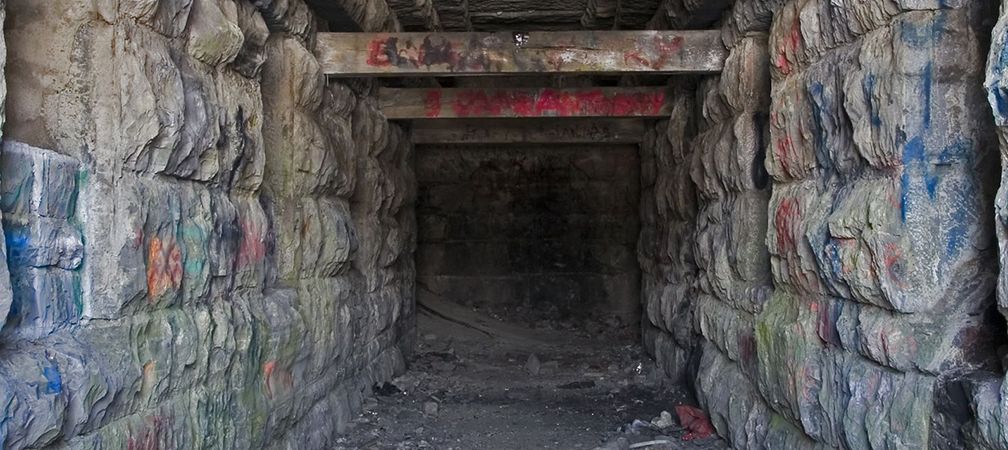
Former mine entrance © Brian Killmore CC BY 2.0

National Accord

In 1996, federal, provincial and territorial ministers responsible for wildlife committed to a national accord to protect species at risk by agreeing to “establish complementary legislation and programs that provide for effective protection of species at risk throughout Canada.” Canada and Ontario went a step further in 2011 by developing an Agreement on Species at Risk that commits to coordination and cooperation on preventing species from becoming at risk, as well as protecting and recovery identified species.

The Government of Ontario has abandoned these commitments. Species do not recognize arbitrary political boundaries, and cooperative federalism is absolutely necessary to conserve species at risk, especially amid a biodiversity crisis.

Prothonotary warbler, Endangered species, species at risk in Ontario, population declines, fewer of these birds, habitat loss, habitat degradation, negative human impacts, biodiversity loss, insectivore loss
Prothonotary warbler, Endangered species © Bill Majoros CC BY-SA 2.0

Limitations of SARA

The SARA is not equivalent to the ESA and to date, the federal government has been reluctant to exercise its power under the act on non-federal lands. The Government of Ontario has given no indication that the federal government was engaged on the draft SCA or agreed to step in and provide protections for the migratory birds and aquatic species that have lost provincial protections. On the contrary, Minister McCarthy along with the Alberta Environment Minister sent a letter to their federal counterpart in June, 2025 that requested the federal government amend SARA “to respect the constitutional jurisdiction of the provinces”, along with request to weaken other environmental regulations.

Further evidence that SARA is not fit to purpose to make up for the once gold standard provincial ESA, is that the backlog of species needing reassessment by Environment and Climate Change Canada will grow to 574 by the end of 2030. Additionally, as of 2022, the Auditor General of Canada found that 10% of federally listed species did not have recovery strategies or management plans in place as required by the act. Furthermore, of the 409 recovery strategies prepared by 2022, 20% did not identify the species’ critical habitat, which is necessary for protections under SARA.

New subdivisions and retail development displaces farmland, habitat and natural systems as well as degrading the environment with visual disturbance, noise, emissions and pollution nearby a watershed, Stayner, Ontario
New subdivision replaces previous farmland, Stayner © Noah Cole

Despite the Government of Ontario’s claims that the protections under the ESA for migratory birds and aquatic species were duplicative with federal protections, it is clear that SARA and the federal government are not equipped to provide equivalent protections.

Call to Action

Extinction threatens one million of approximately 8 million plants and animals worldwide. Responding effectively requires cooperation across all levels of government, as previously agreed to under the national accord and Canada-Ontario agreement.

Ontario’s weakening of protections for species at risk threatens our long-term well-being. Join us in urging the Government of Ontario to repeal Bill 5.

❌
Subscriptions