The Scrappy cartoons have always been a favorite of mine, and maybe always will be-but, in the past,the collectors of 16mm cartoons I was often chatting with would often here a less-than-favorable review of them – saying “The Krazy Kats are better”. While I *had* a lot of Krazy Kats, I usually wouldn’t pursue them in the same way I would the Scrappys, so I ended up with a lot of Scrappys and only a handful of Krazys comparatively over the years. That isn’t to say I didn’t enjoy them. They were j
The Scrappy cartoons have always been a favorite of mine, and maybe always will be-but, in the past,the collectors of 16mm cartoons I was often chatting with would often here a less-than-favorable review of them – saying “The Krazy Kats are better”. While I *had* a lot of Krazy Kats, I usually wouldn’t pursue them in the same way I would the Scrappys, so I ended up with a lot of Scrappys and only a handful of Krazys comparatively over the years. That isn’t to say I didn’t enjoy them. They were just in a category somewhere below the Scrappys, and when I found some for sale, the Scrappy I didn’t have would be bought first.
Now, all these years later, I’m way, way less likely to focus on collecting film and more about restoring things from film. There’s just too much to do, but I do think, possibly, at some point, I’ll still want to get more Krazys than I have currently.
Of course, The Columbia Krazy Kat isn’t really Krazy Kat at all, at least not in the sense of the brilliant comic strip. The Columbia Krazys are their own entity, bearing more a resemblance to every other studio’s cute 30s characters and the expected population of animals. I have to admit I really like most anything with that formula, so, in that way, the early ones are great. This one, Ritzy Hotel (1932) has all the elements of the best of the series – great animation, funny gags and a happy Joe DeNat score. What could be better?
Ben Harrison and Manny Gould were exclusively helming the direction of the series from 1926, when Mitnz’s studio was in New York, moved to the west coast into the beginning of the sound era though 1933, then continuing to direct some of the cartoons along with the Color Rhapsodies series. It was a popular enough series through those early 30s years, then really began to lose steam in the mid-30s as so many cartoon series do.
I’ve been really enjoying reading your thoughts on these cartoons, and the information each person brings as well. I can’t wait until the end of the school year and the current giant pile of restoration and Blu-ray stuff I’m sorting through to be a little less overwhelming so I can spend a little time writing a little more too!
This week’s print is from Tommy Stathes’ collection- he was kind enough to lend. It’s sadly warping a little here and there, but still a good watch. Thanks Tommy, and have a good week all!
A cartoon illustration of a happily deranged looking cat on a doorstop clasping its hands in joy. Caption reads "Today seemed like yet another perfect day to leave a dead bird on the doorstep."
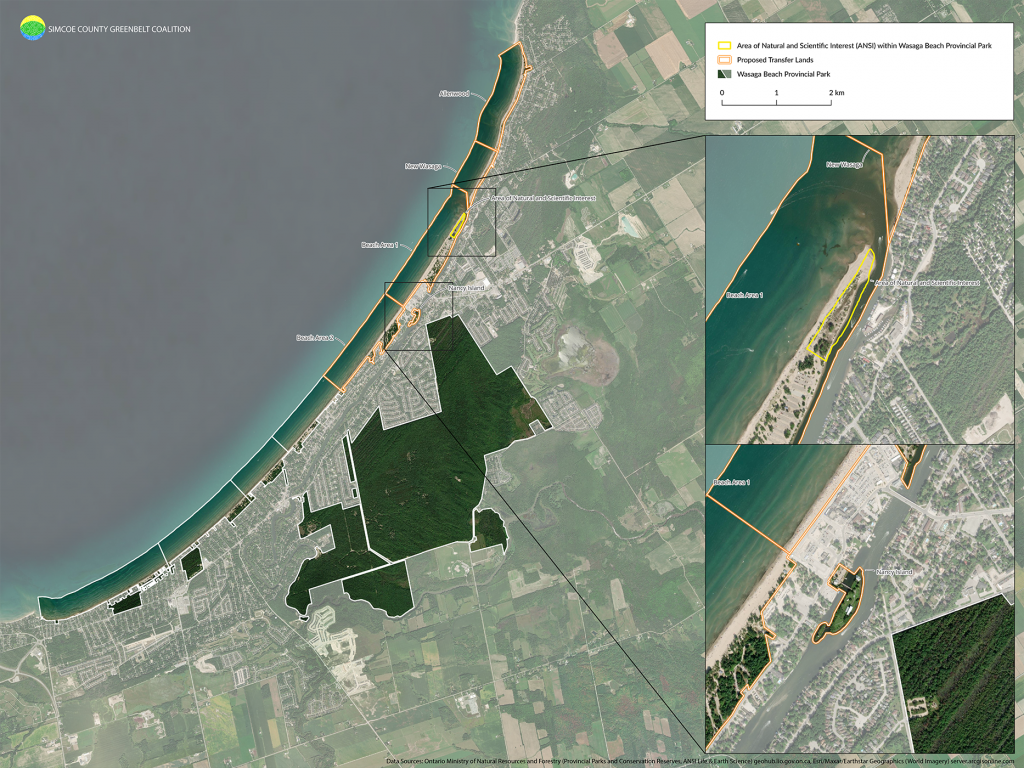
Wasaga Beach Provincial Park is one of Ontario’s most beloved natural places and provides habitat for endangered piping plovers. Stretching 14 kilometres along the Georgian Bay shoreline, it attracts more than one million visitors annually. Wasaga Beach is the most visited provincial park in the province. Beyond the crowds, the park protects dune ecosystems and habitats that are vital to other at-risk species like the eastern hognose snake, Hill’s thistle and the monarch butterfly.
Now, the Go
Wasaga Beach Provincial Park is one of Ontario’s most beloved natural places and provides habitat for endangered piping plovers. Stretching 14 kilometres along the Georgian Bay shoreline, it attracts more than one million visitors annually. Wasaga Beach is the most visited provincial park in the province. Beyond the crowds, the park protects dune ecosystems and habitats that are vital to other at-risk species like the eastern hognose snake, Hill’s thistle and the monarch butterfly.
Now, the Government of Ontario has removed provincial park protections from a significant portion of the beach and intends to transfer the lands to the Town of Wasaga Beach. This would weaken long-standing protections for these fragile habitats, and the piping plovers that depend on them.
The news came in May 2025, when the Government of Ontario announced the transferring of lands to the Town of Wasaga Beach to develop the waterfront for tourism.
In June, the government posted a proposal on the Environmental Registry (ERO #025-0694) to amend the Provincial Parks and Conservation Reserves Act. The proposal would remove several parcels of land from Wasaga Beach Provincial Park (roughly 60 hectares). Four of the park’s eight beach areas, including Areas 1 and 2, New Wasaga Beach and Allenwood Beach are included in the transfer. These areas are the most important piping plover habitat at Wasaga Beach.
Public response to the proposal was overwhelmingly opposed, with approximately 98 percent of comments objecting to the removal of beach areas from the park. Key concerns focused on potential environmental impacts, legal and governance issues, and implications for public access and equity.
Despite this feedback, no changes were made to the proposal, citing the Town of Wasaga Beach’s commitments to maintaining public access, and avoiding development on the beach. Lands removed from the park will remain subject to Ontario’s environmental protection laws.
While the province has stated the beaches will remain public, what remains unclear is how these lands and their ecological integrity would be managed once they are no longer under provincial park legislation. These changes come at the hills of over 100 species losing protection under the province’s new Species Conservation Act.
The changes to both land ownership and species at risk laws significantly heighten the endangerment to piping plovers at Wasaga Beach.
Piping plovers are small shorebirds that nest directly on open sand, making them especially vulnerable to disturbance. In Ontario, they are listed as endangered under federal law, and Wasaga Beach has played a critical role in their population recovery. Successful nesting depends on a healthy dune ecosystem, undisturbed beaches, and careful seasonal management – conditions that can be easily disrupted if the lands are developed for tourism.
With decisions about shoreline use, tourism infrastructure, and beach “maintenance” now under municipal authority, activities like beach raking could threaten nesting piping plovers and weaken the dune systems that naturally protect the shoreline from erosion, storms, and climate impacts.
The replacement of Ontario’s Endangered Species Act with the Species Conservation Act narrows the definition of protected habitats, potentially leaving dunes and foraging areas outside nesting sites unprotected. In addition, the Government of Ontario intends to de-list migratory birds all together to “remove duplication for species already receiving federal protections.” To date, the federal government has been reluctant to implement the Species at Risk Act on non-federal lands, which is why complementary provincial legislation was always necessary.
In a 2025 media release, Ontario Nature’s Conservation Policy and Campaigns Director Tony Morris said transferring these areas to the town puts both wildlife and long-standing conservation efforts at risk.
Under municipal ownership, decades-long dune restoration and habitat protections, carried out by Ontario Parks, could disappear. Without the Provincial Parks and Conservation Reserves Act in place, Morris says the town would not be required to manage the land for ecological health.
The emergency order request seeks immediate protection for critical piping plover habitat at Wasaga Beach. With the nesting season approaching, conservation groups are calling for action by March 1, 2026, noting that further delays could have serious consequences for the species’ survival and recovery in Ontario.
Call or email your MPP, and elected officials from the Town of Wasaga Beach to ask what they are doing to ensure Wasaga Beach remains a natural shoreline that balances tourism and a healthy ecosystem for the species that call it home.
Nevada just shattered its March statewide high temperature record by 6 degrees, which is a ‘72 miles per hour in a school zone’ kind of margin. And it happened during the hottest 11-year stretch in 176 years of recorded temperature tracking.
A mid-March heat wave in the American West pushed temperatures in Laughlin, Nevada, to 106°F, far above the previous March record of 100°F. The fact that this happened in March is alarming, especially since it coincided with a near-total collapse of the regi
Nevada just shattered its March statewide high temperature record by 6 degrees, which is a ‘72 miles per hour in a school zone’ kind of margin. And it happened during the hottest 11-year stretch in 176 years of recorded temperature tracking.
A mid-March heat wave in the American West pushed temperatures in Laughlin, Nevada, to 106°F, far above the previous March record of 100°F. The fact that this happened in March is alarming, especially since it coincided with a near-total collapse of the region’s snowpack. This sets the stage for an early and possibly severe wildfire season. The heat also fits a troubling trend confirmed by the World Meteorological Organization last week: 2015 through 2025 have been the 11 warmest years ever recorded on Earth.
Usually, temperature records are broken by small amounts. What happened in Nevada last month was very different. Some places broke monthly high temperature records by as much as 8 degrees. Reno had seven days above 80°F in March, compared to the previous record of just two days. “It’s not just that we broke monthly records,” said Nevada State Climatologist Baker Perry, “but it’s by how much we broke the monthly records, and not just in one place.”
A Snow Drought That Wasn’t in the Forecast
The heat wave didn’t hit a typical winter landscape. Nevada was already experiencing what Perry calls an unprecedented snow drought. Even though winter precipitation was close to normal and there were big storms in mid-February, warm, moist air arrived soon after. This caused what the National Weather Service called the second-highest single-day snowmelt ever recorded in the eastern Sierra, only surpassed by flooding in 1997.
Normally, snow melts slowly through April and May, but this year it happened all at once in late February and early March. SNOTEL monitoring stations across Nevada show the impact clearly: 70% of sites in northern and central Nevada now report zero inches of snowpack. That’s not just low—it’s gone. The incidence of drought is closely correlated with rising atmospheric CO2 levels recorded at the Mauna Loa Observatory in Hawaii, which is threatened with defunding by the Trump Administration.
Atmospheric CO2 levels from 2021 to 2026. Source: N.O.A.A.
What worries scientists most is the combination of these events. “To have these two unprecedented, exceptional events happening at once is a combination that is particularly concerning,” Perry said.
What This Means for Fire Season
Wildfire risk isn’t only about heat. It depends on the sequence of conditions leading up to fire season, and this year’s setup is especially dangerous.
The snowmelt and early rains caused plants to grow weeks ahead of schedule. This early growth creates lots of fine fuels. As these plants dry out over the spring—now with less moisture from snowpack—they become the kindling that can fuel fast-moving fires.
Truckee Meadows Fire Protection District Division Chief August Isernhagen said the early green-up could lead to conditions we haven’t seen before as fire season approaches. He urged people to be even more careful than in recent drought years.
“The majority of our starts, and nearly all of our catastrophic fires are human caused,” Isernhagen said in a statement from the University of Nevada, Reno.
Mountain forests face another challenge. Dawn Johnson, Warning Coordination Meteorologist at the NWS in Reno, explained that losing snowpack this early means heavy timber can become drought-stressed much sooner than usual, turning it into a fire hazard months earlier than normal. A cooler storm pattern expected in early April might bring some relief, but experts warn it may be too little, too late to make a real difference.
Eleven Years. No Exceptions.
The Nevada heat wave wasn’t an isolated event. It happened during the longest stretch of global heat ever recorded.
The WMO’s State of the Global Climate 2025 report, released on March 23, confirmed that every year from 2015 to 2025 is among the hottest ever recorded. Depending on the data, 2025 was either the second- or third-warmest year since records began, with temperatures about 1.43°C above pre-industrial levels. Atmospheric CO₂ reached its highest level in 2 million years, and ocean temperatures set a new record for the ninth year in a row.
UN Secretary-General António Guterres put the streak in stark terms: “When history repeats itself eleven times, it is no longer a coincidence. It is a call to act.”
The report also introduced a new measure called Earth’s energy imbalance (EEI). This tracks the difference between the energy the planet receives from the sun and the energy it sends back into space. In 2025, EEI was at its highest since records began in 1960. Surface temperatures, which get most of the attention, only show about 1% of the planet’s extra heat. Over 91% is absorbed by the oceans, which have taken in the equivalent of about 18 times the world’s total annual energy use each year for the past 20 years. EEI gives a clearer picture, showing that the planet is becoming more out of balance.
“In 2025, heatwaves, wildfires, drought, tropical cyclones, storms and flooding caused thousands of deaths, impacted millions of people and caused billions in economic losses,” said WMO Secretary-General Celeste Saulo. She added that the changes driven by human activities “will have harmful repercussions for hundreds — and potentially thousands — of years.”
What’s happening in the Western U.S. matches the WMO’s global findings perfectly. The report highlighted major glacier loss in 2025 along North America’s Pacific coast. These events aren’t separate—they’re both signs of the same warming trend, just showing up in different ways and times.
“We seem to be entering this new era where temperatures will be significantly higher than what they were ten years ago,” said climate scientist Sarah Perkins-Kirkpatrick of Australian National University. She explained that the changes of the past three years can only be explained by climate change.
What About the Cold in the East?
This is where things get both surprising and important.
If you live in the Northeast, Midwest, or Southeast, 2025 might not seem like a record-warm year. Some parts of the eastern U.S. have had cold snaps and severe winter weather that made national news. So how does that fit with 11 straight years of record global heat?
This actually makes sense in climate science. Climate change doesn’t warm every place at the same time. Instead, it disrupts atmospheric patterns like the polar vortex, which usually keeps cold air over the Arctic. As the Arctic warms much faster than the rest of the planet—about four times the global average, according to NOAA—the polar vortex weakens and shifts, letting cold air move into areas that don’t usually get it.
In other words, the same forces causing record heat in Nevada are also behind the unusual cold in the eastern U.S. These aren’t opposites—they’re both results of a destabilized climate system. Weather feels local, but our climate is shared. When the West is hot in March and the East is cold, both are signs of the same disrupted system.
Lower the risk of starting fires. Most wildfires are caused by people, so be extra careful during high-risk times. Don’t have campfires during bans, avoid dragging chains on your vehicle or trailer, and make sure your equipment doesn’t create sparks.
Support climate policy at both the state and federal levels. Reach out to your Congressional representatives. The WMO data shows the trend is clear. The decisions we make now will shape how severe fire seasons are in the future.
Cut your home’s carbon footprint by using energy efficiently, choosing cleaner transportation, and making changes to your diet. One person’s actions won’t solve the global problem, but when many people make changes, it can have a real impact on emissions.
If you live in the eastern U.S., don’t let cold winters make you ignore climate data. Pay attention to what’s happening across the country—the same atmosphere connects us all.
Does anyone (besides us geeks at Cartoon Research) really miss or even care about Conrad the Cat?
After all, he only appeared in three cartoons, all in 1942, and in two of them he was a mere co-star. Chuck Jones created the character, then abandoned him after that trifecta. A doughy yellow cat specializing in physical comedy, viewers remember Conrad as a knockoff of Disney’s Goofy, especially when Pinto Colvig voiced him in Conrad the Sailor. (Side note: Ink and Paint veteran Martha Sigall rel
Does anyone (besides us geeks at Cartoon Research) really miss or even care about Conrad the Cat?
After all, he only appeared in three cartoons, all in 1942, and in two of them he was a mere co-star. Chuck Jones created the character, then abandoned him after that trifecta. A doughy yellow cat specializing in physical comedy, viewers remember Conrad as a knockoff of Disney’s Goofy, especially when Pinto Colvig voiced him in Conrad the Sailor. (Side note: Ink and Paint veteran Martha Sigall related that the I&P department thought that Conrad was a caricature of Jones himself).
Conrad, however, can be seen as a transitional figure in Chuck Jones’ development as a Warner animator and director. From the bones of Conrad would arise a snappier and more cosmopolitan Jones, one capable of perhaps more nuance than any of his contemporaries. Let’s examine this thesis.
Chuck Jones became a Warner director in 1938. His first cartoon, starring an unnamed kitten in The Night Watchman, featured a cute character that very much resembled his next “star’ Sniffles the mouse, whom Jones created and first directed in 1939 (Naughty but Mice). Siffles was childlike and super-cute. His gabby voice, provided by Margaret Hill-Talbot (later by Marjorie Tarlton), reinforced this take on the character. Sniffles went on to headline a dozen cartoons between 1939 and 1946, showing little evolution.
During those years, Jones was obsessed with laborious drawings and layouts, lighting effects, and showed a strong predilection for Disney-flavored action. Conflict tended to be character-versus-object (or self), a far cry from the later interplay between Bugs and Daffy, for example.
Jones’ cartoons tended to be gentle, with visual references to Disney’s Silly Symphony period. Nowhere is this more evident than in the 1940 cartoon Tom Thumb in Trouble. His characters were adorable and mild, and until Jones found a more individual voice, they seemed most anchored in Pluto Pup. The Jones unit at this time had some outstanding talent: animators Robert Cannon, Ken Harris, Robert McKimson, Ben Washam, and background artist Paul Julian. Yet the best this group could achieve was shorts that recalled Disney but could not be confused with its output.
By the time Conrad Cat appeared in The Bird Came C.O.D. (1942), there were signs of Jones transitioning to a different comic style. Although Conrad strongly recalled Goofy (minimal vocals by Mel Blanc), especially when wrestling with a palm tree, there are glimpses of Jones’ future work; in one scene, while watering the tree, Conrad mugs to the camera. After smacking into a door for the second time, he gives the audience a frustrated side glance. After finally getting the plant through the door, more fourth-wall facial expressions are seen.
Skip ahead to Conrad’s encounter with the bird(s) in a magician’s hat. The bird (a visual predecessor to Henery Hawk) treats Conrad with far more violence than could be imagined in a Sniffles cartoon. Notably, the bird recalls Jones’ Minah Bird (first appearing in 1939) in that he marches to a distinct musical theme. Jones is clearly using comedy differently in this short.
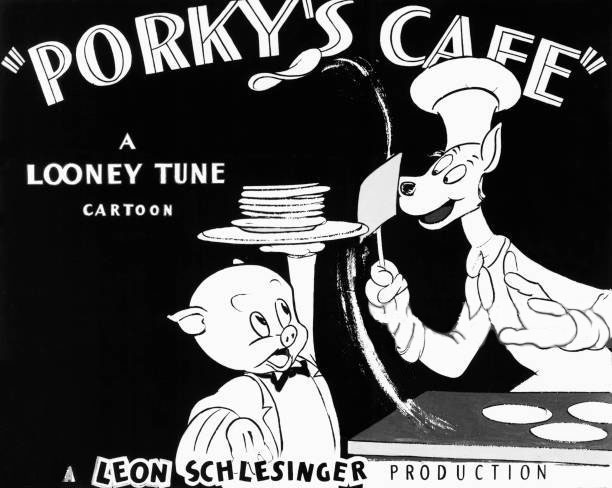
In his final two cartoons, both in 1942, Conrad was a co-star, paired with two of Warner’s biggest stars. Such pairings are likely as good as they could be for the goofy yellow cat, since he was far too weak to be a stand-alone character. In Porky’s Café, Conrad is a short-order cook who still manages to show glimpses of Jones’ future work; there are more gags and more telling reaction shots from Conrad. Jones was to become a master of expressing emotion through the twitch of an eye or a tiny movement of the mouth. These precursors can be glimpsed in the scene where Conrad attempts to beckon a recalcitrant pancake.
Conrad’s final cartoon was Conrad the Sailor, in which Daffy Duck harassed the poor cat in a total mismatch. Not only was Conrad constantly defeated by Daffy (who was far more like Bob Clampett’s duck than the egotist Jones would later fashion him into). As related earlier, Conrad’s voice was unfortunately provided by Pinto Colvig, the longtime portrayer of Disney’s Goofy, with no tweaking of the Goofy vocalization. Fairly or not, Colvig’s dialogue and singing reinforced the observation that Jones had not quite abandoned his Disneyesque tendencies.
As stated, while Conrad was not a character that could ever be featured independently, Conrad did offer occasional glimpses of Chuck Jones’ evolving style. Conrad was better built for comedy than Sniffles was, and he worked far better in gag situations than, say, the childlike Porky Pig in Old Glory (1939) or Tom Thumb. Conrad at least suggested an adult figure, and that represented a step forward.
Later, with writers such as Michael Maltese and a more developed sense of how to underplay a gag, Jones would blossom into one of Warners most sophisticated directors. If Jones reshaped the personalities of the studio’s stars during his heyday, it still started with a single step. Conrad the Cat may not stir many fond memories, but his three cartoons during 1942 just might have been that step.
“How about doing a moth survey at Sydenham?”
“A moss survey?” Asked Roberta Buchanan, local property steward for Sydenham River Nature Reserve, who didn’t quite hear me while we were walking outside.
“No, moths. Like a nocturnal equivalent to the butterfly survey. Who knows what we’ll find?”
It was 2023. I knew how unique the reserve was through my involvement with the annual butterfly and breeding bird surveys, and I suspected this oasis of biodiversity had fantastic potential for moths.
C
“A moss survey?” Asked Roberta Buchanan, local property steward for Sydenham River Nature Reserve, who didn’t quite hear me while we were walking outside.
“No, moths. Like a nocturnal equivalent to the butterfly survey. Who knows what we’ll find?”
It was 2023. I knew how unique the reserve was through my involvement with the annual butterfly and breeding bird surveys, and I suspected this oasis of biodiversity had fantastic potential for moths.
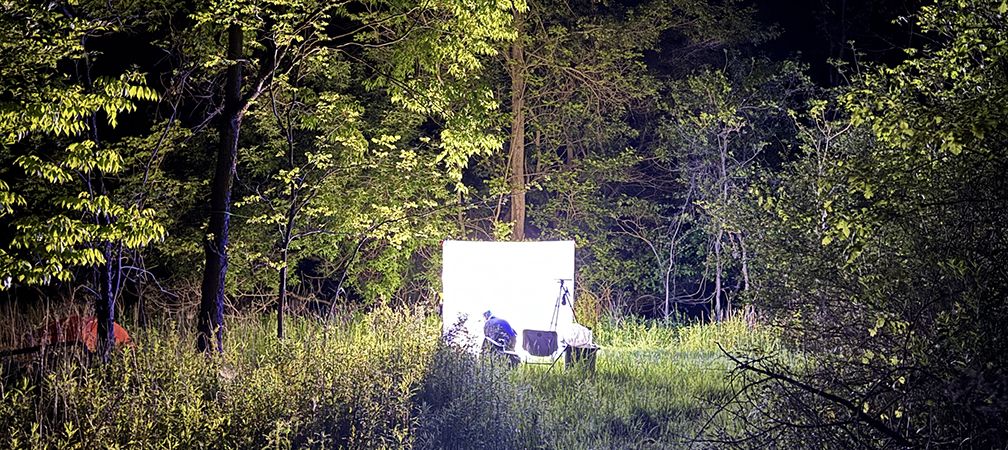
Compared to their diurnal counterparts, moths are relatively under-surveyed. Most species are nocturnal and inconspicuous, and documenting them requires specialized survey techniques – sheets and live traps baited with light or food. It also requires dedicated surveyors willing to stay up all night!
On the evening of June 24, 2024, a team of volunteers (Roberta Buchanan, Mark Buchanan, Paul Carter, Pete Chapman, Scott Connop, Deryl Nethercott, Dale Buchner, and myself) from Lambton Wildlife set up two light sheets and two traps across the Sydenham River Nature Reserve property. We documented hundreds of individual moths well into the night, and even more when we opened the traps the following morning. Then came the real fun: sorting through thousands of photos and identifying every moth.
Identifying all these moths is no trivial task. There are over 3,000 species of moths in Ontario, so field guides include only the most common species. Encountering moths that aren’t in the guide is common, and several groups of moths are notoriously hard to identify, even for experienced moth-ers. My approach is to photograph every moth, upload these photos to iNaturalist with my tentative ID, and wait for confirmation by a moth expert. For those who don’t know, iNaturalist is an online platform where you can post photos or recordings of an organism and crowdsource identifications from experts all over the world.
To keep track of the growing species list, I created an iNaturalist project which automatically consolidates all the moth observations from the property. The strength of this approach is that it stays current, as taxonomic changes and revised identifications will update the species list automatically. This makes it more reliable over time than a static checklist, which inevitably becomes outdated. As of 2026, we have documented 196 species of moth that first night, 13 of which are considered vulnerable at some level. After a second survey in May 2025, the total moth species count at Sydenham River Nature Reserve stands at 328, including 30 vulnerable species.
Fast forward to July 2025. I was checking my iNaturalist and saw there was a comment on one of my moth observations from the 2024 survey. Someone disagreed with my identification of what I believed to be a common white-fringed emerald, suggesting instead a species I hadn’t heard of – a Tuscarora emerald.
I quickly checked the range map, and my excitement spiked: this was a very rare moth, with only about fifty observations, all from the eastern United States – mostly localized populations in the Appalachians. If this was actually a Tuscarora emerald, it would likely represent the first record for Canada.
The identifier, Daniel Kluza (d_kluza on iNaturalist), a New Zealand-based biologist and iNaturalist taxonomy curator, pointed out a critical detail: our moth lacked the pure white spot on top of the abdomen which is present on the white-fringed emerald. This was a subtle difference, but potentially a decisive one. I needed a second opinion.
I reached out to Seabrooke Leckie, co-author of the Peterson Field Guide to Moths of Northeastern North America, and asked what she thought of it. Her response was unequivocal:
“I pulled out the Moths Of North America fascicle for this group to have a look at the official description of both species, Tuscarora and White-fringed, and I agree that this is Tuscarora. What a find!… Besides the presence/absence of the white spot at the base of the abdomen, the fascicle also says the white costa is very narrowly bordered inwardly by an apricot colour, and the AM and PM lines are wider than in White-fringed, both of which appear present here. There are no other eastern species that have both the white fringe and no markings on the abdomen.”
What makes this record especially meaningful is not just the rarity of Tuscarora emerald, but the way in which it was found. It was the result of methodical work by a team of volunteer community scientists, combined with the expertise of moth specialists. Not too long ago, access to such expertise was a significant roadblock, but it’s now easily facilitated through platforms such as iNaturalist.
We don’t know if this observation represents a previously overlooked population, a vagrant individual, or a northern range expansion driven by climate change. What is clear, however, is that protected places like Sydenham River Nature Reserve continue to demonstrate their conservation value in unexpected ways. When we take the time to look closely and collaboratively at under-surveyed groups like moths, we reveal hidden layers of biodiversity, uncovering the true richness of landscapes we thought we already knew.
A cartoon illustration of a stern cat peeking out behind a curtain at a surprised man in a chair. Caption reads "What unnerved Walter most about seeing the cat standing behind the curtain was the fact that Walter did not own a cat."
Since 2018, Ontario’s nature protections have been repeatedly weakened. While a few stories such as the ongoing changes to Conservation Authorities or the Greenbelt scandal made headlines, dozens of major changes have flown under the radar, buried deep inside massive government bills. It has been a lot to track, even for us.
Today, Ontario Nature is releasing a comprehensive new resource: Tracked Changes: The Decline of Ontario’s Legal Protections for Nature since 2018. We tracked every single
Since 2018, Ontario’s nature protections have been repeatedly weakened. While a few stories such as the ongoing changes to Conservation Authorities or the Greenbelt scandal made headlines, dozens of major changes have flown under the radar, buried deep inside massive government bills. It has been a lot to track, even for us.
Today, Ontario Nature is releasing a comprehensive new resource: Tracked Changes: The Decline of Ontario’s Legal Protections for Nature since 2018. We tracked every single piece of legislation that weakened legal protections for nature and biodiversity from the first term of the current provincial government to today. We broke it all down in plain language, cutting through the legislative jargon to reveal exactly how our environmental laws have been rewritten.
Our review, detailed in the full report, catalogs the changes made bill-by-bill and schedule-by-schedule. Over the past seven years, key environmental laws, built over decades, have been systematically dismantled.
The Endangered Species Act (ESA) has been a primary target. Changes began with Bill 108 in 2019, which created a “Species at Risk Conservation Fund.” Critics called this a ‘pay-to-slay’ scheme, allowing proponents to pay a fee instead of being legally required to provide an “overall benefit” to the species they are harming. This process culminated in 2025 with Bill 5, which fundamentally rewrote the ESA to prioritize economic considerations over science-based recovery and even created a new law, the Species Conservation Act, to eventually replace it entirely.
Conservation Authorities (CAs), our frontline defenders against flooding and protectors of wetlands, have been substantially weakened. Bill 229 in 2020 forced CAs to issue permits for developments authorized by a Minister’s Zoning Order, even if those projects would be denied under their own standards for flood protection. The Auditor General criticized this move for shifting environmental decision-making from qualified professionals to political processes.
Public oversight and democratic accountability have been sidelined at every turn. The independent Environmental Commissioner of Ontario was eliminated in 2018 through Bill 57. The government has repeatedly circumvented the Environmental Bill of Rights, sometimes passing legislation before public comment periods on those very proposals have even closed, as happened with Bill 150 in 2023.
Few of these changes got the headlines they deserved. Nearly all of them were buried inside massive omnibus bills. These are bills that bundle dozens of changes into a single piece of legislation.
For example, Bill 5, the Protect Ontario by Unleashing our Economy Act, 2025, was a single bill that:
Cancelled environmental agreements for the Eagle’s Nest mine project and exempted the Chatham-Kent waste site from certain approvals.
Centralized mining authority in the Minister, enabling fast-tracked permits.
Removed public consultation rights for permits related to the Ontario Place redevelopment.
Established Special Economic Zones where selected projects can be exempted from provincial and local laws, including environmental protections.
This strategy of putting so much into a single bill ensures that major changes to environmental protections pass into law with little media coverage or public awareness. Our new resource cuts through this volume, separating each schedule so you can see exactly what changed and how.
These changes didn’t happen all at once, and taken together, they systematically dismantle many of Ontario’s most significant legal environmental protections.
This report is designed as a tool for advocates, journalists, and anyone who wants to understand what has happened to nature protections in Ontario over three terms of the current government. We hope this will make it easier for people to see the full picture and understand not only what laws have changed, but how these changes have circumvented democratic transparency.
Believe it or not, Ontario’s Endangered Species Act (ESA) was passed with all-party support back in 2007. Subsequently, of course, it was undermined through numerous exemptions and approvals for harmful activities, and now, through Bill 5, the Government of Ontario is tossing it aside completely. It is being replaced by the Species Conservation Act, 2025, (SCA) which is in no way its equal. With a view to eliminating barriers to development, it is claimed the new law will “help speed up project
Under the SCA, no migratory birds, aquatic species or species of special concern will be provincially listed. The rationale for removing protections for migratory birds and aquatic species is that they already receive federal protection under the Species at Risk Act (SARA). In the case of special concern species, the provincial government is not listing them because they were not subject to “prohibitions under the ESA”. The provincial government is thus abandoning responsibility for 106 out of the 270 or so species currently deemed to be at risk in Ontario.
In 1996, federal, provincial and territorial ministers responsible for wildlife committed to a national accord to protect species at risk by agreeing to “establish complementary legislation and programs that provide for effective protection of species at risk throughout Canada.” Canada and Ontario went a step further in 2011 by developing an Agreement on Species at Risk that commits to coordination and cooperation on preventing species from becoming at risk, as well as protecting and recovery identified species.
The Government of Ontario has abandoned these commitments. Species do not recognize arbitrary political boundaries, and cooperative federalism is absolutely necessary to conserve species at risk, especially amid a biodiversity crisis.
The SARA is not equivalent to the ESA and to date, the federal government has been reluctant to exercise its power under the act on non-federal lands. The Government of Ontario has given no indication that the federal government was engaged on the draft SCA or agreed to step in and provide protections for the migratory birds and aquatic species that have lost provincial protections. On the contrary, Minister McCarthy along with the Alberta Environment Minister senta letter to their federal counterpart in June, 2025 that requested the federal government amend SARA “to respect the constitutional jurisdiction of the provinces”, along with request to weaken other environmental regulations.
Further evidence that SARA is not fit to purpose to make up for the once gold standard provincial ESA, is that the backlog of species needing reassessment by Environment and Climate Change Canada will grow to 574 by the end of 2030. Additionally, as of 2022, the Auditor General of Canada found that 10% of federally listed species did not have recovery strategies or management plans in place as required by the act. Furthermore, of the 409 recovery strategies prepared by 2022, 20% did not identify the species’ critical habitat, which is necessary for protections under SARA.
Despite the Government of Ontario’s claims that the protections under the ESA for migratory birds and aquatic species were duplicative with federal protections, it is clear that SARA and the federal government are not equipped to provide equivalent protections.
Ontario’s weakening of protections for species at risk threatens our long-term well-being. Join us in urging the Government of Ontario to repeal Bill 5.

 Login
Login


 Ben Harrison and Manny Gould were exclusively helming the direction of the series from 1926, when Mitnz’s studio was in New York, moved to the west coast into the beginning of the sound era though 1933, then continuing to direct some of the cartoons along with the Color Rhapsodies series. It was a popular enough series through those early 30s years, then really began to lose steam in the mid-30s as so many cartoon series do.