Taiwan’s President Lai Ching-te said Thursday he would be “happy” to talk to US leader Donald Trump — a conversation that would break more than four decades of diplomatic protocol and risk angering China.
Taiwan President Lai Ching-te delivers a speech to mark his second anniversary in office on May 20, 2026. File photo: Taiwan’s Presidential Office, via Flickr.
Trump told reporters on Wednesday that he would speak to Lai, as the White House weighs arms sales to the democratic island.
Taiwan’s President Lai Ching-te said Thursday he would be “happy” to talk to US leader Donald Trump — a conversation that would break more than four decades of diplomatic protocol and risk angering China.
Taiwan President Lai Ching-te delivers a speech to mark his second anniversary in office on May 20, 2026. File photo: Taiwan’s Presidential Office, via Flickr.
Trump told reporters on Wednesday that he would speak to Lai, as the White House weighs arms sales to the democratic island.
It was the second time since a summit in Beijing last week that Trump has said he would call the Taiwanese leader.
Such communication would be the first time since Washington switched diplomatic relations from Taipei to Beijing in 1979 that serving presidents of Taiwan and the United States would speak to each other.
Lai said Taiwan was “committed to maintaining the stable status quo in the Taiwan Strait” and that “China is the disruptor of peace and stability”, the Taiwanese foreign ministry said in a statement.
China ‘firmly opposes’ call
Lai would be “happy to discuss these matters with President Trump”, the statement said.
“I’ll speak to him. I speak to everybody,” Trump said, adding that he had a great meeting with Chinese President Xi Jinping during his state visit to Beijing last week.
US President Donald Trump addresses the nation on the shooting of two National Guard soldiers in Washington, DC, on November 26, 2025, from his residence in Mar-a-Lago in Palm Beach, Florida. Photo: White House, via Flickr.
“We’ll work on that, the Taiwan problem,” Trump said.
China’s foreign ministry said Thursday it “firmly opposes official exchanges” between the United States and Taiwan, as well as US arms sales to the island.
“China urges the United States to implement the important consensus reached during the meeting between the Chinese and US heads of state, honour its commitments and statements, handle the Taiwan question with the utmost prudence,” ministry spokesman Guo Jiakun told a press briefing.
He added that Washington should “stop sending wrong signals” to Taiwan.
After wrapping up his trip to Beijing, Trump suggested arms sales to Taiwan could be used as a bargaining chip with China, which claims the island is part of its territory and has threatened to seize it by force.
Since then, Lai’s government has been on the offensive, insisting that US policy on Taiwan has not changed and that Trump made no commitments to China on arms sales to the island.
Taiwan relies heavily on US support to deter any potential Chinese attack, and has been under intense pressure to increase its spending through investment in American firms.
The Coney Island Creek dune planting project started in 2021, with the goal of increasing coastal resilience and giving community members hands-on experience protecting their environment.
The Coney Island Creek dune planting project started in 2021, with the goal of increasing coastal resilience and giving community members hands-on experience protecting their environment.
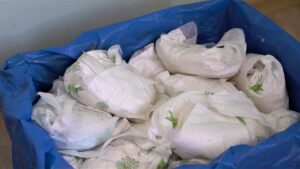
A typical American baby goes through roughly 2,500 to 3,000 disposable diapers in the first year of life — seven or eight a day, every day, for two to three years. The bill lands somewhere between $840 and $1,200 a year, depending on brand, size, and the tariffs that quietly raised diaper prices in 2025.
Multiply it across the country, and the picture changes again. The last time it counted, the Environmental Protection Agency estimated U.S. disposable diaper generation at 4.1 million tons in 20
A typical American baby goes through roughly 2,500 to 3,000 disposable diapers in the first year of life — seven or eight a day, every day, for two to three years. The bill lands somewhere between $840 and $1,200 a year, depending on brand, size, and the tariffs that quietly raised diaper prices in 2025.
Multiply it across the country, and the picture changes again. The last time it counted, the Environmental Protection Agency estimated U.S. disposable diaper generation at 4.1 million tons in 2018, about 1.4 percent of everything Americans threw away that year. The agency found no significant recycling or composting of disposable diapers.
The diaper is one of the most engineered, most subsidized, most disposed-of consumer products ever invented, yet we still have almost no idea what to do with it when it’s full.
Rising Household Costs
Diaper costs have crept up. Industry sources put the average disposable at $0.22 to $0.33 each, with monthly outlays of $70 to $100 typical for a home with a new baby. Tariff-affected brands imported from overseas are running higher. Over a full diapering cycle of roughly 2.5 years, a single child produces around 6,500 soiled disposables.
That bill is not evenly distributed. The National Diaper Bank Network (NDBN) Diaper Check 2024 found that 46 percent of U.S. families with children under four reported diaper insecurity, meaning they could not always afford enough diapers to keep a child clean and dry. That share has climbed from roughly one-third a decade earlier. The Urban Institute estimates nearly 8 million American children live in households that struggle to afford diapers. Diapers are not covered by SNAP or WIC, and in 23 states, they are still taxed at rates as high as 7 percent, though Missouri, Nevada, and Alabama all eliminated or paused their diaper taxes in 2025.
Diaper insecurity carries a mental-health load too. NDBN’s research found that caregivers without enough diapers were twice as likely to report near-daily depression. The household story of diapers is not just an environmental story. It is a poverty story dressed up in a baby-aisle marketing budget.
What’s Actually in That Diaper
The modern disposable is an unrecyclable marvel of materials engineering. According to EDANA, the European nonwovens trade body, the average baby diaper is roughly 35 percent fluff pulp made from wood-derived cellulose, 33 percent super-absorbent polymer (SAP, usually sodium polyacrylate, made from petrochemicals), 17 percent polypropylene plastic, 6 percent polyethylene plastic, 4 percent adhesives, 4 percent other materials, and 1 percent elastics.
The composition has shifted dramatically. Absorbent content rose from about 1 percent in 1987 to nearly 38 percent by 2019 as manufacturers pursued a thinner, more absorbent product. The “ultra-thin” diaper marketing of the last two decades is, in materials terms, a fossil-fuel story: fewer trees, more polymers.
That polymer matters as the diaper heads for a landfill. Polyethylene, polypropylene, and sodium polyacrylate are not biodegradable. The elastics aren’t either. Even the adhesives are designed to hold a wet load together for hours, so they don’t readily break down in conventional recycling streams.
Do Diapers Persist for 500 Years?
The widely cited statistic is that a disposable diaper takes up to 500 years to decompose in a landfill. That number deserves a closer look. Disposable diapers in their modern form have existed only since 1948, so no one has ever seen one fully decompose. The 500-year figure is an extrapolation from polymer breakdown rates, not a measured outcome. Because the plastic and SAP components are not biodegradable on any human timescale, and a sealed modern landfill design inadvertently inhibits decomposition, not accelerates it. The estimated timescale is likely correct, or even conservative.
Instead of decomposing, soiled diapers in a landfull produce methane. As the cellulose fraction breaks down anaerobically, it generates methane, a greenhouse gas that traps roughly 80 times more heat than carbon dioxide over a 20-year window. Landfill gas capture varies widely by locale. Where it isn’t captured, diaper waste contributes directly to near-term climate warming.
There is also a public-health dimension. The EPA has noted that disposable diapers introduce pathogens into the waste stream through the human waste they contain, including rotavirus, hepatitis, and other viable organisms that survive in landfill leachate. Most municipal solid-waste systems treat diapers as ordinary trash even though their contents would, in any other context, require infectious-waste handling.
Recycling Exists — Barely
Curbside-style diaper recycling does not exist in the United States. Diaper recycling is one of the harder problems in the circular economy. The product is wet, fouled, fastened to itself, and built from a chemistry that resists separation. A handful of programs have tried.
FaterSMART, the joint venture between Procter & Gamble and Italy’s Angelini Group, has operated a diaper recycling plant in Treviso, Italy, since 2017, using high-temperature steam pressure to sterilize used diapers and separate plastic, cellulose, and SAP. P&G expanded the approach into a pilot in Amsterdam with TerraCycle and the Dutch municipal waste authority AEB, which distributed recycling bins in two districts. The technology works. Whether it can scale is a political and economic question.
NappiCycle, a Welsh company, takes another route, converting used diapers and other absorbent hygiene products into fibers that are blended into asphalt for road resurfacing. A 1.4-mile stretch of highway in Wales now contains the equivalent of more than 107,000 used diapers in its road surface. The fibers reportedly make the asphalt quieter and longer-lasting. Fifteen of Wales’ 22 local authorities now collect or plan to collect absorbent hygiene products separately.
Knowaste, a UK company that ran a 70,000-ton-per-year diaper recycling plant in the Netherlands, closed in 2007 after a new incinerator beat it on price. It turned out burning dirty diapers was cheaper, which may be a short-sighted perspective. That failure is worth remembering. Diaper recycling is a problem of cheap landfilling and cheap incineration crowding out higher-value end-of-life alternatives.
DYPER and TerraCycle offer the closest thing to a U.S. consumer option, a bamboo-pulp diaper subscription paired with a mail-back composting service. Used diapers ship via UPS to a TerraCycle facility, where they are commercially composted over three to six months and end up as soil used in highway medians and similar applications. The catch is cost: the ReDYPER service adds about $39 a month to an already premium subscription. It is a workable model for households that can afford to pay roughly double the average disposable bill.
The Cloth Question, Honestly
The cloth-versus-disposable debate has raged for decades. The most rigorous public assessment remains the UK Environment Agency’s 2008 update of a lifecycle analysis that concluded both cloth and disposable diapers had broadly similar overall environmental footprints — but in different categories. Disposables dominated in waste generation and raw-material extraction. Cloth dominates water and energy use from laundering. Neither produces a sustainable environmental benefit.
The interesting finding was that the comparison was highly sensitive to parent behavior. Washing at 60°C instead of 90°C, line drying instead of tumble drying, and reusing diapers across multiple children reduced the cloth-diaper footprint by up to 40 percent. The UK updated the analysis in 2023, reporting that reusable nappies produced about 25 percent less CO₂ than single-use ones under typical conditions, which is a meaningful but not enormous advantage.
The life cycle analysis literature suggests that cloth, used well, has a lower footprint and a vastly smaller waste stream. Where the real impact sits — fluff pulp and SAP — is exactly where the consumer has no options to change their habits.
Upstream: The Trees and Oil You Don’t See
While the conversation about diapers usually ends at the curb. The bigger story is upstream.
Fluff pulp, the softwood cellulose that gives a diaper its bulk and wicking, comes overwhelmingly from southern pine plantations in the U.S. and from boreal forests in Canada and Scandinavia. Industry estimates put U.S. diaper-driven softwood consumption at about 250,000 trees a year, and an analysis from the Ellen MacArthur Foundation, summarized by the World Economic Forum, places global crude oil consumption for the disposable diaper industry at roughly 248 million barrels a year, about the same amount of oil used by Belgium annually.
FSC certification of fluff pulp varies sharply by manufacturer. Pampers states that all of its wood pulp is third-party certified and that it uses FSC-certified pulp; Huggies, Seventh Generation, and The Honest Company make similar claims on their premium lines. But the disclosures rarely specify whether the certification is FSC 100% (entirely from certified forests), FSC Mix (which can include a minority of uncertified fiber), or FSC Recycled. Beneath the certified labels, most diaper marketing leans on the phrase “responsibly sourced,” a term with no industry-wide definition and no audit requirement, which a manufacturer can use without any independent verification of the supply chain. Aparent comparing two boxes on a shelf cannot map the certification language to a provable environmental outcome.
The SAP absorptive supply chain is even less visible. Sodium polyacrylate is synthesized from acrylic acid, which is derived from propylene, a petrochemical feedstock. Every “ultra-thin” generation of diaper has increased that dependency on fossil fuels. There is no commercial bio-based SAP at scale yet, though research programs are ongoing.
Each diaper is a small unit of forest, a smaller unit of crude oil, and a packet of human waste, tied together by adhesives engineered to hold for eight hours and then sit in the ground indefinitely.
Policy Is Moving — Slowly
The regulatory landscape is starting to catch up. The European Union’s Single-Use Plastics Directive requires extended producer responsibility (EPR) schemes for absorbent hygiene products and mandates clearer labeling on plastic content and proper disposal. France banned a list of chemicals used in diapers in 2020 after a national agency found measurable levels of pesticides and dioxins in retail products.
In the United States, the policy conversation has focused almost entirely on affordability, such as by eliminating sales tax on diapers and pushing to include them in WIC and SNAP eligibility. Both are needed. Neither addresses the waste stream. A handful of states are beginning to consider EPR frameworks that include hygiene products, but the U.S. is years behind Europe on this issue.
What You Can Do
At home:
Consider a hybrid system: cloth at home, disposables for travel and daycare use. The approach captures most of the cloth waste reduction without the all-or-nothing commitment that derails many cloth attempts.
If you stay with disposables, look for FSC-certified fluff pulp and skip varieties with added fragrance or lotion — neither offers any benefit and both add chemistry your child doesn’t need.
Donate unopened diapers your child has outgrown to your local diaper bank rather than throwing them away. The NDBN locator maps member organizations.
In your community:
Ask your municipal waste authority whether they are tracking absorbent hygiene product recycling pilots. The Welsh model is replicable; what’s missing in most U.S. cities is the political will to act.
Support state-level legislation eliminating sales tax on diapers. As of mid-2025, 23 states still tax them. The NDBN state issues tracker lists active bills.
Support inclusion of diapers in WIC and SNAP. Both programs explicitly exclude diapers despite being intended to cover basic needs.
At the policy level:
Push for federal EPR consideration of absorbent hygiene products. The EU has shown that this is administratively feasible. The U.S. has not yet taken the step, but momentum is growing.
Engage with state-level circular-economy bills that would extend producer responsibility to products beyond packaging.
A guide to what receipts, documents and forms must be saved, and for how long, to satisfy the IRS. Plus, tips for storing, scanning and shredding all that paper.
A guide to what receipts, documents and forms must be saved, and for how long, to satisfy the IRS. Plus, tips for storing, scanning and shredding all that paper.
President Xi Jinping hailed China and Russia’s “unyielding” ties in talks with Vladimir Putin on Wednesday, as the pair met to underscore their alliance days after Donald Trump’s own visit to Beijing.
Chinese President Xi Jinping (left) welcomes Russian President Vladimir Putin at the Great Hall of the People in Beijing on May 20, 2026. Photo: The Kremlin.
The two countries’ ties have deepened since Moscow’s 2022 invasion of Ukraine, as Russia has become increasingly dependent on China, i
President Xi Jinping hailed China and Russia’s “unyielding” ties in talks with Vladimir Putin on Wednesday, as the pair met to underscore their alliance days after Donald Trump’s own visit to Beijing.
Chinese President Xi Jinping (left) welcomes Russian President Vladimir Putin at the Great Hall of the People in Beijing on May 20, 2026. Photo: The Kremlin.
The two countries’ ties have deepened since Moscow’s 2022 invasion of Ukraine, as Russia has become increasingly dependent on China, its main oil customer.
Putin was received by Xi outside Beijing’s opulent Great Hall of the People in much the same fashion as Trump last week, complete with chanting children and military fanfare.
But the language was much warmer, with Xi telling the Russian leader Beijing and Moscow have “continuously deepened our political mutual trust and strategic coordination with a resilience that remains unyielding”, according to Chinese state media.
Opening talks, both were quick to laud their countries’ special ties as they extended their treaty of “friendly cooperation”.
Putin, quoting a Chinese phrase, told Xi: “A day apart feels like three autumns”, adding that relations had reached an “unprecedentedly high level” despite “unfavourable external factors”, Russian media footage showed.
In an apparent swipe at the United States, Xi warned of “unilateral and hegemonic countercurrents running rampant” in the world.
Children greet Chinese President Xi Jinping (left) and Russian President Vladimir Putin during the welcome ceremony at the Great Hall of the People in Beijing on May 20, 2026. Photo: The Kremlin.
In contrast to Trump’s visit last week, which yielded little in the way of immediate concrete announcements, Putin and Xi signed a slew of agreements on Wednesday on trade, media and energy.
The two leaders later had talks over tea, which the Kremlin had previously said would be reserved for “the most important issues” such as Ukraine, Iran and relations with the US.
That session lasted around 1.5 hours before Putin headed to the airport, according to Russian media.
Fossil fuel push
Beneath the camaraderie, Putin is now perceived by many to be the junior partner in the relationship.
The Russian leader has been weakened over four years of the Ukraine conflict, with his country’s economy shrinking in the first quarter of the year as factors such as wartime spending, labour shortages and sanctions take their toll.
Analysts believed Putin would use his visit to push for progress on the “Power of Siberia 2”, a major natural gas pipeline running from Russia to China through Mongolia.
But Kremlin spokesman Dmitry Peskov told Russian media Wednesday that while the two sides had reached a “basic understanding” — including on “the route and how it will be built” — there was no “clear timeline”, and “there are still some details to be worked out”.
Chinese President Xi Jinping (left) and Russian President Vladimir Putin inspect the honour guard at the Great Hall of the People in Beijing on May 20, 2026. Photo: The Kremlin.
The US-Israeli war on Iran has hampered crude and gas flows from the Middle East, giving an opportunity for Putin to offer Russian energy sources as an alternative.
“Russia and China are actively cooperating in the energy sector… We are, of course, ready to continue reliably supplying all these types of fuel to the rapidly growing Chinese market,” Putin said Wednesday.
His priorities may differ from China’s, which wants the Middle East conflict concluded as soon as possible.
Underlining that, Xi told Putin on Wednesday that “a comprehensive ceasefire is of utmost urgency, resuming hostilities is even more inadvisable and maintaining negotiations is particularly important”.
‘Sovereign foreign policy’
Xi has played host to a series of world leaders as an increasingly unpredictable United States under Trump has pushed many to shore up alliances with Beijing.
Many have urged him to use his influence with Russia and Iran to help bring an end to the respective conflicts there.
US President Donald Trump and Chinese President Xi Jinping tour the Hall of Prayer of Good Harvest at the Temple of Heaven in Beijing on May 14, 2026. Photo: The White House, via Flickr.
Ukrainian President Volodymyr Zelensky had asked Trump to discuss ending the war during his meetings with Xi last week.
The pair did talk about the issue, but the US president left China without a breakthrough.
Beijing has regularly called for talks to end the war in Ukraine, but has never condemned Russia for sending in troops — presenting itself instead as a neutral party.
The two leaders talked about Ukraine, Chinese state media said after the visit had ended, without giving further details.
On Wednesday Putin said that Russia and China were “committed to an independent and sovereign foreign policy”.
In a joint statement released by the Kremlin, Russia said it “positively assesses the objective and unbiased position of the Chinese side regarding the situation in Ukraine and welcomes China’s aspiration to play a constructive role”.
An image from 2000 of the Texas death chamber in Huntsville. | Joe Raedle/Newsmakers
The Supreme Court announced on Thursday that it will not decide Hamm v. Smith, a case involving a genuinely difficult constitutional question about whether an Alabama inmate may lawfully be executed.
The immediate upshot of this decision is that Joseph Clifton Smith, who’s at the heart of this case, will not be killed. Smith prevailed in the federal appeals court that previously heard his case. And the
The immediate upshot of this decision is that Joseph Clifton Smith, who’s at the heart of this case, will not be killed. Smith prevailed in the federal appeals court that previously heard his case. And the fact that the justices decided not to decide Hamm — they dismissed it “as improvidently granted,” to use the Court’s precise legal terminology — means that Smith’s victory in the lower court stands.
Though the full Court issued no opinion in Hamm, six justices joined at least one of three concurring or dissenting opinions revealing how they thought the case should have been decided. Justice Sonia Sotomayor’s concurring opinion offers a likely explanation for why her Court chose to make this case go away. Meanwhile, Justices Clarence Thomas and Samuel Alito’s dissenting opinions reveal some riffs among the Court’s Republicans.
In Atkins v. Virginia (2002), the Supreme Court held that it is unconstitutional to execute someone with an intellectual disability. The Hamm case largely turned on whether Smith’s IQ is low enough that he qualifies as intellectually disabled. But most of the justices appear to have thrown up their hands and determined that they are not well-positioned to determine Smith’s IQ.
Sotomayor’s opinion suggests that Alabama may have lost this case because of inept lawyering. Among other things, she points out that none of the expert witnesses that testified in a lower court, including Alabama’s own expert, used the same methods to determine Smith’s IQ “that Alabama now claims is necessary.”
At least some constitutional protections against capital punishment are probably safe, for now.
Because the Supreme Court has the final word on questions of constitutional law, the justices are supposed to be reluctant to decide questions that are not fully vetted by lower courts, due to the risk that the Court could hand down an uncorrectable error if it decides a case too hastily. Thus, Sotomayor argues that her Court was right to “exercise caution” by not handing down the definitive word on a constitutional question that was not fully aired in other forums.
Meanwhile, at least some of the Republican justices appear to have backed away from more hardline positions that they took in the past. That means that at least some constitutional protections against capital punishment are probably safe, for now.
Most of the Republican justices appear to have made peace with Atkins
The Court’s right flank has historically opposed Atkins altogether. The late Justice Antonin Scalia, for example, claimed in Atkins that only “severely or profoundly” disabled people — perhaps those with an IQ of 25 or lower — are protected from execution. But, under the Atkins framework, people with an IQ of 70 or below are often ineligible for the death penalty. And people who test slightly higher than 70, such as Smith himself, may also sometimes show that they are intellectually disabled by pointing to other factors besides IQ.
But only Thomas, who wrote a dissenting opinion in Hamm that was joined by no one else, called for Atkins to be overruled.
It’s particularly surprising that Justice Neil Gorsuch, who previously has expressed very hardline views in death penalty cases, appeared to chart a more moderate course in Hamm. Gorsuch seemed to suggest in Bucklew v. Precythe (2019) that his Court should toss out the entirety of its past 60 years worth of cases interpreting the Eighth Amendment’s ban on cruel and unusual punishments, and instead adopt a new rule that would allow the government to impose very high penalties for minor crimes.
But, of the three Hamm opinions, only Thomas cited Bucklew. And Gorsuch neither joined Thomas’s opinion nor did he join some parts of Alito’s opinion, which called for harsher rules in Atkins cases. So it appears that Gorsuch’s Bucklew opinion may be an orphan.
Alito, meanwhile, wrote a bifurcated opinion, major parts of which were joined by a total of four justices — Alito, Chief Justice John Roberts, Thomas, and Gorsuch. But only Thomas joined the part of Alito’s opinion which called for the most limits on Atkins.
The parts of Alito’s opinion that were joined by four justices largely concern the unusual facts present in Hamm.
It’s safe to say that Smith’s claim that he is intellectually disabled is marginal. While courts consider whether a capital defendant’s IQ is below 70 in order to determine if that defendant is intellectually disabled, Smith took several tests that measured his IQ somewhere in the 70s — and none of them showed that he has an IQ of 70 or below.
Under the Court’s previous death penalty cases, the fact that a death row inmate tests slightly above 70 is not fatal to his Atkins case — in part because IQ tests have a margin of error and may overestimate a test subject’s IQ. But Alito essentially argues that someone like Smith, who took multiple tests that showed him with an IQ above 70, may be executed.
In the part of his opinion joined only by Thomas, meanwhile, Alito claims that “‘higher scores are likely to be more indicative’ of a person’s intelligence than the lower scores,” a rule that would potentially doom capital defendants with a wide range of scores, some of which are below 70.
Still, it’s notable that Alito focused his opinion so closely on the minutiae of the Hamm case, without making broader attacks on Atkins or on the general rule that intellectually disabled people may not be executed. It is tough to evaluate where the full Court stands on Atkins, as three justices — Elena Kagan, Brett Kavanaugh, and Amy Coney Barrett — were silent in Hamm. But it now appears likely that the Court’s current majority does not plan a wholesale assault on Atkins, or on the Court’s broader framework for determining which punishments are impermissible. That’s good news for inmates whose lives could be spared by Atkins and similar cases.
The Court’s Republican majority is often hostile to past precedents that were decided by more liberal justices. Indeed, at times, they appear to have been going through a checklist, overruling decisions where the Court’s right flank lost and transforming dissents by justices like Scalia or Thomas into majority opinions. But, for now, at least, it appears that Atkins is not on this Court’s checklist.

 Login
Login