Reading view

The Editorial Board Marks the Latest Chapter in AGU Books
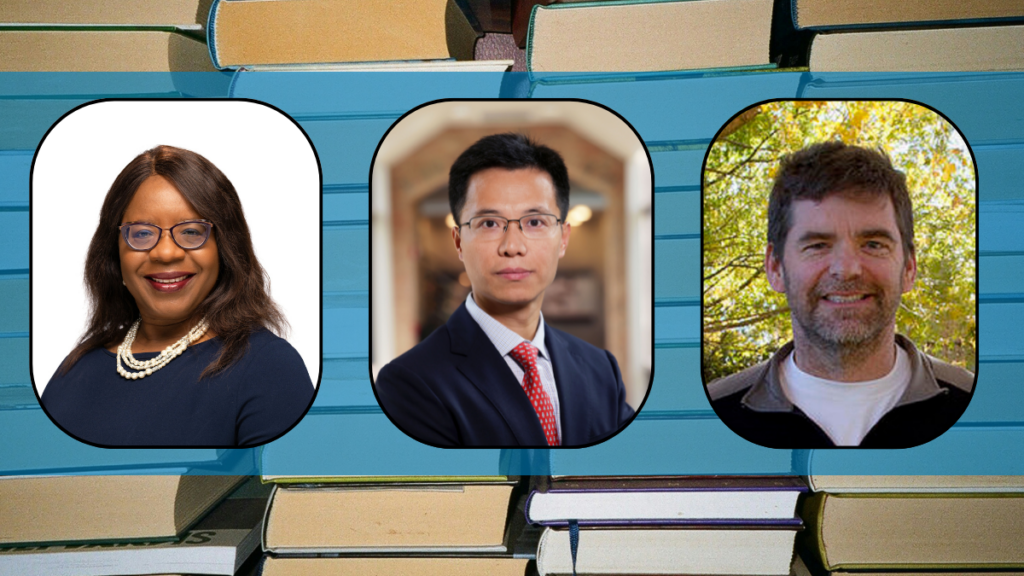
Photos of 3 members of the AGU Books Editorial Board.
Editors’ Vox is a blog from AGU’s Publications Department.

The AGU Books Editorial Board comprises researchers spanning the breath of the Earth and space sciences. From diverse perspectives comes an interdisciplinary catalog of monographs and textbooks—and collaborations between scientists whose paths might not cross otherwise.

In honor of the 70th anniversary of the AGU Books Program, we interviewed three members who have served on the Books Board since its founding in 2020: Estella Atekwana is a near-surface geophysicist and serves as a dean and professor at the University of California Davis; Xianzhe Jia is a space physicist and professor at the University of Michigan; Jim O’Connor is a research geologist with the United States Geological Survey. We asked these Editorial Board members about their favorite projects and why books remain important within the scientific literature  which is dominated by journals.

What is a memory or project that stands out from your AGU Books Editorial Board experience?
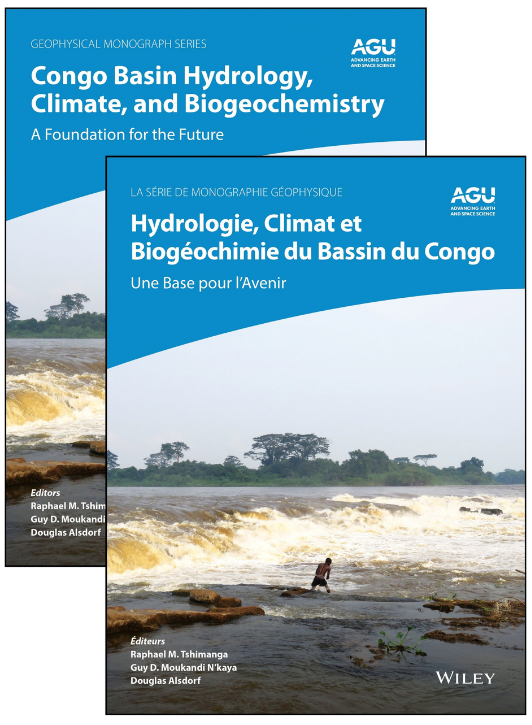
Supporting Congo Basin Hydrology, Climate, and Biogeochemistry pushed Board member Jim O’Connor to engage with new topics and geographic areas of study.

JOC: Two items stand out for me. One is one of the first books that I handled, Congo Basin Hydrology, Climate, and Biogeochemistry: A Foundation for the Future. This book was so far outside my zone (topically and spatially) yet so gratifying to be a small part of. It was really a very different book, discussing much classic hydrology but also touching on resource management and politics in an area where those topics are complicated. It was so interesting. And it was published in both English and French.

The other memory sticking with me is our early discussions on what AGU books could and should be about. The discussions were so wide-ranging (including children’s books!), and they really forced me out of what was probably a pretty narrow lane. I suppose such discussions might be expected when you put together a diverse group of scientists and give them a chance to explore what AGU books could be.
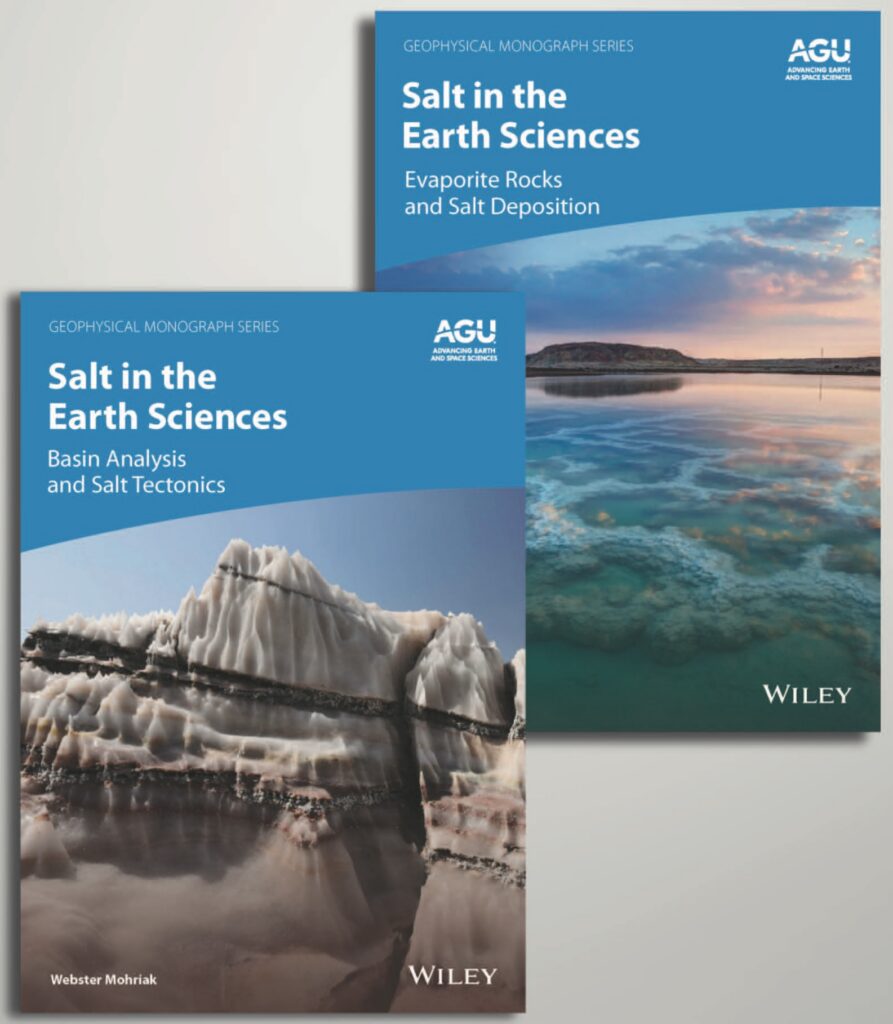
Board member Estella Atekwana saw Salt in the Earth Sciences progress from a proposal through multiple iterations and finally to a published book.

EA: One project that stands out is serving as the Subject Editor for the two-volume set Salt in the Earth Sciences: Evaporite Rocks and Salt Deposition and Salt in the Earth Sciences: Basin Analysis and Salt Tectonics by Webster Mohriak. It was a pleasure to work with Dr. Mohriak, who was thoughtful, responsive, and deeply engaged with the review process. I also developed a tremendous appreciation for the reviewers, who took the time to read the full volume carefully, sometimes through multiple iterations, and provide detailed and constructive feedback. Seeing the book move from proposal to publication was deeply rewarding. It reminded me how much care, expertise, and collaboration go into producing a high-quality scholarly book.

XJ: One project that stands out for me is a book that’s still in production. It is about exoplanets, focused on how stellar-driven space environments interact with (exo)planetary magnetic fields and atmospheres and, ultimately, shape habitability. What’s made it memorable is that the book sits right at the boundary between communities that don’t always share the same language—space physics, planetary science, and exoplanets. I’m excited for it to become a resource that helps readers move back and forth between exoplanets and our solar system with a shared comparative framework.

What is your favorite thing about serving on the AGU Books Editorial Board?

EA: When I was first asked to serve as on the AGU Books Editorial Board, I approached the role with some skepticism. I wondered why early- and mid-career faculty or scientists would choose to write books when the academic reward system often emphasizes journal articles, citation counts, and publications in high-impact journals. However, serving on the Board has changed my perspective. I have enjoyed reviewing book proposals, encouraging leaders in the field to consider writing books, and working with an editorial team that provides thoughtful support every step of the way.

My favorite thing about serving on the AGU Books Editorial Board is getting to help shape syntheses—not just what’s new, but what the community collectively understands.

Xianzhe Jia

XJ: My favorite thing about serving on the AGU Books Editorial Board is getting to help shape syntheses—not just what’s new, but what the community collectively understands. This role gives me the opportunity to work with Volume Editors and authors to turn a set of strong contributions into a coherent, usable resource, and to do that in a way that brings different subfields into the same conversation.

JOC: I suppose my favorite thing has been similar to that of being a journal editor. One is forced to confront a much wider scientific arena than that framed by one’s particular scientific discipline. Every AGU book I’ve worked with has had some element of “new and cool” that came with it.

Why are books important for Earth and space science communities? 

XJ: Scientific fields advance by connecting pieces that are often studied separately—stars and their activity, planets and their atmospheres and magnetospheres—and those connections are hard to establish from individual papers alone. A good book synthesizes what we know across those interfaces, makes assumptions and terminology explicit, and highlights where knowledge gaps exist. That’s valuable both for training new scientists and for enabling collaboration; books help researchers from different disciplines meet on common ground, especially when we’re trying to interpret sparse data and compare very different environments.

JOC: I believe that in many instances books enable better stories. The length and format freedom, particularly in relation to journal articles, allows for longer and more fully developed narratives. And I believe good storytelling is essential for communicating science. My personal experience is that books I have been a part of have much wider and long-lasting reach to a wider public than most journal articles. Though this may be changing (or already changed) in the social media age.

In many fields, a well-written book becomes the go-to reference for generations of students, researchers, and practitioners.

Estella Atekwana

EA: Books are important because they provide a trusted, comprehensive place to access knowledge on a particular topic. In many fields, a well-written book becomes the go-to reference for generations of students, researchers, and practitioners. I am reminded of the book Geodynamics by Donald Turcotte and Gerald Schubert, which was foundational to my own studies as a Ph.D. student and has remained an essential text in the field through subsequent editions. It was a special delight when I came to UC Davis to meet Professor Donald Turcotte, then Professor Emeritus in Earth and Planetary Sciences, the author of a book that had been so fundamental to my intellectual development. That experience reinforced for me the lasting impact books can have. They synthesize knowledge, broaden access, and help sustain a global scientific community.

—Dara Liling (dliling@agu.org; 0009-0005-6828-2811), American Geophysical Union, USA; Estella Atekwana (0000-0003-1424-4068), University of California Davis, USA; Xianzhe Jia (0000-0002-8685-1484), University of Michigan, USA; and Jim O’Connor (0000-0002-7928-5883), United States Geological Survey, USA
Citation: Liling, D., E. Atekwana, X. Jia, and J. O’Connor (2026), The Editorial Board marks the latest chapter in AGU Books, Eos, 107, https://doi.org/10.1029/2026EO265023. Published on 1 June 2026.
This article does not represent the opinion of AGU, Eos, or any of its affiliates. It is solely the opinion of the author(s).
Text © 2026. The authors. CC BY-NC-ND 3.0
Except where otherwise noted, images are subject to copyright. Any reuse without express permission from the copyright owner is prohibited.

  •  

7 Decades of Books Leave a Lasting Legacy

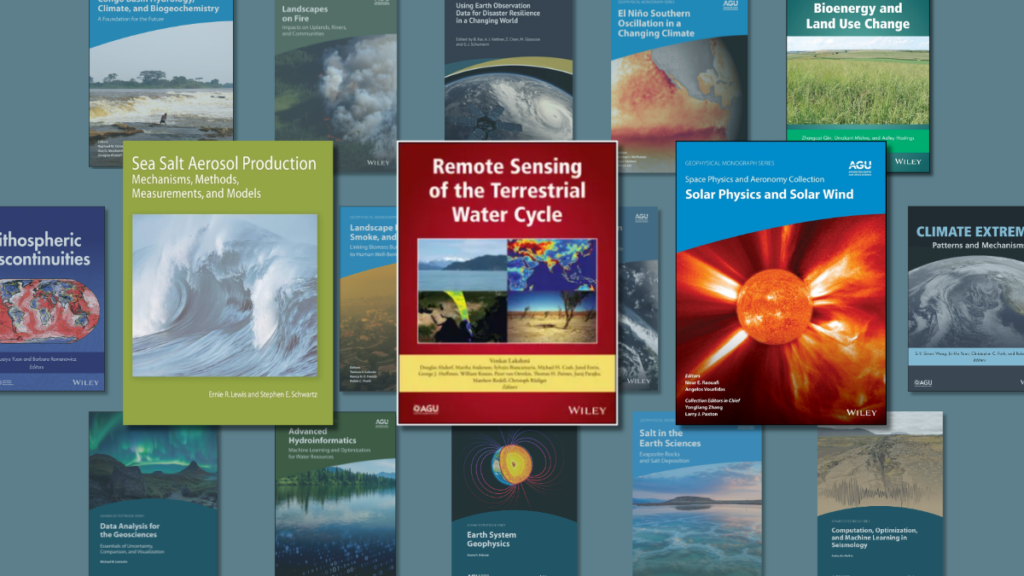
A graphic showing AGU book covers through the years.
Editors’ Vox is a blog from AGU’s Publications Department.

As the AGU Books Program celebrates its 70th anniversary in 2026, we reflect on the longevity of scientific work published in book format and the enduring nature of readership—sometimes for decades after publication. We spoke with Volume Editors and Authors of AGU books published in each of the past 3 decades about why they decided to pursue book projects and why readers are still discovering their work years later.

2000s: Filling Gaps in the Existing Research

Ernie R. Lewis and Stephen E. Schwartz decided to write a book after finding a gap in the literature when conducting their own research. Sea Salt Aerosol Production: Mechanisms, Methods, Measurements, and Models, published in 2004, explores the major influences that sea salt aerosol exerts over diverse areas of geophysics.

Why did you decide to write an AGU monograph? 

Sea salt aerosol is the dominant background aerosol in the atmosphere and the topic of Lewis and Schwartz’s 2004 book. Credit: Richard Dorrell, Wikimedia Commons

We were looking for a quality venue for publication that would lend respect to the book and could accommodate many large, complicated color figures, which were essential to the book. AGU’s Geophysical Monograph Series met these requirements.

We had been examining the literature pertinent to the production of sea salt aerosol, the dominant background aerosol in the atmosphere, to develop means of representing it in chemical transport models for aerosol influences on clouds and climate. We found major discrepancies in reported production flux (orders of magnitude) and in its dependence on controlling variables. Ultimately, we decided we needed to write a book dealing with the physical processes and comparing the numerous prior studies.

How has the study of sea salt aerosols evolved since the publication of your book?

This field has grown enormously since publication of the book in 2004, especially with new studies identifying the role of organics affecting production of aerosol particles, particle composition, hygroscopic properties, and rate of exchange of water between gas and condensed phase.

Why do you think your book continues to be of value to readers?

Perhaps the greatest strength of the book is its emphasis on processes and material properties. The chapter on fundamentals is nearly 100 pages; the chapter on measurements and models required to determine production fluxes is nearly 200 pages. The material in these chapters is essential to understanding the governing processes.

We are gratified by the continuing influence of the book, a measure of which is that the book has been cited over a thousand times, with an average annual citation rate of more than 70 over the past several years—some 20 years after publication.

2010s: Finding the Cutting Edge from AGU Events

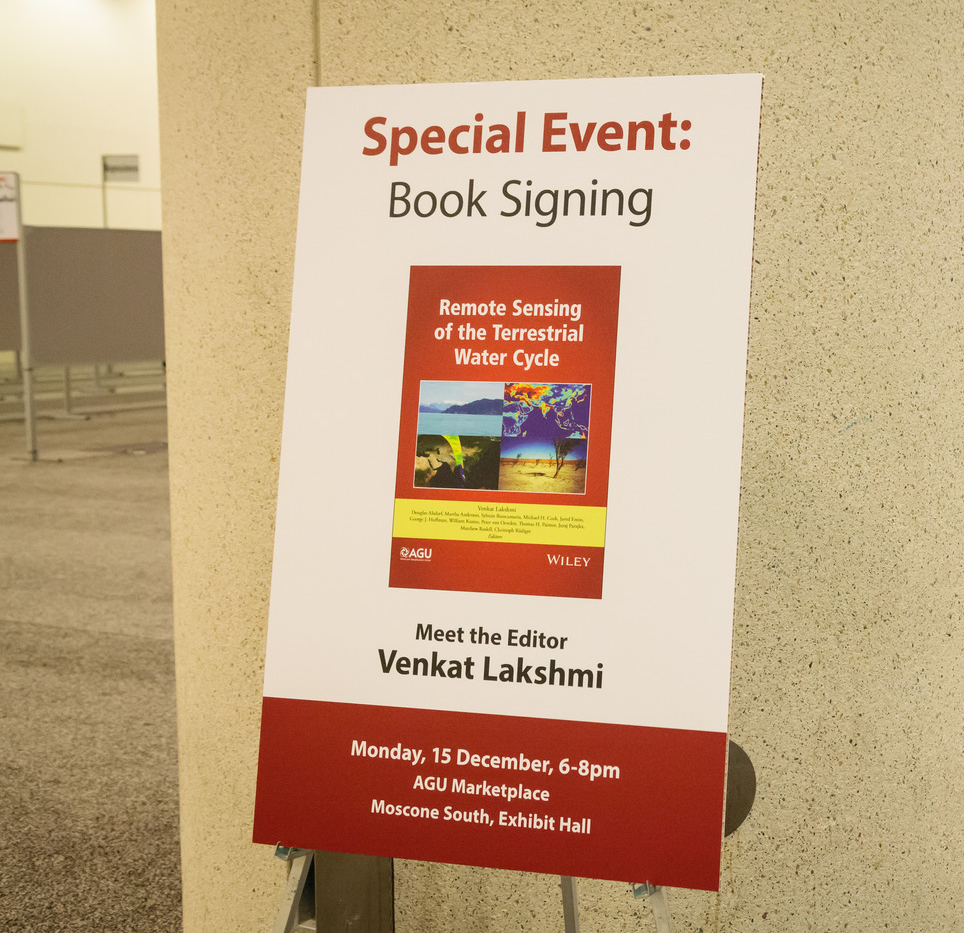
A successful 2012 AGU Chapman Conference convinced Venkataraman Lakshmi that a book was needed to document key outcomes from the conference. He went on to co-edit Remote Sensing of the Terrestrial Water Cycle, published in 2014, which examines the use of satellite data for quantifying the spatial and temporal variations in the hydrological cycle.

Why did you decide to edit a book? 

The reason to edit any book is a lack of content on the subject and that the topic is cutting-edge in the research sphere. All the books I have edited with AGU, including Remote Sensing of the Terrestrial Water Cycle, have been outcomes of either sessions organized at the AGU Annual Meeting or a Chapman Conference. The book then serves as a state-of-science for the community and is still widely read.

AGU Annual Meetings and Chapman Conferences have been integral to Lakshmi’s path as a book editor. Credit: Beth Bagley

How has the field of remote sensing as it relates to the terrestrial water cycle evolved since the publication of your book?

The field of remote sensing of the terrestrial water cycle doubles in knowledge every few years. New Earth observing missions have been launched or will be launched soon, and these missions hold promise for unraveling the mysteries of the hydrological cycle.

Why do you think your book continues to be of value to readers? 

The book captures what we can expect from Earth observing missions and sets the stage for how the science questions regarding the water cycle have evolved over the past few decades.

2020s: Building on the Success of Earlier Work

Yongliang Zhang and Larry J. Paxton, from the Johns Hopkins Applied Physics Laboratory, edited not one but five books, published in 2021. This five-volume collection, Space Physics and Aeronomy, presents the latest scientific observations, models, and theories about the Sun and the solar wind, magnetospheres in the solar system, Earth’s ionosphere, Earth’s upper atmosphere, and space weather.

Why did you decide to edit a set of books?

Following a successful AGU 2014 session on auroral dynamics to which about 60 abstracts were submitted, we were invited by editors of three publishers in the United States and Europe to edit a book on auroras. We accepted the invitation from AGU–Wiley as there was a lot of interest in auroral study in the AGU community. We submitted a proposal for a book titled Auroral Dynamics and Space Weather. The book,published in 2015, was successful and a few years later, we were invited to edit multiple books as a major reference work in the field of heliophysics. We took the opportunity and finished the five-book set in 2021.

How have space physics and aeronomy evolved since the publication of your books?

First, new satellite missions and more ground observations are available that fill some of the measurement gaps that existed when we published the books. Second, recent advances in AI capability together with increasing data volume in space physics enable a better specification of the space physics phenomena as well as space weather forecasting.

Why do you think your books continue to be of value to readers? 

These five volumes (six, counting Auroral Dynamics and Space Weather) provide, in one set, a detailed overview of the science of the space environment from the Sun to the Earth and its variability, or “space weather.” A series of books like this is invaluable as a survey of real knowledge that provides readers the opportunity to discover new insights in heliophysics.

As of early 2026, two major imperatives that drive NASA research are facilitating the space economy and supporting the Moon to Mars initiative with an emphasis now on supporting the return to the Moon. Heliophysics, the focus of our books, enables the outward journey to near-Earth space, the Moon, and beyond. Scientists at all stages in their careers are sure to find in these six volumes useful insights that they can use to address new NASA funding opportunities.

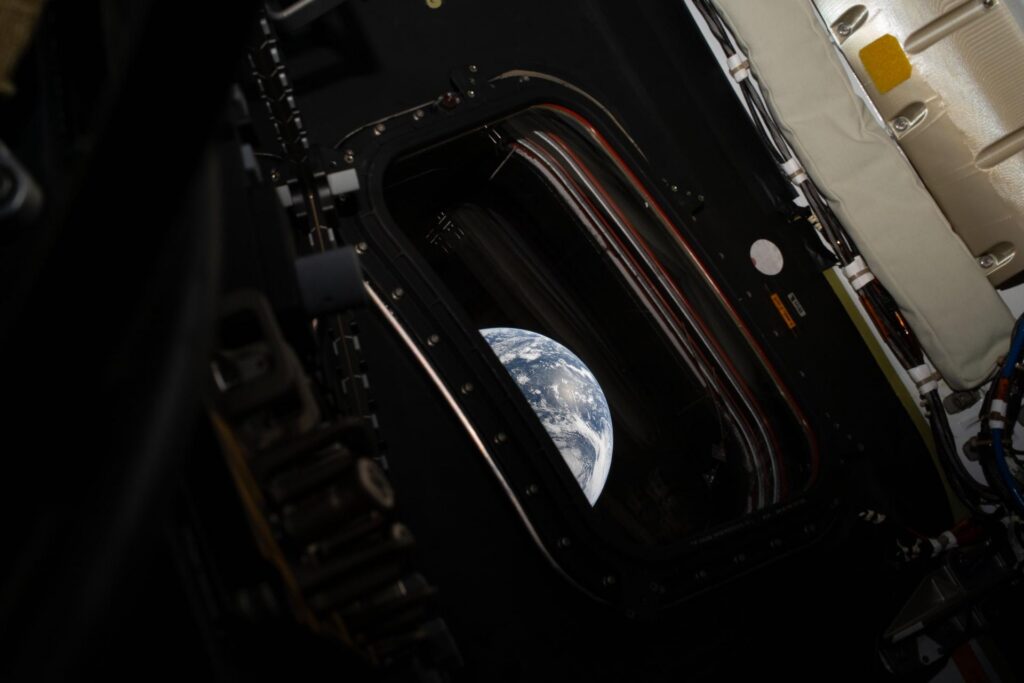
Heliophysics, the focus of Paxton and Zhang’s set of books, is essential to new NASA missions. A view of Earth taken by NASA astronaut and Artemis II commander Reid Wiseman from the Orion spacecraft in April 2026. Credit: NASA

These three experiences are just a snapshot of the more than 750 volumes published by AGU Books since the 1950s. While the methods and technologies used in scientific research have evolved dramatically, as has the process and formats for publishing books, the need for volumes covering the breadth of Earth and space sciences remains strong. The AGU Books Program has proven that books—whether the outcome of a gap discovered in the literature, a popular conference session, or the success of previous works—have a lasting place in the ecosystem of scientific publishing.

—Dara Liling (dliling@agu.org, 0009-0005-6828-2811), American Geophysical Union, USA; Venkataraman Lakshmi (0000-0001-7431-9004), University of Virginia, USA; Ernie R. Lewis (0000-0002-2023-7406), Brookhaven National Laboratory, USA; Larry J. Paxton (0000-0002-2597-347X), Johns Hopkins University Applied Physics Laboratory, USA; Stephen E. Schwartz (0000-0001-6288-310X), Stony Brook University, USA; and Yongliang Zhang (0000-0003-4851-1662), Johns Hopkins University Applied Physics Laboratory, USA

Citation: Liling, D., V. Lakshmi, E. R. Lewis, L. J. Paxton, S. E. Schwartz, and Y. Zhang (2026), 7 decades of books leave a lasting legacy, Eos, 107, https://doi.org/10.1029/2026EO265024. Published on 3 June 2026.
This article does not represent the opinion of AGU, Eos, or any of its affiliates. It is solely the opinion of the author(s).
Text © 2026. The authors. CC BY-NC-ND 3.0
Except where otherwise noted, images are subject to copyright. Any reuse without express permission from the copyright owner is prohibited.
  •  
❌