The NFL is complying with an investigation by Attorney General James Uthmeier (R) over whether the league violated its "Rooney Rule" on head coach hirings. “I think we have been very clear about our programs, and we obviously evaluate them all the time, not just for how they get better, but also to make sure that...
The NFL is complying with an investigation by Attorney General James Uthmeier (R) over whether the league violated its "Rooney Rule" on head coach hirings. “I think we have been very clear about our programs, and we obviously evaluate them all the time, not just for how they get better, but also to make sure that...
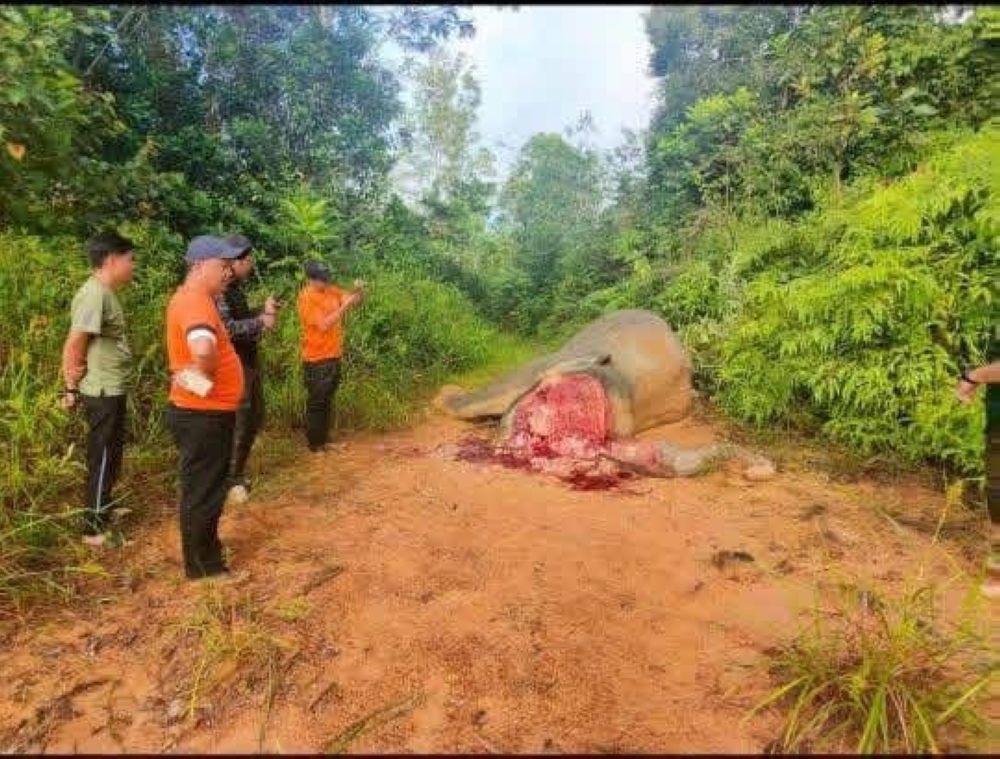
KOTA KINABALU, May 19 — Sabah authorities are investigating the death of a Bornean elephant found mutilated in a forest reserve in Tongod, believed to be linked to ivory poaching.State Tourism, Culture and Environment Minister Datuk Jafry Ariffin said he was deeply concerned by the discovery of the dead elephant within the nursery forest area of the Sungai Pinangah Forest Reserve.According to reports, the Kinabatangan Wildlife team received a complaint at approx
KOTA KINABALU, May 19 — Sabah authorities are investigating the death of a Bornean elephant found mutilated in a forest reserve in Tongod, believed to be linked to ivory poaching.
State Tourism, Culture and Environment Minister Datuk Jafry Ariffin said he was deeply concerned by the discovery of the dead elephant within the nursery forest area of the Sungai Pinangah Forest Reserve.
According to reports, the Kinabatangan Wildlife team received a complaint at approximately 8.25am on May 18, 2026 regarding a dead elephant suspected to be linked to wildlife crime.
A field inspection was conducted the same day at 12.13pm at the incident site within the nursery forest area in Sungai Pinangah Forest Reserve, Tongod.
A male Bornean elephant (Elephas maximus borneensis), measuring approximately 2.9 metres in height with a footprint size of 1.45 metres, was found with its face and mouth cut in an L-shaped pattern using sharp tools, while the tusks were missing and suspected to have been removed.
Initial inspections also found cut marks on the head area.
According to investigations, estate staff in Tongod had on May 17 at about 5.30pm heard a loud explosion-like sound. However, inspection efforts could not be carried out immediately due to continuous heavy rainfall throughout the night.
At 6.30am the following morning, the estate manager together with staff conducted monitoring activities and discovered the dead elephant.
At this stage, no gunshot wounds were detected on the body parts examined, although a full examination of the animal is still ongoing. Heavy rainfall during the suspected period also made it difficult for investigators to identify tracks and evidence at the scene.
“The exact cause of death has yet to be determined and a post-mortem examination together with further investigations will now be carried out by the Sabah Wildlife Department,” said Jafry.
“I wish to stress that if investigations confirm the involvement of poaching activities, illegal ivory removal or other wildlife offences, firm action without compromise must be taken against those responsible,” he said.
“The Bornean elephant is one of Sabah’s most iconic and protected wildlife species and remains an important component of the state’s biodiversity and conservation efforts. Any act threatening its survival must be treated seriously.
“We cannot allow Sabah to become a ground for wildlife crime. Every loss of a protected species is a loss to our natural heritage and the future of Sabah’s biodiversity.”
Mohamed Mahudhee suffered decompression sickness after searching for scuba divers in Vaavu Atoll and died in hospitalA Maldivian military diver has died during a high-risk operation to recover the bodies of four of the Italian scuba divers who drowned while exploring a deep underwater cave in the Maldives.The diver suffered underwater decompression sickness after searching for the bodies of the Italians who, according to Italy’s foreign ministry, had “apparently died while attempting to explore
Mohamed Mahudhee suffered decompression sickness after searching for scuba divers in Vaavu Atoll and died in hospital
A Maldivian military diver has died during a high-risk operation to recover the bodies of four of the Italian scuba divers who drowned while exploring a deep underwater cave in the Maldives.
The diver suffered underwater decompression sickness after searching for the bodies of the Italians who, according to Italy’s foreign ministry, had “apparently died while attempting to explore caves at a depth of 50 metres (164ft)”.
Following the successful ten-year run of the Ontario Reptile and Amphibian Atlas, Ontario Nature developed a Long-Term Monitoring Protocol (LTMP) to fill important knowledge gaps about Ontario’s common and at-risk snakes. Since 2019, we’ve expanded the LTMP from nine monitoring locations to over 60 sites across the province! We recently published a Story Map where you can learn all about this project and how to get involved.
The Long-Term Monitoring Protocol (LTMP)
Ontario Nature’s Long-Te
Following the successful ten-year run of the Ontario Reptile and Amphibian Atlas, Ontario Nature developed a Long-Term Monitoring Protocol (LTMP) to fill important knowledge gaps about Ontario’s common and at-risk snakes. Since 2019, we’ve expanded the LTMP from nine monitoring locations to over 60 sites across the province! We recently published a Story Map where you can learn all about this project and how to get involved.
The Long-Term Monitoring Protocol (LTMP)
Ontario Nature’s Long-Term Monitoring Protocol (LTMP) for snakes was launched in 2019. It uses standardized survey methods across a large geographic area to help improve our understanding of snake populations, detect changes over time, and guide conservation efforts. The LTMP brings together First Nations, scientists, landowners and volunteers to monitor snakes across the province, using plywood boards placed within snake habitat.
Sites conducting snake surveys using the Long-Term Monitoring Protocol. Sites in darker green have been part of the project for longer; sites in lighter green have joined the project more recently.
Help us monitor snakes!
You can participate in snake surveys as a volunteer or set up a new snake monitoring site! Many of the existing sites are monitored by volunteers and may be looking for more people to help with surveys. If you have access to land with suitable snake habitat, you could set up your own site with plywood boards, survey for snakes, and contribute data to our province-wide database.
Ontario’s 2026 Budget, A Plan to Protect Ontario, arrives with familiar promises of economic resilience and infrastructure growth. But beneath the surface, a persistent gap remains: meaningful investments in nature. Similar to last year’s budget, the province continues to ignore the importance of biodiversity and nature to economic resilience, community well-being and Ontario’s long-term prosperity.
Recommendations Still Being Ignored
In 2025, Ontario Nature raised concerns that the provincia
Ontario’s 2026 Budget, A Plan to Protect Ontario, arrives with familiar promises of economic resilience and infrastructure growth. But beneath the surface, a persistent gap remains: meaningful investments in nature. Similar to last year’s budget, the province continues to ignore the importance of biodiversity and nature to economic resilience, community well-being and Ontario’s long-term prosperity.
The unified message was clear: protecting and restoring nature is not a barrier to economic growth but is a foundation for it. Yet the 2026 budget does not meaningfully respond to these recommendations. Our recommendations presented a clear path forward – strategic investments in nature can strengthen our economy, protect communities and reduce long-term costs.
Investing in Protected Areas Creates Jobs and Boosts the Economy
Ontario remains well behind the pace required to meet the national goal of protecting 30 percent of lands and water by 2030. With just over 11 percent currently protected, the province risks falling further behind without a significant redirection in its course. A clear solution remains unprioritized: investing in protected areas is not only an environmental imperative, but an economic strategy. A coordinated annual investment of $60 million to expand Ontario’s protected areas network, particularly on Crown land, would help close this gap and support regional land use planning to protect high biodiversity and cultural value areas from industrial development.
Expanding protected area networks invests in nature-based recreation job opportunities, boosting our economy alongside protecting valuable areas. Across Canada, nature-based recreation creates over one million jobs and generates $101.6 billion in economic activity annually, not including the many additional ecosystem services that nature provides such as absorbing carbon, offsetting flood risks and improving air quality.
Despite these benefits, the 2026 budget does not significantly expand investments in wetland conservation, leaving communities exposed to rising costs.
Ontario’s 2026 budget speaks the language of resilience and protecting Ontario, but it fails to invest in the natural systems that make resilience possible. It seems that most Ontarians are not convinced the government is “protecting Ontario” based on recent polling. Until this changes, the province will continue to take on higher costs, greater risks and missed opportunities.
While provinces across Canada begin implementing meaningful conservation plans, Ontario is falling behind. Rather than weakening environmental protections and shifting the costs of conservation onto communities, the provincial government must commit to sustained, long-term investments in nature.
Protecting nature protects all of us. Stay informed, contact your MPP, and demand better protections for Ontario’s lands and waters. You can also take action today by signing one of Ontario Nature’s Action Alerts.
At one point, the Pacific Northwest lost three square miles of old-growth forest every week to clearcutting. Now, the Trump administration is returning to this practice.
In February 2026, the Bureau of Land Management (BLM) proposed changes to management plans for nearly 2.5 million acres of Oregon forests. The goal is to increase timber production fourfold and remove protections for old-growth forests and the endangered species that rely on them.
This proposal comes at a time when science is re
At one point, the Pacific Northwest lost three square miles of old-growth forest every week to clearcutting. Now, the Trump administration is returning to this practice.
In February 2026, the Bureau of Land Management (BLM) proposed changes to management plans for nearly 2.5 million acres of Oregon forests. The goal is to increase timber production fourfold and remove protections for old-growth forests and the endangered species that rely on them.
This proposal comes at a time when science is revealing even more about the importance of these forests. They are some of the best carbon-storing ecosystems on Earth, vital reservoirs of biodiversity, and essential for the communities nearby. If lost, they cannot be replaced within any human lifetime.
What Is an Old-Growth Forest?
Researchers first used the term in the 1970s to describe complex, biodiverse forests at least 150 years old. Still, there is no single definition for “old growth.” In the U.S., a federal rule protects trees over 21 inches in diameter in six national forests, where most old-growth forests are found. Many environmentalists define old growth as any forest that has never been logged. All definitions focus on complexity: old-growth forests have layered canopies, fallen logs in different stages of decay, and an understory full of fungi, ferns, and centuries of stored soil carbon.
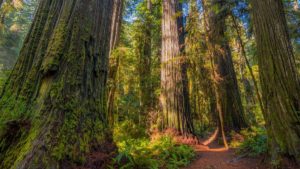
In western Oregon, this complexity shows in Douglas fir and western red cedar trees that grow up to 200 feet tall, covered in moss so thick it hides their trunks. Even today, these forests are among the most productive timberlands in the world.
The Carbon Case, Revised and Strengthened
It was once believed that only young forests accumulated carbon while old forests merely stored it. Scientists now know that is wrong. A landmark global analysis of 519 forest carbon-flux estimates found that in forests aged 15 to 800 years, net carbon balance is usually positive. Old forests keep sequestering — they are not neutral.
A 2024 study in AGU Advances compared old-growth forests in the Pacific Northwest to younger managed forests. It found that old-growth forests produce more biomass for each unit of water used, keep storing carbon even as they age, and are much more resilient to drought than replanted forests. This resilience is especially important as Oregon faces hotter, drier summers, making the drought-buffering ability of old-growth forests just as valuable as their carbon storage.
A 2025 study in Science of the Total Environment found that mature and old-growth forests are better than younger forests at tackling both climate change and biodiversity loss at the same time. Plantations and second-growth timber stands cannot match these benefits.
The numbers show that cutting down old-growth trees is a bad idea. Bev Law, professor emerita at Oregon State University, told reporters that bringing BLM harvests back to 1 billion board feet a year, as the Trump administration aimed for in 2019, would be “insanity.” These forests can live for thousands of years. The carbon stored in their wood and soil stays out of the atmosphere and keeps building up over time.
Oregon Becomes a Battleground
The main threat from the Administration is focused on western Oregon’s O&C Lands. These lands, once granted to the Oregon and California Railroad, were returned to federal ownership in 1916 and now cover about 2.5 million acres across 17 counties managed by the BLM. In the 1960s, annual timber harvests often topped 1 billion board feet, reaching a peak of 1.638 billion in 1964. Harvests dropped sharply in the 1990s after the northern spotted owl and marbled murrelet were listed as threatened, and the Northwest Forest Plan shifted management toward conservation.
In February 2026, Trump’s BLM announced plans to revise management for these lands, aiming to bring timber production back to pre-1990 clear-cutting levels. The proposal covers all 2.5 million acres across 17 counties, including well-known areas such as the Sandy River watershed, North Fork Clackamas, the Valley of the Giants, the Upper Molalla River, and Alsea Falls. Since 2000, harvests have ranged from 45 to 275 million board feet per year. The new plan would raise that to 1 billion board feet.
The public comment period closed March 23, 2026; a record of decision is tentatively scheduled for February 12, 2027. That timeline could outlast the current administration, but the proposal, once formally proposed, would constrain future management options. The idea is to strip away environmental protections for salmon and drinking water and fire and fuels to maximize timber extraction across public lands in western Oregon, said George Sexton, conservation director for KS Wild.
The Roadless Rule and the Bigger Picture
The BLM proposal is part of a larger rollback. In August 2025, USDA Secretary Brooke Rollins announced that the Trump administration plans to end the 2001 Roadless Rule. This Clinton-era rule bans road building, logging, and mining on about 58 million acres of federal forest land, including 2 million acres in Oregon. Rollins described the rule as burdensome, outdated, and one-size-fits-all.
Environmental groups immediately promised litigation. “If the Trump administration actually revokes the roadless rule, we will see them in court,” said Earthjustice attorney Drew Caputo. Oregon Rep. Andrea Salinas introduced the Roadless Area Conservation Act in June 2025 to codify the rule into law, drawing nearly 50 House cosponsors.
In early 2025, Trump signed two executive orders telling agencies to speed up timber sales and avoid environmental reviews for more than 400 threatened and endangered species, such as wild salmon, marbled murrelets, and spotted owls. A Republican budget bill passed in the Senate also required the Forest Service to increase timber production by at least 250 million board feet each year and to sign 20-year logging contracts, regardless of the environmental impact.
Worth More Standing
There is a real economic case for logging, but it has limits. Many Oregon counties have struggled financially since logging declined in the 1990s, and timber revenue is important for rural budgets. However, industry representatives admit that most mills can no longer handle large old-growth logs. Technology now focuses on smaller and medium-sized wood, according to Amanda Sullivan-Astor of the Associated Oregon Loggers. The economic setup for harvesting old-growth trees is missing, even before considering legal challenges that could delay any plans for years.
The value of old-growth forests goes far beyond timber, and this is not reflected in timber prices. These forests support a huge variety of life, including not just spotted owls and murrelets, but also salmon, elk, bears, rare fungi, and plants that cannot survive even in plantations of the same species. Old-growth forests help manage water, protect drinking supplies, prevent erosion and landslides, and shield nearby communities from wildfires. This is the opposite of what the BLM claims clearcutting would do. In fact, the BLM’s own research has shown that clearcutting old-growth rainforests actually increases fire risk.
The fungal networks under the forest floor are getting more attention from scientists and in popular books. These networks add another layer of complexity that cannot be replaced. Scientists are still learning how trees use these fungal connections to share nutrients and chemical signals over many years. These systems take centuries to form and cannot be recreated in plantations.
Any unknown benefits that old-growth forests might offer will be lost forever, all for about $1,000 per centuries-old tree, the current price for old-growth timber.
What You Can Do
The BLM’s process for revising O&C Lands management is still ongoing. Although the public comment period ended in March 2026, the Environmental Impact Statement process is still underway, and legal challenges are almost certain. Here are some ways you can stay involved:
Contact your federal representatives about the Roadless Area Conservation Act and urge them to cosponsor legislation making the Roadless Rule permanent law.
Support the Old-Growth Forest Network, which works to designate protected native forests in every county in the U.S.
Visit and spend time in public lands. Your presence and spending as a visitor help show the value of forests beyond timber, which is important for land use planning.
If you live in a county with O&C Lands, go to local commissioner meetings where timber revenue is being discussed. While logging does bring in money, there are also strong financial reasons to keep forests intact, protect clean water, and support outdoor tourism.
Rabbits and hares are often overlooked, even though they are a crucial part of our ecosystems serving as a key food source for many species and even an indicator of climate change.
“Poor rabbits. It’s the exact reason I started rehabbing them, because I felt sorry for them,” says Tallulah, founder of My Wildlife Rescue, the only authorized wildlife custodian in Ontario that specializes in rehabilitating neonatal and juvenile wild rabbits and hares. “Other animals have the ability to defend the
Rabbits and hares are often overlooked, even though they are a crucial part of our ecosystems serving as a key food source for many species and even an indicator of climate change.
“Poor rabbits. It’s the exact reason I started rehabbing them, because I felt sorry for them,” says Tallulah, founder of My Wildlife Rescue, the only authorized wildlife custodian in Ontario that specializes in rehabilitating neonatal and juvenile wild rabbits and hares. “Other animals have the ability to defend themselves.”
Tallulah, who opened her rescue in 2018, suggests there are two reasons that rabbits and hares are underrated animals: people see rabbits as common and often assume wild native rabbits and domestic rabbits are similar, so they lose interest in learning about wild ones. “Basically, they are just seen as common, and you can just get [a domestic] one in the store,” she says.
And unlike bears, lynx and wolves, “They aren’t charismatic megafauna…Humans like to learn about predators, I don’t know why, but it seems like something we can relate to,” Tallulah hypothesizes, “They are also very hard to study because they are small, quiet and active at dusk and dawn.”
Although largely understudied in Ontario, Tallulah argues that native rabbits and hares are sensitive indicators of climate change. Droughts, for example, can drastically reduce rabbit litters mid-summer, as extreme heat stresses mothers, limits food, and increases mortality among kits. “Last year, we had loads of babies in the spring, then nothing in the middle of the summer, and it picked up again in the fall,” says Tallulah, reflecting how a summer drought directly affects rabbit populations.
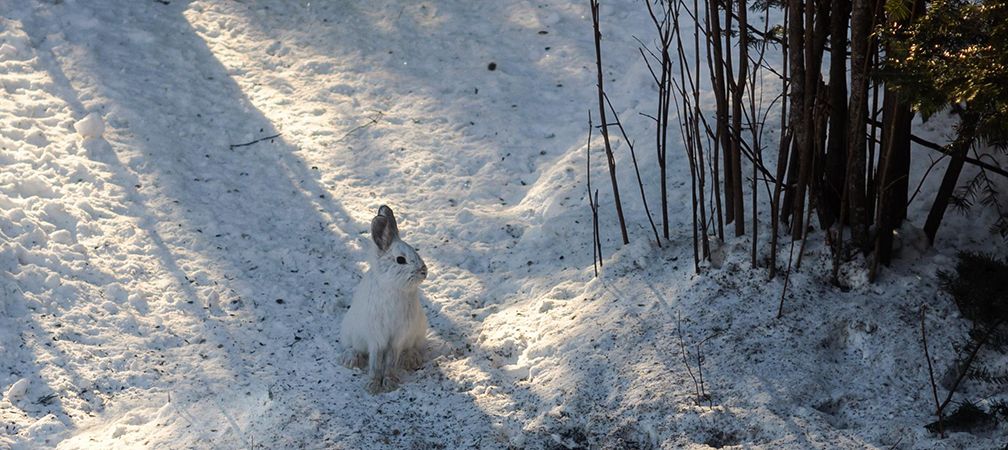
Snowshoe hares face another challenge: their fur changes colour based on day length, not snow cover. With winters arriving later and ending earlier, the white hares stand out against snowless ground, making them more vulnerable to predators. Changes in populations and survival rates of these animals reflect the broader impacts of shifting weather patterns.
Because wild rabbits and hares are often not seen as having economic value, rescues that care for them tend to receive limited public or government support and fewer donations. This is unfortunate, as species like the snowshoe hares form a crucial part of the food web. “They basically feed everybody. For example, the Canada lynx lives and dies by the cycle of the snowshoe hare. If there are very few hares, there will be very few lynx because that’s usually what they eat.”
At her Ottawa-based rescue, Tallulah cares for two of Ontario’s most common young rabbits (kits) and hares (leverets): Eastern cottontails and snowshoe hares. In total, Ontario is home to five species, including the white-tailed jackrabbit, Arctic hare in the far north, and the non-native European hare, which was introduced over a century ago but is rarely seen today. Chances are that the Eastern cottontail and snowshoe hare are the two you’ll most likely spot in the wild.
The Main Difference Between Rabbits and Hares
If you come across a young rabbit or hare, these key differences can help you identify them:
Rabbits are born blind, hairless, and completely helpless. They grow fur and open their eyes around seven to eight days old. Eastern cottontail rabbits build small nests, shallow indentations in the grass lined with fur and vegetation.
Hares are born with fur, with their eyes open, and are ready to move. Snowshoe hares do not burrow; instead, their leverets are born in the open. Within a day, the young start exploring and hiding, though they remain near the birthplace because the mother returns twice daily to feed them, similar to Eastern cottontails. Additionally, mature hares fur changes colour with seasons, helping them blend into their environment.
How to Help Rabbits and Hares
“Everybody can do something [to help rabbits and hares this spring],” says Tallulah. Here’s what she recommends:
Let grass grow the entire season, from early spring until late fall. Avoid mowing certain areas as tall grass provides food, cover and nesting spots. Mowing grass risks destroying nests and hurting or killing the kits and leverets.
For adult rabbits and hares living in the wild, provide clean water, not food. Never feed or attempt to tame wild rabbits and hares.
Plant native vegetation. Include extra vegetables in your garden for the rabbits instead of chasing them or letting pets harass them. “They don’t have a grocery store they can go to. Be kind,” says Tallulah.
Keep pets in check: Leash dogs and keep cats indoors or build a catio to protect wildlife.
Avoid rodenticides. Hire professionals that use humane ways to capture animals and keep harmful chemicals out of the food chain.
For wild rabbits and hares that need help, contact a wildlife centre that takes in rabbits. Tallulah also warns that domestic rabbits should never be released into the wild. Their bright colours make them easy targets for predators, and they lack the camouflage, instinct and hardiness of wild rabbits and hares. Additionally, they are too friendly towards humans and pets and the harsh climate is fatal for them. Released domestic rabbits often die quickly from starvation, predation or disease. Contact a rabbit rescue like https://rabbitrescue.ca/ or use this rabbit rescue resource page https://wabbitwiki.com/wiki/Ontario to rehome an unwanted pet.
“How about doing a moth survey at Sydenham?”
“A moss survey?” Asked Roberta Buchanan, local property steward for Sydenham River Nature Reserve, who didn’t quite hear me while we were walking outside.
“No, moths. Like a nocturnal equivalent to the butterfly survey. Who knows what we’ll find?”
It was 2023. I knew how unique the reserve was through my involvement with the annual butterfly and breeding bird surveys, and I suspected this oasis of biodiversity had fantastic potential for moths.
C
“A moss survey?” Asked Roberta Buchanan, local property steward for Sydenham River Nature Reserve, who didn’t quite hear me while we were walking outside.
“No, moths. Like a nocturnal equivalent to the butterfly survey. Who knows what we’ll find?”
It was 2023. I knew how unique the reserve was through my involvement with the annual butterfly and breeding bird surveys, and I suspected this oasis of biodiversity had fantastic potential for moths.
Compared to their diurnal counterparts, moths are relatively under-surveyed. Most species are nocturnal and inconspicuous, and documenting them requires specialized survey techniques – sheets and live traps baited with light or food. It also requires dedicated surveyors willing to stay up all night!
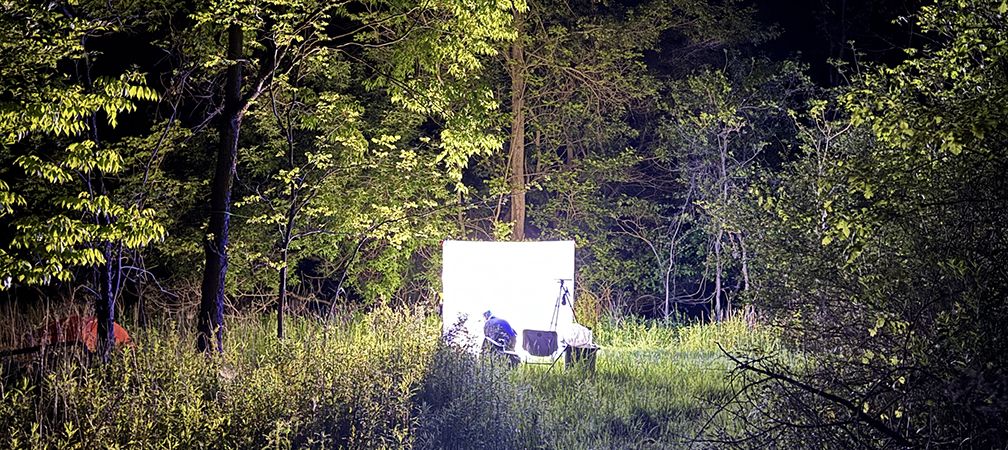
On the evening of June 24, 2024, a team of volunteers (Roberta Buchanan, Mark Buchanan, Paul Carter, Pete Chapman, Scott Connop, Deryl Nethercott, Dale Buchner, and myself) from Lambton Wildlife set up two light sheets and two traps across the Sydenham River Nature Reserve property. We documented hundreds of individual moths well into the night, and even more when we opened the traps the following morning. Then came the real fun: sorting through thousands of photos and identifying every moth.
Identifying all these moths is no trivial task. There are over 3,000 species of moths in Ontario, so field guides include only the most common species. Encountering moths that aren’t in the guide is common, and several groups of moths are notoriously hard to identify, even for experienced moth-ers. My approach is to photograph every moth, upload these photos to iNaturalist with my tentative ID, and wait for confirmation by a moth expert. For those who don’t know, iNaturalist is an online platform where you can post photos or recordings of an organism and crowdsource identifications from experts all over the world.
To keep track of the growing species list, I created an iNaturalist project which automatically consolidates all the moth observations from the property. The strength of this approach is that it stays current, as taxonomic changes and revised identifications will update the species list automatically. This makes it more reliable over time than a static checklist, which inevitably becomes outdated. As of 2026, we have documented 196 species of moth that first night, 13 of which are considered vulnerable at some level. After a second survey in May 2025, the total moth species count at Sydenham River Nature Reserve stands at 328, including 30 vulnerable species.
Fast forward to July 2025. I was checking my iNaturalist and saw there was a comment on one of my moth observations from the 2024 survey. Someone disagreed with my identification of what I believed to be a common white-fringed emerald, suggesting instead a species I hadn’t heard of – a Tuscarora emerald.
I quickly checked the range map, and my excitement spiked: this was a very rare moth, with only about fifty observations, all from the eastern United States – mostly localized populations in the Appalachians. If this was actually a Tuscarora emerald, it would likely represent the first record for Canada.
The identifier, Daniel Kluza (d_kluza on iNaturalist), a New Zealand-based biologist and iNaturalist taxonomy curator, pointed out a critical detail: our moth lacked the pure white spot on top of the abdomen which is present on the white-fringed emerald. This was a subtle difference, but potentially a decisive one. I needed a second opinion.
I reached out to Seabrooke Leckie, co-author of the Peterson Field Guide to Moths of Northeastern North America, and asked what she thought of it. Her response was unequivocal:
“I pulled out the Moths Of North America fascicle for this group to have a look at the official description of both species, Tuscarora and White-fringed, and I agree that this is Tuscarora. What a find!… Besides the presence/absence of the white spot at the base of the abdomen, the fascicle also says the white costa is very narrowly bordered inwardly by an apricot colour, and the AM and PM lines are wider than in White-fringed, both of which appear present here. There are no other eastern species that have both the white fringe and no markings on the abdomen.”
What makes this record especially meaningful is not just the rarity of Tuscarora emerald, but the way in which it was found. It was the result of methodical work by a team of volunteer community scientists, combined with the expertise of moth specialists. Not too long ago, access to such expertise was a significant roadblock, but it’s now easily facilitated through platforms such as iNaturalist.
We don’t know if this observation represents a previously overlooked population, a vagrant individual, or a northern range expansion driven by climate change. What is clear, however, is that protected places like Sydenham River Nature Reserve continue to demonstrate their conservation value in unexpected ways. When we take the time to look closely and collaboratively at under-surveyed groups like moths, we reveal hidden layers of biodiversity, uncovering the true richness of landscapes we thought we already knew.

 Login
Login