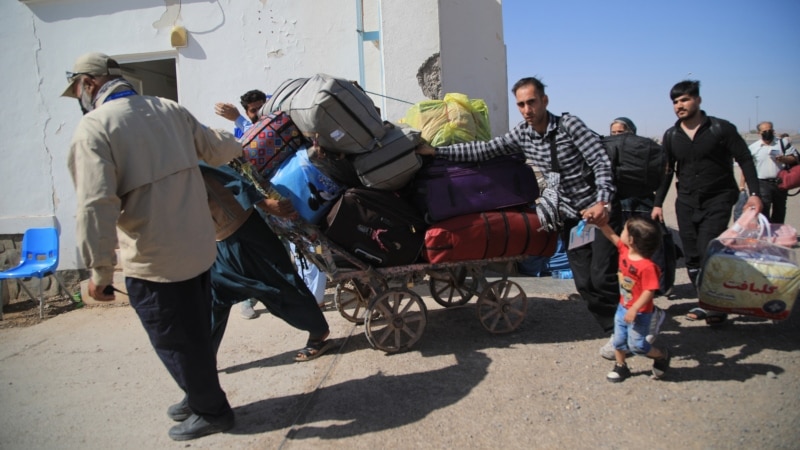
As Iran struggles with the economic fallout from months of conflict, Afghan refugees and migrant workers in the Islamic republic say they are paying a disproportionate price.
As Iran struggles with the economic fallout from months of conflict, Afghan refugees and migrant workers in the Islamic republic say they are paying a disproportionate price.
Pratt dropped to third with 25.8% of the vote as he was beaten to the runoff by incumbent Mayor Karen Bass and progressive Nithya Raman when AP called the race.
Pratt dropped to third with 25.8% of the vote as he was beaten to the runoff by incumbent Mayor Karen Bass and progressive Nithya Raman when AP called the race.
Russia warned Kyiv-based diplomats and representatives of international organizations to prepare to evacuate the Ukrainian capital, saying its forces would launch a "massive" missile attack against the city if Ukraine disrupted its May 9 World War II commemorations.
Russia warned Kyiv-based diplomats and representatives of international organizations to prepare to evacuate the Ukrainian capital, saying its forces would launch a "massive" missile attack against the city if Ukraine disrupted its May 9 World War II commemorations.
Ukraine launched hundreds of drones at targets across Russia, including scores over the St. Petersburg region, on the final day of Russia’s most important investment forum.
Ukraine launched hundreds of drones at targets across Russia, including scores over the St. Petersburg region, on the final day of Russia’s most important investment forum.
Source: Journal of Geophysical Research: Planets
Orbital imaging has hinted that Mars may have carbon-containing rocks called carbonates on its surface. Carbonates on Mars could offer new insights into how water interacted with rock on the Red Planet, helping scientists learn more about its past. In addition, because carbonates on Earth are primarily produced by living organisms, these rocks are high-value targets in the search for signatures of past life on Mars.
NASA’s Perseverance rove
Orbital imaging has hinted that Mars may have carbon-containing rocks called carbonates on its surface. Carbonates on Mars could offer new insights into how water interacted with rock on the Red Planet, helping scientists learn more about its past. In addition, because carbonates on Earth are primarily produced by living organisms, these rocks are high-value targets in the search for signatures of past life on Mars.
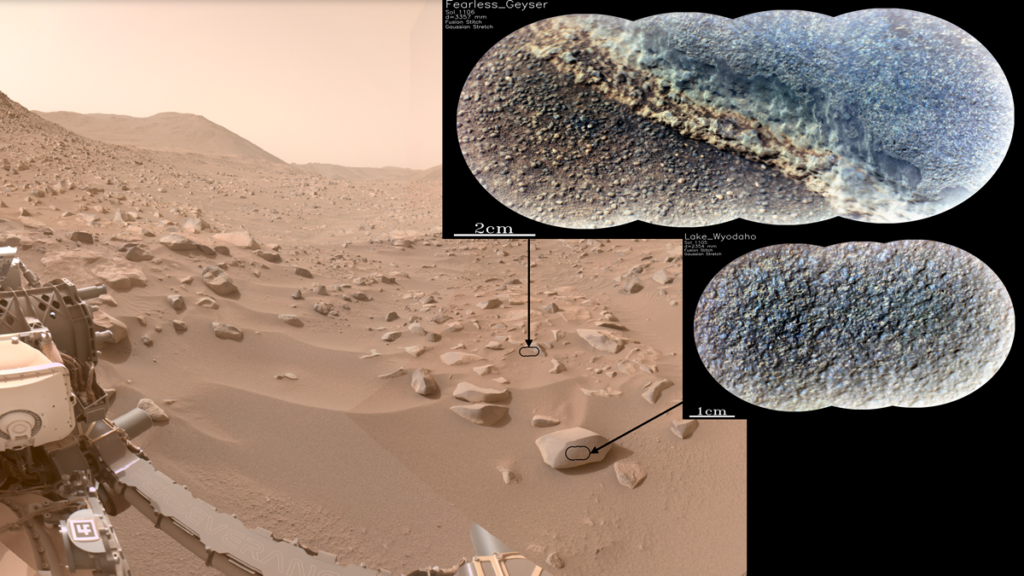
NASA’s Perseverance rover has been traversing Mars since 2021, covering more than 41 kilometers, much of it within Jezero Crater in the Nili Fossae region. Previous orbital data indicated the crater contains carbonates, as well as abundant olivine, which can change to carbonate in the presence of water and carbon dioxide. Now Clavé et al. have analyzed spectroscopic data from Perseverance’s SuperCam instrument suite from multiple locations within Jezero Crater, providing clear evidence of carbonates on Mars, as well as detailed information on how the mineralogy varies between locations.
The authors confirmed the presence of both carbonates and olivine-bearing rocks throughout Jezero Crater and found a generally inverse relationship between the two minerals. By contrast, carbonates were generally positively correlated with the presence of hydrated silica. The researchers hypothesize that an ancient lake in the crater, along with potential hydrothermal activity, played a role in transforming olivine to carbonate. The varying amounts of carbonate and different alteration states seen today may have been caused by changing lake levels on Mars billions of years ago, the researchers suggest.
Amounts of carbonate by weight vary between locations, from 1%–3% in the Séítah unit to 6%–16% in the Eastern Margin Unit. Extrapolating to the entire regional olivine-rich unit, the researchers calculated it could contain as much as 1.1 × 10¹⁴ kilograms of carbon, or up to 0.4% of the current total mass of the Martian atmosphere. Overall, Mars’s crust could contain significant amounts of carbon, implying that widespread carbon sequestration may have cooled the planet significantly in the past. (Journal of Geophysical Research: Planets, https://doi.org/10.1029/2025JE009107, 2026)
Citation: Scharping, N. (2026), Carbon-rich rocks may have cooled the ancient Martian atmosphere, Eos, 107, https://doi.org/10.1029/2026EO260170. Published on 28 May 2026.
After 88 days of a near-total Internet blackout, Iranians are slowly reconnecting, but to the same heavily censored, regulated network they had before.
After 88 days of a near-total Internet blackout, Iranians are slowly reconnecting, but to the same heavily censored, regulated network they had before.

 Login
Login