
Normal view

  • ✇Eos
  • Cosmic Bombardment Created Potential for Prebiotic Chemistry Aaron Sidder
    Source: AGU Advances Asteroids and planetesimals regularly bombarded Earth between about 4.6 billion and 3.5 billion years ago, in the Hadean and Archean eons. Because few rocks today are more than 4 billion years old, our understanding of the planet’s environment during that time is limited. However, samples from the Moon and its cratered surface hint at the period’s rate of cosmic impacts. Early asteroid strikes were responsible for significant changes in Earth’s crust, which was primar
     

Cosmic Bombardment Created Potential for Prebiotic Chemistry

5 June 2026 at 12:02
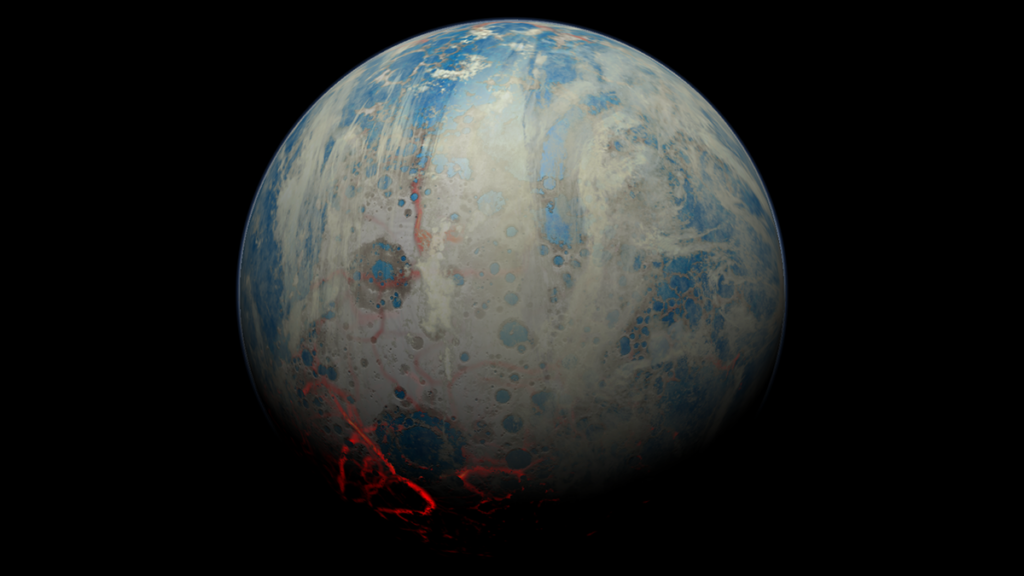
Artist’s illustration of early Earth showing much of the planet covered with a gray, crater-pocked surface, while other areas are covered with blue water or outlined by glowing red lineaments representing molten rock.
Source: AGU Advances

Asteroids and planetesimals regularly bombarded Earth between about 4.6 billion and 3.5 billion years ago, in the Hadean and Archean eons. Because few rocks today are more than 4 billion years old, our understanding of the planet’s environment during that time is limited. However, samples from the Moon and its cratered surface hint at the period’s rate of cosmic impacts.

Early asteroid strikes were responsible for significant changes in Earth’s crust, which was primarily basalt-like at the time. The shock waves from collisions fractured the crust and increased porosity, allowing fluids and gases to move through the rocks. Prior research suggests that the resulting hydrothermal systems—such as the network of geysers around Yellowstone National Park—provided the environment for the origin and evolution of early life on Earth.

Alexander et al. explored how surface impacts during the Hadean and Archean allowed fluids and gases to maneuver through crustal environments. The authors built a large suite of impact simulations with the iSALE shock physics code, toggling parameters such as basalt crust thickness, geothermal gradients, and the presence or absence of a 5-kilometer-deep ocean. The simulations detailed how collisions on the surface shaped permeability in the crust. They then integrated a model for ancient bombardment data to understand the cumulative effects of repeated strikes over time.

The results indicate that prior to 4.3 billion years ago, impacts may have made the crust far more permeable, particularly in its top 8 kilometers. From the simulations, the authors inferred that the size of permeable regions was dependent on impact energy, and that geothermal gradients and rock composition in the crust affected the degree of fragmentation after impact. These porous domains formed potential settings for prebiotic chemistry within the early crust.

The research is the first comprehensive study of impact-generated permeability in early Earth’s outermost layer. The results provide a novel framework for evaluating how bombardment influenced hydrothermal circulation and geochemical alteration during the Hadean and Archean eons, with implications for our understanding of life’s origin and evolution in Earth’s earliest days. (AGU Advances, https://doi.org/10.1029/2025AV002097, 2026)

—Aaron Sidder, Science Writer
A photo of a telescope array appears in a circle over a field of blue along with the Eos logo and the following text: Support Eos’s mission to broadly share science news and research. Below the text is a darker blue button that reads “donate today.”
Citation: Sidder, A. (2026), Cosmic bombardment created potential for prebiotic chemistry, Eos, 107, https://doi.org/10.1029/2026EO260180. Published on 5 June 2026.
Text © 2026. AGU. CC BY-NC-ND 3.0
Except where otherwise noted, images are subject to copyright. Any reuse without express permission from the copyright owner is prohibited.
  • ✇Eos
  • Carbon-Rich Rocks May Have Cooled the Ancient Martian Atmosphere Nathaniel Scharping
    Source: Journal of Geophysical Research: Planets Orbital imaging has hinted that Mars may have carbon-containing rocks called carbonates on its surface. Carbonates on Mars could offer new insights into how water interacted with rock on the Red Planet, helping scientists learn more about its past. In addition, because carbonates on Earth are primarily produced by living organisms, these rocks are high-value targets in the search for signatures of past life on Mars. NASA’s Perseverance rove
     

Carbon-Rich Rocks May Have Cooled the Ancient Martian Atmosphere

28 May 2026 at 13:12
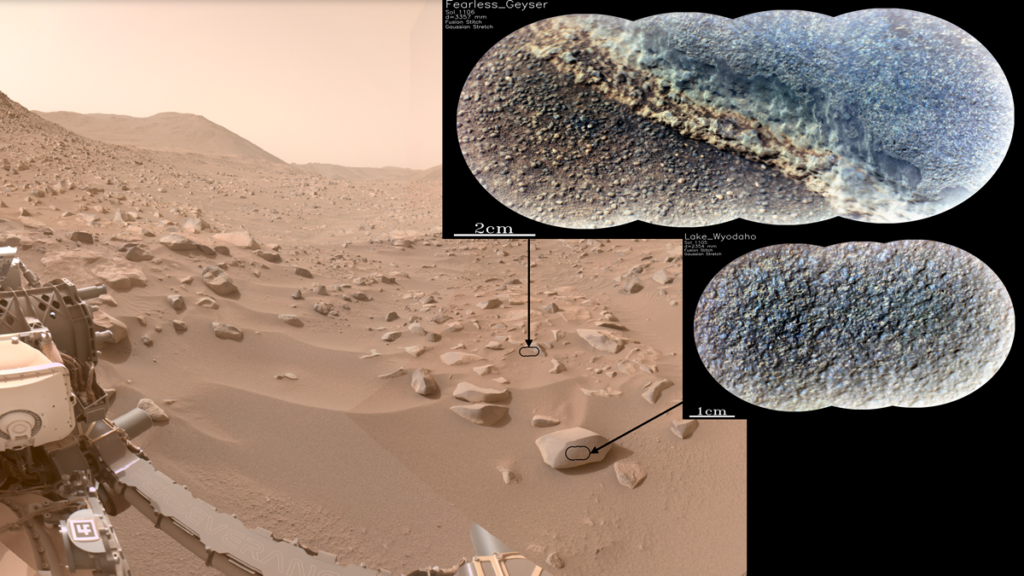
A photograph from the surface of Mars shows two insets zoomed in on rocks. The insets show the rocks with a rough texture and blue and gray colors.
Source: Journal of Geophysical Research: Planets

Orbital imaging has hinted that Mars may have carbon-containing rocks called carbonates on its surface. Carbonates on Mars could offer new insights into how water interacted with rock on the Red Planet, helping scientists learn more about its past. In addition, because carbonates on Earth are primarily produced by living organisms, these rocks are high-value targets in the search for signatures of past life on Mars.

NASA’s Perseverance rover has been traversing Mars since 2021, covering more than 41 kilometers, much of it within Jezero Crater in the Nili Fossae region. Previous orbital data indicated the crater contains carbonates, as well as abundant olivine, which can change to carbonate in the presence of water and carbon dioxide. Now Clavé et al. have analyzed spectroscopic data from Perseverance’s SuperCam instrument suite from multiple locations within Jezero Crater, providing clear evidence of carbonates on Mars, as well as detailed information on how the mineralogy varies between locations.

The authors confirmed the presence of both carbonates and olivine-bearing rocks throughout Jezero Crater and found a generally inverse relationship between the two minerals. By contrast, carbonates were generally positively correlated with the presence of hydrated silica. The researchers hypothesize that an ancient lake in the crater, along with potential hydrothermal activity, played a role in transforming olivine to carbonate. The varying amounts of carbonate and different alteration states seen today may have been caused by changing lake levels on Mars billions of years ago, the researchers suggest.

Amounts of carbonate by weight vary between locations, from 1%–3% in the Séítah unit to 6%–16% in the Eastern Margin Unit. Extrapolating to the entire regional olivine-rich unit, the researchers calculated it could contain as much as 1.1 × 10¹⁴ kilograms of carbon, or up to 0.4% of the current total mass of the Martian atmosphere. Overall, Mars’s crust could contain significant amounts of carbon, implying that widespread carbon sequestration may have cooled the planet significantly in the past. (Journal of Geophysical Research: Planets, https://doi.org/10.1029/2025JE009107, 2026)

—Nathaniel Scharping (@nathanielscharp), Science Writer

A photo of a telescope array appears in a circle over a field of blue along with the Eos logo and the following text: Support Eos’s mission to broadly share science news and research. Below the text is a darker blue button that reads “donate today.”
Citation: Scharping, N. (2026), Carbon-rich rocks may have cooled the ancient Martian atmosphere, Eos, 107, https://doi.org/10.1029/2026EO260170. Published on 28 May 2026.
Text © 2026. AGU. CC BY-NC-ND 3.0
Except where otherwise noted, images are subject to copyright. Any reuse without express permission from the copyright owner is prohibited.
❌
Subscriptions