A few years’ back, a viral trend overtook social media that nobody saw coming: ShantyTok. Seemingly overnight, TikTok and Instagram were inundated with posts celebrating the niche world of maritime sea shanties. The fad ostensibly began with the spread of Scottish singer Nathan Evans’ version of “Wellerman,” a New Zealand whaling shanty with historical roots stretching back well over a century.
As newcomers dove into a vast backcatalog of songs, many quickly highlighted just how catchy these
A few years’ back, a viral trend overtook social media that nobody saw coming: ShantyTok. Seemingly overnight, TikTok and Instagram were inundated with posts celebrating the niche world of maritime sea shanties. The fad ostensibly began with the spread of Scottish singer Nathan Evans’ version of “Wellerman,” a New Zealand whaling shanty with historical roots stretching back well over a century.
As newcomers dove into a vast backcatalog of songs, many quickly highlighted just how catchy these tunes really are. But while early sea shanty composers didn’t envision ever reaching the top of the charts, they certainly wrote them to be earworms. The sea shanty is only one variant of a work song—rhythmic melodies designed to help laborers keep pace with one another during repetitive, often backbreaking jobs. Other types of work songs developed over generations among Appalachian coal miners, prison chain gangs, and British textile workers, just to name a few examples.
While there are extensive anthropological studies on the folk tradition’s influence and importance of work songs, there isn’t as much empirical research into its efficacy during actual work. At Austria’s Central European University, a team of cognitive scientists recently delved into how songs like shanties may affect the laborers’ performance. Their findings, published in the Proceedings of the Royal Society B, provides strong evidence that work songs not only maintain collective timing among team members—the shared tempo prevents individuals from accidentally quickening the pace.
Groups often unintentionally speed up shared tasks, so much so that there is even a term for it: joint rushing. Don’t feel bad if you’re a victim of it, however. You’re not alone.
“This can happen even when they try to keep a steady tempo, and even among trained musicians,” cognitive researcher and study co-author Thomas Wolf told Phys.org on May 12.
Wolf, like many other listeners, became curious about work song traditions amid the #ShantyTok era. While reading Ted Gioia’s seminal book, Work Songs, he noted how the tunes were frequently described as “keeping the pace.” One prominent example was the Scottish tradition of oyster dredging, whose workers often sang to keep the right tempo while rowing.
Wolf and his colleagues decided to examine work songs under controlled laboratory conditions. They paid particular attention to two frequent aspects that they believed helped keep tempo—solo vocalization and metric subdivision.
“Many work songs are sung either by a lead singer or in call-and-response patterns, meaning that at least part of the vocalization is produced by only one person,” he explained, adding that the songs also regularly include “musical events between the instrumental actions.”
For instance, a work song for a task requiring an action like pulling a rope or swinging a hammer may include additional notes or syllables that coincide with the task itself. These musical subdivisions lower the chance of varied timing, which is known to cause joint rushing.
To test their theories, Wolf’s team asked pairs of volunteers to tap along to a metronome’s tempo, then continue to keep time once the device was turned off. They then compared their performances to those undertaken during a “work song condition” in which one person counted off “one, two, one, two,” (and so on) with the metronome. Taps needed to match the one, while the “two occupied the space between taps. Although their past research showed joint rushing is difficult to control even among groups of trained musicians, the results were completely different in the latest experiments.
“What was striking in this study was that, just by having one person count in a specific way, joint rushing was not only reduced, but statistically speaking, it was completely eliminated,” said Wolf.
Their findings indicate even simple vocalizations can strongly influence group coordination. According to the study’s authors, this means that work songs are not only popular because they keep people aligned. They also prevent the speedier ones from throwing everyone else off their groove. Although interesting from a historical standpoint, this research could help inform solutions to coordination problems that many people deal with today in sports, occupational safety, high-stress situations, and physical rehabilitation. So while sea shanties and other work songs helped laborers during a bygone era, the psychology behind them can still help people for generationst to come.
You can learn a lot about a society from the way they raise children. That includes not only what children learn, but how, when, and where they play.
Our modern concept of childhood emerged during the Enlightenment movement of the 18th century. Influential figures like philosopher Jean-Jacques Rousseau promoted the idea that children need special opportunities to explore and express themselves through playtime.
Before then, children were treated essentially as small adults. Of course, kid
You can learn a lot about a society from the way they raise children. That includes not only what children learn, but how, when, and where they play.
Our modern concept of childhood emerged during the Enlightenment movement of the 18th century. Influential figures like philosopher Jean-Jacques Rousseau promoted the idea that children need special opportunities to explore and express themselves through playtime.
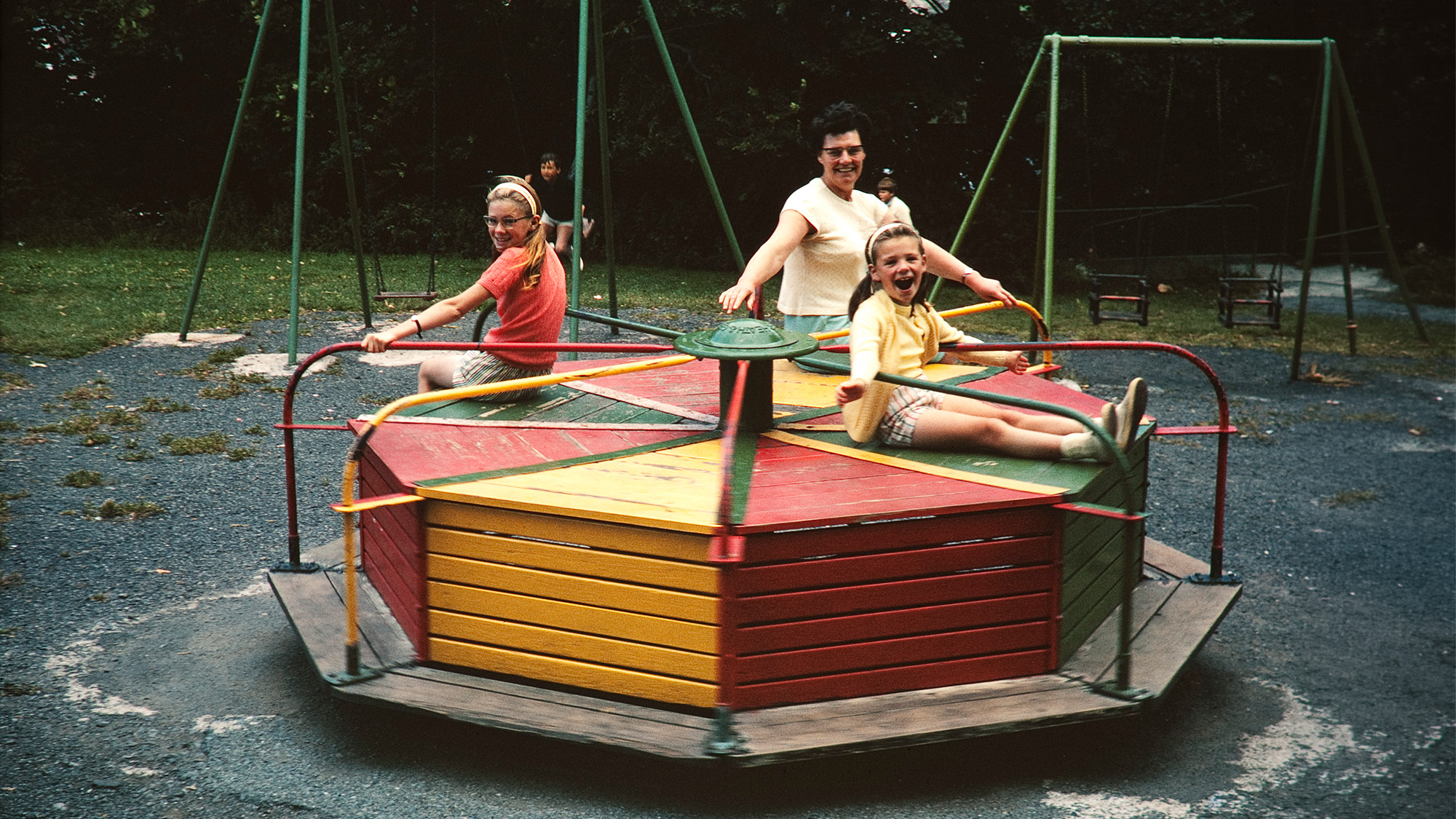
Before then, children were treated essentially as small adults. Of course, kids in ancient or medieval times liked to run around and play as much as kids today, and they did so wherever they could. But only after childhood became thought of as a distinct stage of life with unique needs did adults start to design spaces like playgrounds.
When we look at the history of playgrounds, we can see how ideas about children’s play have changed over time.
The first playgrounds weren’t for children
The term “playground” predates the modern definition and was first used “to describe a general place of recreation,” Jon Winder, a historian of urban environments at the University of Liverpool in the UK, tells Popular Science. Winder explains that the modern children’s playground originated in 1840s England, when parks in the cities of Manchester and Salford set aside areas for children’s activities.
The first playgrounds were just areas set aside for recreation. This circa 1914 photograph shows boys playing baseball on a so-called “playground.” Image: HUM Images / Contributor / Getty Images .
The park designers were influenced by earlier German education reformers like Friedrich Fröbel, who outfitted his schools with sandboxes for young students. Best-known for coining the term “Kindergarten,” Fröbel believed that cooperative outdoor play was essential to children’s development.
In the 19th century, “there was quite a lot of sharing of ideas between the UK and Europe” regarding social issues like education and public health, says Winder. The massive changes wrought by the Industrial Revolution, including an ever-growing urban population, brought with them concerns about how these changes were affecting adults and children alike.
Early children’s playgrounds were meant to get kids off city streets
While rural children could still play in fields and forests, working-class urban children often played in the street, exposed to a variety of dangers. Adding children’s playgrounds to cities “was partly about removing [children] from the street” for their safety, says Winder. However, “that idea merged with these ideas about recreation, that there was something inherent about city life that led to physical degeneration of people.”
The perceived negative effect of city living was considered a potential threat to the British Empire, which needed strong, healthy citizens. Gymnastic exercise regimens like Pilates became the health craze of the time. What people thought was best for adults extended to children, and “the spaces that were set aside for children to play in invariably also had gymnastic equipment,” says Winder.
The first playgrounds were not for fun
Some of the equipment in those first 19th century playgrounds resembles what we might see in an Olympic gymnast’s routine today, such as vaulting horses and climbing rings. Winder points out the absurdity of children being expected to know how to safely and effectively use such things. However, he explains, “It wasn’t about play as we would understand it. It was about physical exercise and strength.” Playgrounds were less about imagination and more about “wholesome strengthening exercises.”
Winder notes that these early athletic playgrounds were also used to enforce Victorian gender norms. Not only were the first playgrounds separated by gender, he explains, “They had different equipment in them, because social reformers thought that girls and boys were capable of different types of physical exercise.” While a girls’ playground might have space for hopscotch and shuttlecock, boys would get more physically challenging equipment like ladders and climbing ropes.
Furthermore, the design of the first playgrounds seemed intended to keep children themselves conveniently out of sight. Winder noted in 2022 that the first English playgrounds in Manchester “were hidden in the shrubbery on the boundary of the park, to prevent them from spoiling the view of the picturesque landscape.”
Playgrounds spread around the world
As playgrounds spread to other cities in the UK and continental Europe, British companies began to mass-manufacture playground equipment. The reach of the British Empire meant that such equipment could be exported as far afield as South Africa and New Zealand, bringing with it contemporary ideas about what playgrounds were for.
American social reformers and urban planners soon joined the international conversation. “There were playground campaigners in the UK who were in correspondence with some of the organizations in the U.S.,” says Winder. “They swapped letters and did site visits.”
American educator Henry Barnard drew up plans for a playground as early as 1848. It featured rotary swings, blocks, toy carts, and a shaded area for teachers to keep watch from. However, the first public playgrounds in the United States weren’t built until the late 1880s, with both Boston and San Francisco claiming the record.
Following the earlier British model of the playground as a place to work out more than to play, Boston’s children’s playgrounds were part of a larger “open-air gymnasium” for all ages, and were separated by gender.
Early playgrounds mostly consisted of gym equipment. Boys and girls were also divided for play time. This circa 1905 photograph shows girls playing on an early playground on Harriet Island in St. Paul, Minnesota. Image: Getty Images / Universal History Archive / Contributor / Circa Images / Glasshouse Images
However, there were some differences between American and European playgrounds. Early American playgrounds often featured adult facilitators who led athletic activities, something like modern gym teachers, as well as indoor activity spaces for bad weather. And as public playgrounds spread throughout the United States, racial segregation (both legal and de facto) was enforced in many such spaces until the 1950s.
Putting the “play” back in playground
In 1921, industrialist Charles Wicksteed opened Wicksteed Park in Kettering, England, which Winder calls “a big, significant shift in the development of these children’s spaces.” Unlike earlier public playgrounds, Wicksteed Park emphasized amusement over exercise. Decked out with an ever-evolving range of equipment, as well as a theater, fountains, and refreshment areas, the space was designed to be enjoyed equally by boys, girls, and adults.
Rather than having gymnastics equipment, Wicksteed debuted some new kinds of playground equipment at his park based on fairground rides, such as the first playground slides, which were inspired by early roller coasters.
Wicksteed is also credited with designing the modern playground swing, after the homemade swings that children had previously hung from trees (or even street lamps). Wicksteed sold his equipment to other parks, and the influence of Wicksteed Park spread far and wide.
By the 1930s, says Winder, many designers had begun to accept the idea that “playgrounds perhaps needed to be fun to attract children and get them off the street.” While the playground was still seen as a place for children to get physical exercise in the 20th century, it increasingly became a site of entertainment.
In 1921, industrialist Charles Wicksteed opened Wicksteed Park in Kettering, England, which was one of the first playgrounds actually designed for amusement. Later playgrounds like this one followed Wicksteed’s approach. Image: Getty Images / Edoardo Frola
The playground’s present and future
Both playground equipment and our perception of playgrounds have become more focused on fun over time. However, this also means that specific manufactured equipment has become increasingly viewed as essential to the playground. Today, park and school administrators may feel pressured to buy the right products to make a playground feel complete. Is it really a playground if there’s no slide or swing set?
Winder identifies a tension between equipment that stimulates creativity, and the constraints of budget and practicality. Kids can do a lot more with sand than with a set of swings, but it’s also a lot more work to keep clean and tidy.
But as ideas about education and the role of play in children’s lives have continued to evolve, the 20th century has also seen an increase in playgrounds that integrate more thoughtfully with the space around them.
Dutch architect Aldo Van Eyck transformed hundreds of abandoned urban spaces into unique playgrounds designed to inspire children’s natural creativity, without dividing them from the rest of the environment, like the first Victorian playgrounds.
Designing playgrounds “was never about making city streets better places to play,” says Winder. “It was about removing kids from the street and segregating them into one place.”
Winder advocates for urban design that “creates a more balanced relationship between people and vehicles on streets.” With more pedestrian-friendly spaces meshed into urban environments, children can be safe to let their imaginations run wild, whether that’s in a playground, in a park, or in other places set up for foot traffic.
“Kids are inherently playful,” says Winder, and they’ll find ways to play wherever they are. The challenge for adults has always been to try and get them to play the way we want them to.
In The History of Every Thing, Popular Science uncovers the hidden stories and surprising origins behind everyday things.
Psilocybin is the psychoactive compound that puts the “magic” in magic mushrooms. Ingest enough of a fungus like Psilocybe cubensis, and users are liable to experience sensory hallucinations, euphoria, and even altered perceptions of time. Mounting research also suggests that smaller, microdosed amounts may offer promising alternative therapeutic options for treating PTSD, depression, and even alcoholism.
But what happens when you give fish the same psychoactive ingredient? It may sound like
Psilocybin is the psychoactive compound that puts the “magic” in magic mushrooms. Ingest enough of a fungus like Psilocybe cubensis, and users are liable to experience sensory hallucinations, euphoria, and even altered perceptions of time. Mounting research also suggests that smaller, microdosed amounts may offer promising alternative therapeutic options for treating PTSD, depression, and even alcoholism.
But what happens when you give fish the same psychoactive ingredient? It may sound like an odd, even pointless experiment, but biological neuroscientists think the results could inform future medical and psychiatric treatments. Their evidence laid out in a study published today in the journal Frontiers in Behavioral Neuroscience suggests small levels of psilocybin ease anxiety or aggression. Or, at the very least, it calms down a notoriously mean species of fish.
The mean fish in question is the mangrove rivulus (Kryptolebias marmoratus). It is a remarkable creature found along the coast of Florida all the way to Brazil.The 1.5 to three inch amphibious fish has evolved to not only thrive in brackish waters, but survive on land for as long as two months. They’re also extremely aggressive and territorial, making them suitable for certain social and behavioral studies. And because the mangrove rivulus self-fertilizes and produces genetically identical embryos, they offer researchers conveniently uniform models.
To test how psilocybin affects the traditionally confrontational fish, a team from Nova Scotia’s Acadia University and the University of British Columbia bred three genetically distinct lines of laboratory rivulus. One group was exposed to the psychoactive compound, another essentially served as a target for their aggression, and a third was employed separately to assess psilocybin absorption and bodily concentration.
Researchers first observed the standard interactions between two fish separated by a mesh barrier in a tank. These frequently include high-energy “swimming bursts” to intimidate each other without making physical contact, as well as less energy intensive, head-on displays of hostility. On the following day, the team placed one of the rivulus into a water tank that included dissolved psilocybin for 20 minutes. Finally, they transported the now-dosed fish back into the tank with its original foe and watched their reunion.
The team’s findings offer the first direct evidence that psilocybin can selectively reduce the escalating aggression in the fish, without dampening their social interactions. Rivulus with psilocybin in their system significantly reduced their tendency to perform swimming bursts, but still participated in easier head-on displays. Basically, the fish calmed down a bit—but they also got very lazy.
“Psilocybin’s calming effect appears to selectively reduce energetically costly, escalated behaviors while lower‑energy social display behaviors remained largely unchanged,” study co-author and biologist Dayna Forsyth said in a statement. “This suggests that this compound can selectively dampen escalated social conflict rather than shutting down behavior altogether.”
That’s great for the mangrove rivulus, but what about humans? While the experiment focused on a single dose of psilocybin under short time constraints, the team’s findings may kickstart further explorations of the psychoactive compound’s uses in therapeutic treatments. In particular, knowing what social behaviors are affected by psilocybin versus the behaviors that remain unchanged can help researchers hone the scope of their future work.
“These are questions that are difficult or impossible to answer directly in humans,” added University of British Columbia biologist and study c-oauthor Suzie Curie.
Red means stop. Red means danger. Red means passion. The color conjures up a whole range of emotions and associations. It inspired an entire Taylor Swift album. And yet if someone asked you to describe what red actually looks like, without pointing at something red, you’d hit a wall almost immediately.
So why is it that a color so evocative and distinctive as red (or any color, for that matter) still manages to elude our attempts to nail it down with words?
If you just now said, “It’s be
Red means stop. Red means danger. Red means passion. The color conjures up a whole range of emotions and associations. It inspired an entire Taylor Swift album. And yet if someone asked you to describe what red actually looks like, without pointing at something red, you’d hit a wall almost immediately.
So why is it that a color so evocative and distinctive as red (or any color, for that matter) still manages to elude our attempts to nail it down with words?
If you just now said, “It’s because color doesn’t exist,” well played! If you’re like me and your face just turned an indescribable shade of red, welcome to the club.
“There is no color in the world,” says American neuroscientist Christof Koch. “There are photons of a particular wavelength emitted by the sun that strike an object, and then get reflected into the eye of the viewer. The electrical activity that’s generated there then travels up into the cortex of the brain, and gets processed into something we call color.”
In other words, red isn’t something out there in the world waiting to be objectively and uniformly experienced. It’s something your brain makes up. So does color even actually exist? Neuroscientists think maybe not. At least not in the way we think it does.
Does color even exist? Short answer: Not really.
Koch, a Meritorious Investigator at the Allen Institute for Brain Science, discusses the subjective experience of color using a famous thought experiment called Mary’s Room. Introduced in the 1980s by the philosopher Frank Jackson, the experiment involves a hypothetical neuroscientist, Mary, who lives in a black-and-white room. Mary knows everything there is to know about color: the wavelengths, the photoreceptors, the way color is processed within the visual cortex. She has read every paper and has conducted every experiment. But Mary has never actually seen color.
One day, Mary leaves the black-and-white room. And for the first time in her life, she sees a red tomato.
The question Jackson posed is deceptively simple: When Mary sees the red tomato, does she learn something new?
Jackson’s answer was yes. Despite knowing everything science could conceivably tell her about color, Mary is confronted by something that no textbook could convey—the actual experience of seeing red.
“The feeling, the phenomenal quality, whatever you call it—the experience is subjective,” Koch says. “People have invented a dozen words or more to describe it. It remains inexplicable.”
That “it,” Koch says, is the experience itself—the felt sensation of seeing red that no amount of scientific language has ever quite managed to pin down.
Philosophers call that experience a quale (pronounced KWAH-LAY) the felt, first-person experience of something: the redness of red, the sharpness of pain, the taste of coffee. Unlike the wavelength of red, which can be measured precisely, a quale can’t be objectively measured. It’s entirely an inside job.
Koch says the Mary’s Room thought experiment argues against materialism—the philosophical view that everything in the universe, including human experience, can be explained by physics. If materialism is right, there’s nothing science can’t eventually account for. Mary’s Room suggests otherwise: There are some things that science simply can’t explain.
Everyone see colors differently, but not that differently
For the most part, we go about our days equipped with this surprisingly loose consensus on our shared reality. If your blue isn’t quite the same as my blue, it’s close enough not to cause trouble most of the time. But every once in a while, something happens that reminds us how differently our brains can construct the same reality.
In 2015, a photograph of a striped dress went viral for a reason that had nothing to do with fashion. The dress appeared blue and black to many, but millions of people looking at the same image saw white and gold, and couldn’t fathom how anyone could see it differently. In what now seems like a quaint public rift, the internet divided around the hotly debated reality of blue/black versus white/gold.
“It’s as though they were looking at the same screen,” says Koch. But “half the population saw one movie and the other half saw a different movie.”
The explanation, says Koch, has to do with how the brain handles ambiguous lighting. Every time you look at an image, your brain makes an automatic, unconscious calculation about the overall brightness of it. This calculation is based on your habits and life experience.
Because early risers spend more waking hours in natural daylight, their brains are calibrated to filter out blue light, leaving white and gold. Night owls, accustomed to warmer artificial light, filter that out instead and land on blue and black.
“You get up early in the morning and see a lot of sunlight, or you get up very late and are primarily up at night with artificial light,” Koch says. “So depending on that implicit assumption, your brain gives rise to these two different percepts: white and gold, or blue and black.” It’s not a conscious, deliberate decision you take to view the dress one way or the other.
Does this dress look blue and black or white and gold? Your answer might have to do with whether you’re an early riser or night owl. Video: What Colour Is This Dress? (SOLVED with SCIENCE), AsapSCIENCE
For Koch, the dress is a window into something fundamental about human perception.
“There is input from the world, but then your particular brain might make a set of assumptions, and my brain might make a different set of assumptions,” he adds. “We obviously agree most of the time, though, or else we wouldn’t have evolved.”
And for the most part, we do agree. A species that couldn’t agree on some basic shared realities wouldn’t have gotten very far. So don’t worry: Your understanding of red is probably pretty similar to my understanding of red.
We all have unique, built-in filters that change how we see the world
The dress, it turns out, is just the beginning. Koch cites the concept of the “perception box.” Writer and researcher Elizabeth R. Koch (no relation) coined the term in 2021 to describe the hidden forces that shape how we see the world.
According to this theory, we each have our own unique perception box. Think of two people standing in front of the same abstract painting. One sees something beautiful and moving: The other sees a mess. Same painting, completely different experience. That’s your perception box at work. It’s shaped by your genes, your upbringing, and every experience you’ve ever had.
“We all live in slightly different perception boxes,” he says. “The walls are invisible, and they can expand or shrink, driven by our genes, our neural wiring, our experience.”
Those walls, Koch says, determine far more than which colors we see. They shape how we interpret relationships, how we process emotions, and even how we react to the evening news. Two people can look at the same event and come away with completely different realities, not because one of them is lying, but because their perception boxes are simply built differently.
When it comes to the color red, you can measure its wavelength. You can map exactly what happens in the brain when the eye encounters it. But the actual experience of redness—that felt, interior, indescribable thing—lives inside your perception box, and nowhere else.
“This applies to any conscious experience,” he says. “It applies to pain, say, due to an infected tooth, or the distress you experience when someone leaves you. It’s true for taste, for boredom, for mystical experience, and for psychedelic experience. It has the same ineffable quality.”
Which brings us back to red. You’ve always known it when you’ve seen it. But that color you see? It’s yours and yours alone.
In Ask Us Anything, Popular Science answers your most outlandish, mind-burning questions, from the everyday things you’ve always wondered to the bizarre things you never thought to ask. Have something you’ve always wanted to know? Ask us.
Study of 1,300 campaigners finds arrests, fines and jail terms increase determination of activists to take direct actionThe criminalisation of direct action climate protests in the UK is counterproductive and increases the determination of activists to undertake disruptive demonstrations, according to a study of 1,300 campaigners.New findings suggest arrests, fines and lengthy prison sentences given to nonviolent climate protesters who have blocked roads or damaged buildings may actually radical
Study of 1,300 campaigners finds arrests, fines and jail terms increase determination of activists to take direct action
The criminalisation of direct action climate protests in the UK is counterproductive and increases the determination of activists to undertake disruptive demonstrations, according to a study of 1,300 campaigners.
New findings suggest arrests, fines and lengthy prison sentences given to nonviolent climate protesters who have blocked roads or damaged buildings may actually radicalise them. The repression of protest could even be one driver of recent covert actions such as the cutting of internet cables, they said.
 Login
Login