Normal view

  • ✇Eos
  • Melting Glaciers Make the Coastal Ocean More Sensitive Henry C. Henson
    When we picture the effects of melting glaciers, many of us think of rising seas and retreating ice streams. But along Greenland’s coastline, a quieter transformation is underway, one that is affecting how the ocean breathes and how it reacts to and buffers itself against change. In Young Sound, a fjord carved into Greenland’s remote northeastern coast, decades of monitoring have revealed that glacial meltwater does not simply dilute the salt in seawater. As fresh water enters the ocean, it
     

Melting Glaciers Make the Coastal Ocean More Sensitive

16 April 2026 at 13:09
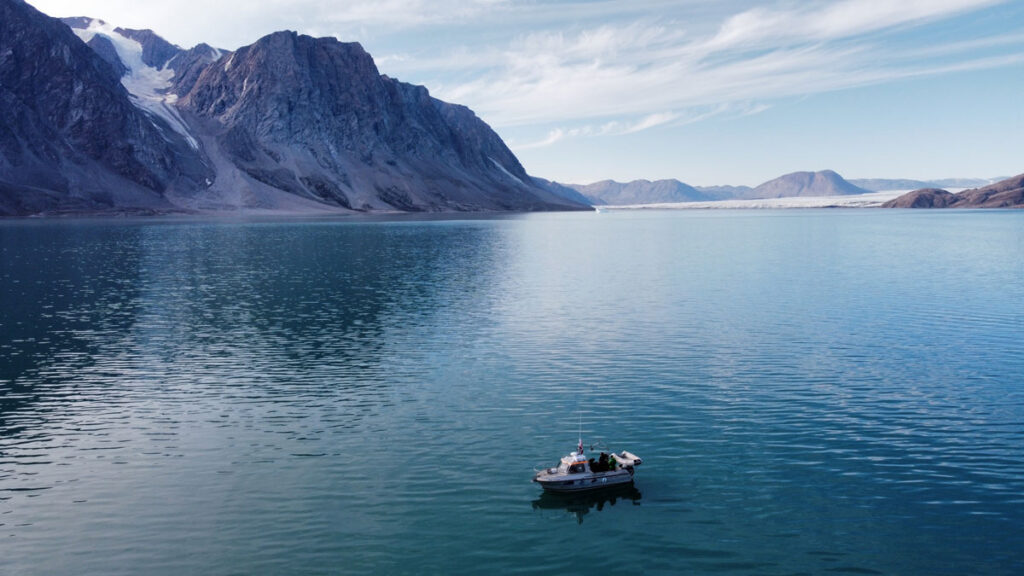
Aerial view of a small research boat sitting in blue-green water in front of glaciated mountains that rise steeply from the shoreline.

When we picture the effects of melting glaciers, many of us think of rising seas and retreating ice streams. But along Greenland’s coastline, a quieter transformation is underway, one that is affecting how the ocean breathes and how it reacts to and buffers itself against change.

In Young Sound, a fjord carved into Greenland’s remote northeastern coast, decades of monitoring have revealed that glacial meltwater does not simply dilute the salt in seawater. As fresh water enters the ocean, it weakens the ocean’s natural chemical resistance to swings in acidity. This so-called buffering capacity keeps seawater pH in balance. The loss of buffering due to freshwater runoff leaves these coastal waters unusually sensitive to even small biological and environmental shifts.

Atmospheric warming is accelerating fastest in the Arctic, and with it come longer glacial melt seasons and increased freshwater runoff. The result is a coastal ocean that is both a frontline witness to climate change and a laboratory for understanding how the chemistry of the seas can change in unexpected ways.

The Ocean’s Chemical Safety Net

Seawater chemistry is naturally buffered by dissolved ions that act as chemical shock absorbers.

Globally, the ocean absorbs about a quarter of carbon dioxide (CO2) emissions each year. That uptake helps to slow climate change, but at a cost. The more CO2 that water absorbs, the more acidic it becomes. Thankfully, seawater chemistry is naturally buffered by dissolved ions—particularly carbonate, bicarbonate, and hydroxide—that act as chemical shock absorbers. These negatively charged ions, collectively called alkalinity, bind to the positive hydrogen ions released when carbonic acid forms, keeping the ocean’s pH relatively stable compared with the more variable conditions in freshwater rivers and lakes.

The polar oceans play a special role in this balance and in the global carbon cycle because cold waters at high latitudes take up carbon from the atmosphere faster than warm tropical waters. Yet these regions are also changing the most rapidly.

When Meltwater Meets the Sea

For 20 years, our team at Aarhus University has measured salinity, temperature, and carbon chemistry in Young Sound. Each August, we make the 2-day journey to northeast Greenland, where we spend the month sailing down the 90-kilometer-long fjord to capture these valuable measurements (Figure 1).

Satellite view over the glaciated islands and land of part of the northeastern Greenland coast. A red line maps the route of an August 2023 research cruise, and an inset map shows the location within Greenland.
Fig. 1. The red line, running from the Greenland Ice Sheet (y) to the Greenland Sea (z), maps the route taken by researchers in August 2023 during their annual transect of Young Sound in northeast Greenland. Credit: Adapted from Henson et al., 2025, https://doi.org/10.1038/s43247-025-02685-4, CC BY-NC-ND 4.0

During the time we have monitored this ecosystem, the melt season has lengthened, with sea ice–free conditions now lasting 8 days longer than 20 years ago. Glaciers feeding the fjord are also thinning and retreating, discharging about 5.5 million cubic meters more water into the fjord each year. These changes have freshened the coastal ocean and subtly, but significantly, altered its chemistry.

Fjords like these have long been known as major CO2 sinks. Surface waters near glaciers often have very low CO2 concentrations, creating a disequilibrium between CO2 levels in the surface ocean and the atmosphere that draws carbon out of the air. But how or why these glacial ecosystems act as carbon sinks and what mechanisms are at play haven’t been thoroughly described. We have also been deeply curious about what else happens when fresh water enters the sea. What are the hidden consequences of this change?

To find out, we paired our long-term field observations with controlled lab experiments in which we mixed glacial meltwater with seawater. Controlled experiments allow us to dig into the nuances of chemical changes that are impossible to measure in the field. We also ran mixing models that allowed us to estimate how the chemistry of those mixed waters responds to small shifts in biological activity or mineral interactions.

The results were striking. When meltwater mixes with seawater, it not only reduces salinity but also dilutes alkalinity, the measure of how well water can neutralize acid and buffer against pH change. This weakening of buffering capacity means that even small changes in photosynthesis or respiration can drive much larger swings in CO2 uptake and acidity than they would in more saline waters.

Aerial view looking across braided river streams and channel bars toward mountains, a glacier, and hills of glacial deposits in the distance. In the foreground, two researchers stand in the gray, sediment-filled waters of one of the streams.
Two researchers wade into a meltwater river in Tyrolerfjord in Northeast Greenland National Park in 2023 to collect samples bearing the chemical fingerprints of climate change in the region. Credit: Henry C. Henson

We found that in the freshened waters of Young Sound, these processes have 2–3 times the influence on carbon uptake that they do farther out at sea. In effect, meltwater primes the coastal ocean to overreact, amplifying any ecosystem changes that might occur.

Measurements from around Greenland show that this is not just a theoretical risk. Surface waters are measurably more acidic where meltwater inputs are high. The biological consequences of this trend are still uncertain, but species living at the edge of their tolerance, such as shell-forming plankton and Arctic cod larvae, could face growing stress as the chemistry of their habitat fluctuates more widely.

A Fragile Balance in the Freshening Arctic

The findings confirm that fjords absorb carbon as a result of biological activity and glacial input but indicate that they do so in a fragile, easily tipped state.

Our study adds nuance to conventional perceptions of carbon cycling in fjords, long seen as places where atmospheric CO2 is drawn down. The findings confirm that fjords absorb carbon as a result of biological activity and glacial input but indicate that they do so in a fragile, easily tipped state. Slight shifts in the processes that pull CO2 out of the air could tip the scales in either direction: toward even more uptake and the accompanying acidification or toward a release of CO2 to the atmosphere.

This chemical sensitivity explains why Arctic fjords can show such strong seasonal and spatial swings in carbon chemistry and why predicting their long-term role in the carbon cycle is difficult. As glaciers retreat and meltwater inputs grow, those sensitivities are likely to intensify.

At first glance, changes in how seawater in the narrow, remote fjords of Greenland reacts to glacial melt might sound like a local concern. But the chemical processes at play have global resonance.

  • A glacial tongue of the Greenland Ice Sheet curves through mountainous tundra.
    A tongue of the Greenland Ice Sheet retreats along the tundra as temperatures across the Arctic warm. Credit: Henry C. Henson
  • Ridges in the Greenland Ice Sheet tell a story of movement and melt. Credit: Henry C. Henson
    Ridges in the Greenland Ice Sheet tell a story of movement and melt. Credit: Henry C. Henson
  • Ground-level view of gray-colored water rippling through a shallow river in a rocky valley between mountains.
    Glacial meltwater from the Greenland Ice sheet flows into Tyrolerfjord and Young Sound and in Northeast Greenland National Park in August 2023. Credit: Henry C. Henson

The Arctic Ocean as a whole is freshening, driven by accelerating ice melt as well as by increasing river discharge and changing weather bringing more precipitation to the region. Although river water, which arrives from the six great Arctic rivers of North America and Eurasia, is more alkaline than glacial melt, its alkalinity is only about half that of seawater. In other words, river runoff also increases the ocean’s chemical sensitivity. Fresh water also delivers organic matter from permafrost, fine sediments from glaciers, and tannin-rich runoff from tundra soils, each of which can influence carbon cycling and further compound changes already underway.

Similar patterns of increased rainfall and runoff reducing surface salinity are emerging around the Antarctic Peninsula, the Gulf of Alaska, and the North Atlantic. Almost everywhere that fresh water enters the ocean, it lowers alkalinity and limits the ocean’s ability to buffer change.

A Window into Climate Intervention

Our results also carry lessons for researchers and companies contemplating ocean chemistry interventions as ways to remove CO2 from the atmosphere. One proposed approach, ocean alkalinity enhancement, involves adding crushed minerals such as lime, olivine, and basalt to seawater to both counteract acidification and increase the ocean’s capacity to take up CO2.

Glacial systems already perform a natural version of this experiment by grinding rock into fine sediment and discharging it into the ocean. Minerals in this sediment react with seawater and shape its carbon chemistry.

Our study suggests that such reactions are especially potent in freshwater-influenced coastal regions, where reduced buffering capacity may amplify chemical responses not only from natural biological processes but also from potential human attempts to alter seawater chemistry. Thus, understanding the balance between carbon uptake and chemical vulnerability will be essential before any large-scale interventions are attempted.

Consequences Locally and Globally

Coastal communities from Greenland to Alaska to northern Eurasia depend on Arctic waters as part of their cultural identity and, by way of fisheries and tourism, for their economic and food security. As chemical buffering capacity declines, coastal ecosystems may become more susceptible to acidification and other environmental stresses. Small changes in temperature, ecosystem metabolism, or nutrient inputs could then have outsized effects on the marine life that supports these communities.

As coastal glaciers retreat and meltwater rivers carve new paths to the sea, they are doing more than raising sea level and reshaping coastlines. They are rewiring ocean chemistry.

At the same time, changing conditions in coastal Arctic ocean regions complicate scientific modeling of carbon cycling and climate feedbacks, which typically relies on averaged estimates of the ocean’s chemical reactivity. With meltwater making the coastal ocean more reactive, these seas may absorb or release CO2 more variably than how global predictions would suggest. In addition to the real effects on local ecosystems, seawater chemical variability could also affect the accuracy of modeled global carbon budgets, which we use to inform future climate projections and guide international policy goals.

As coastal glaciers retreat and meltwater rivers carve new paths to the sea, they are doing more than raising sea level and reshaping coastlines. They are rewiring ocean chemistry, leaving it fresher and more easily disturbed.

The chemical sensitivity we see in Greenland’s fjords today may be a preview of what is to come in many coastal regions. If so, then we must be concerned with not only how much CO2 the ocean can absorb but also how stably it can hold that CO2 in a rapidly changing world.

Author Information

Henry C. Henson (hch@ecos.au.dk), Aarhus University, Denmark

Citation: Henson, H. C. (2026), Melting glaciers make the coastal ocean more sensitive, Eos, 107, https://doi.org/10.1029/2026EO260116. Published on 16 April 2026.
Text © 2026. The authors. CC BY-NC-ND 3.0
Except where otherwise noted, images are subject to copyright. Any reuse without express permission from the copyright owner is prohibited.
  • ✇Eos
  • How Einstein’s Lost Theory Could Help Us Find Minerals Bill Morris
    Albert Einstein postulated in his 1905 theory of special relativity that the speed of light in a vacuum is constant. Ever since, that’s been one of the fundamental assumptions of physics. Now Enbang Li, a physicist at the University of Wollongong in Australia, has challenged this idea by building a machine he says is capable of detecting changes in the speed of light as it crosses Earth’s surface. The findings suggest that light is, in fact, sped up by gravity, which could have implications
     

How Einstein’s Lost Theory Could Help Us Find Minerals

12 June 2026 at 12:00
An empty elevator shaft illuminated by blue light.

Albert Einstein postulated in his 1905 theory of special relativity that the speed of light in a vacuum is constant. Ever since, that’s been one of the fundamental assumptions of physics.

Now Enbang Li, a physicist at the University of Wollongong in Australia, has challenged this idea by building a machine he says is capable of detecting changes in the speed of light as it crosses Earth’s surface. The findings suggest that light is, in fact, sped up by gravity, which could have implications for Earth science applications ranging from climate monitoring to mineral resource exploration.

An Old Conundrum

The idea that light is influenced by gravity is not new. Einstein’s ideas, which were further developed with his theory of general relativity in 1915, predicted massive objects in space would bend light with their gravitational grab. This theory was famously proven in 1919 when two independent teams measured starlight passing a solar eclipse at two different points on Earth’s surface and found the results matched Einstein’s predictions.

This bending of light’s path, according to general relativity, is achieved by a warping of the space-time fabric. Under this scenario, the speed of light remains constant—it just has to travel farther as it navigates the warped space-time around celestial bodies, so to a distant observer, it appears to have been slowed.

But what if light doesn’t navigate warped space-time and actually is slowed down or sped up by the gravity of large objects?

Li pointed out that Einstein himself was not always convinced the speed of light was constant. In 1911, he wrote a paper postulating that light speed changed depending on the gravity of objects it passed by. However, “when he published his general theory,” said Li, “he just abandoned this model.”

If the movement of light can be affected by gravity, Li reasoned, it might be possible to detect variations in its speed on a local level—such as an elevator shaft in a building on the campus of the University of Wollongong.

Raising the Big Issues

Gravity on Earth varies locally, depending on altitude, underground density, and topography. Gravity at the top of a tall building, for example, is measurably weaker than it is at the bottom.

With these variations in mind, Li installed an experiment in an elevator. It consisted of a coil of fiber-optic cable that if stretched out in one direction, would be 10 kilometers (6.2 miles) long. Laser beams were fired through the cables and then reflected back, thus traveling 20 kilometers (12.4 miles) before reaching an ultrafast photodetector. An oscilloscope measured the time it took for the beam to travel that distance. The experiment was run at the top of the shaft and at the bottom.

The biggest challenge, Li said, was filtering out all the surrounding environmental “noise,” such as changing temperature and humidity, electromagnetic disturbance, and building vibrations. Li designed a temperature control system, and the experiment was sealed in an enclosure with electromagnetic shielding to isolate air flows. Li ran the experiment and found light moved minutely faster at the bottom of the shaft than at the top.

Gravity Sensing on the Go

Next, Li took his research a step further by building a small, portable machine he claims can detect changes in the speed of light as it nears more gravitationally dense objects.

In this second experiment, Li positioned a moveable 72-kilogram (159-pound) weight near the machine. Light, he found, moved faster when the weight was near the machine than when it was farther away.

The results, which were published in Scientific Reports, are consistent with the variable speed of light model Einstein proposed in 1911, although Li’s preliminary results are much larger than that model predicts.

If proven, the findings would present a fundamental challenge to our understanding of both general and special relativity.

In the world of Earth sciences, they could lead to greatly improved gravity-sensing technologies. Because of their sensitivity to changes in mass, gravity sensors are used to map the seafloor and to locate underground mineral reserves. Gravity sensing can also improve our understanding of Earth’s climate as variations in the gravity field can be linked to factors like changes in ice mass and shifts in groundwater.

Currently, gravimeters are vulnerable to vibrations and movement, whereas Li’s machine, which has no moving parts, could even be used on board a plane or submarine.

“A Striking Claim”

Chris Stevens, a numerical relativist with the University of Canterbury in New Zealand, called the work “intriguing and ambitious.” While Stevens, who was not involved in the research, said that Li’s work is “well founded,” he noted that any observable effects of gravity on light on Earth would be “extraordinarily small” and therefore these results must be treated with caution.

“In my own research on observable gravitational phenomena,” he explained, “I usually require a few black holes colliding somewhere in the universe. Separating genuine gravitational signatures from environmental and instrumental noise will therefore be exceptionally demanding.”

“The work is exciting because it pushes precision photonic measurement techniques into a regime where relativistic effects may become practically useful for geophysics and sensing applications.”

Stevens said the implications of Li’s research, if validated, would be far-reaching. “The work is exciting because it pushes precision photonic measurement techniques into a regime where relativistic effects may become practically useful for geophysics and sensing applications.”

John Norton, an historian of physics at the University of Pittsburgh who was also not involved in the research, called the findings a “striking claim.” He was, however, skeptical of them, saying “if there is a coupling between light and gravity of magnitude greater than general relativity predicts, it is hard to see how the 1919 eclipse test and later studies of gravitational lensing would not have found it.”

Li acknowledged there is a long way to go before his device finds everyday use. Disentangling the intricacies of space and time, he said, is a vast challenge. “In physics, people still say gravity is a mystery. Light is another mystery. So if you put these two mysteries together, that’s going to be a giant mystery.”

—Bill Morris, Science Writer

Citation: Morris, B. (2026), How Einstein’s lost theory could help us find minerals, Eos, 107, https://doi.org/10.1029/2026EO260189. Published on 12 June 2026.
Text © 2026. The authors. CC BY-NC-ND 3.0
Except where otherwise noted, images are subject to copyright. Any reuse without express permission from the copyright owner is prohibited.
  • ✇Eos
  • The Fiery Tornadoes That Could Mop Up Oil Spills Jonathan Feakins
    It’s been more than a decade since Michael Gollner and his colleagues first watched a viral YouTube video of a fire tornado fueled by Jim Beam bourbon. A warehouse in Kentucky had just been struck by lightning, funneling almost a million gallons of the flammable spirit into a nearby retention pond. As the flames whipped across the surface of the water, however, something in the atmospheric stars aligned: The flames coalesced into a towering fire whirl, more commonly known as a fire tornado.
     

The Fiery Tornadoes That Could Mop Up Oil Spills

18 May 2026 at 12:59
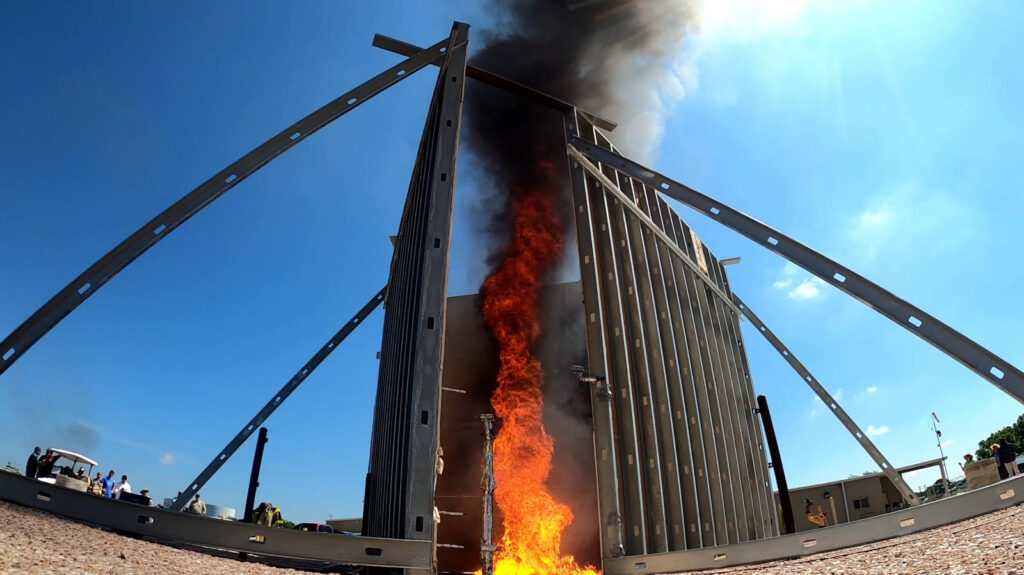
A fire whirl during May 2023 experiments at TEEX Brayton Fire Training Field

It’s been more than a decade since Michael Gollner and his colleagues first watched a viral YouTube video of a fire tornado fueled by Jim Beam bourbon.

A warehouse in Kentucky had just been struck by lightning, funneling almost a million gallons of the flammable spirit into a nearby retention pond. As the flames whipped across the surface of the water, however, something in the atmospheric stars aligned: The flames coalesced into a towering fire whirl, more commonly known as a fire tornado.

“We saw that and went, ‘Wow, that would be a neat application’” for cleaning up oil spills, said Gollner, a mechanical engineering professor at the University of California, Berkeley Fire Research Lab. “I wonder if we could do that on purpose.”

A French pyrotechnic show, Manda Lights, intentionally created this fire tornado. Credit: Ima Julien Cie Manda Lights/Wikimedia Commons, CC BY-SA 4.0

They could, in fact. As Gollner and his collaborators recently reported in Fuel, fire whirls offer the potential to clean up oil spills more quickly and cleanly than existing methods.

Oil spill responses depend on fast, immediate action. After just 24 hours, crude oil naturally absorbs water and begins to sink beneath the waves, wreaking havoc on marine life.

Alongside other major techniques, such as containment and recovery and chemical dispersal, in situ burning via “fire pools” has been adopted as an imperfect but unavoidable tool for addressing oil spills. Fire pools stop the spread of an oil spill but send clouds of smoke into the atmosphere and leave behind a layer of tar that sinks to the seafloor.

The European Space Agency’s Envisat satellite captured an image of the Deepwater Horizon oil spill 1 week after the accident. Credit: European Space Agency, CC BY-SA 3.0 IGO

Fire Away

If it’s far from shore, there are few methods other than basically corralling it up and burning it.”

Environmental agencies like the Bureau of Safety and Environmental Enforcement (BSEE) “were very excited about the concept of putting a change to what had been the standard for cleanup since the Exxon Valdez,” Gollner said. “There’s good knowledge, there’s an oil spill conference every year.…But if it’s far from shore, there are few methods other than basically corralling it up and burning it.”

In May 2023, Gollner, Texas A&M aerospace engineering professor Elaine Oran, and two dozen others congregated at the Texas A&M Engineering Extension Service’s (TEEX) Brayton Fire Training Field in collaboration with BSEE. The team erected a trio of 5-meter walls that would channel air flow above a central pool of water, about 3 meters square and 1.2 meters deep, topped by either a 15- or 40-millimeter layer of oil. The scale of the setup was a far cry from traditional fire whirl experiments, which take place mostly in laboratories.

“Everything’s bigger in Texas,” Gollner said.

The three walls, constructed with gaps in just the right places, caused air drawn in by the flames to spiral into a swirling, combusting tower. The intense whirlwinds effectively acted as a vortex furnace, increasing burning rates by 40% compared to traditional fire pools while also vaporizing many of the particles that would have polluted the air: Emissions of PM2.5, or particles smaller than 2.5 micrometers across that can be harmful to human health, were 40% lower in the fire whirl experiments than in pool fires.

A team built fire tornadoes like this one in a custom-built, three-walled chamber at the TEEX Brayton Fire Training Field. Credit: Wuquan Cui/Michael Gollner
Three cameras and five plastic camera casings are resting on a surface. The camera cases are partially melted.
Cameras recording the fire whirl did their best to survive the experiment. Credit: Wuquan Cui/Michael Gollner

Why these soot reductions occur is still largely a mystery; probing this question would require building a novel laboratory apparatus to take measurements from within the flame itself, Gollner explained. In the field experiments, meanwhile, one of the fire whirls managed to consume 95% of the available fuel, though the remaining tests extinguished prematurely, lowering the overall rates. Ambient wind conditions on the days of the experiments may also have had some effect.

Summoning a fire whirl in even semi-ideal conditions on the outskirts of College Station, Texas, remains a far simpler task than manifesting one in the thick of a disaster: Towing a three-walled tornado generator onto open water becomes as much a question of marine and naval engineering as of fire science. In the experiment at TEEX, the captive firenado rose to the full length of the 5-meter walls; lower walls could make a floating rig easier to transport, but the resulting mix of oxygen and fuel could actually make subsequent air pollution worse, not better.

A piece of charred plastic rests on a surface. A sign leaning against the plastic reads, “Don’t let your research go up in flames.”
Years ago, while attending a fire safety conference, Michael Gollner received a frantic call: An experiment back in Maryland had resulted in boilover, splashing the walls and burning up a piece of lab equipment. Gollner has kept the charred remnant ever since, and on his computer, a photo of it is labeled “Don’t let your research go up in flames.” Credit: Michael Gollner

Ali Rangwala, a professor of fire protection engineering at Worcester Polytechnic Institute (WPI) who was not involved with the project, also encourages scientific due diligence. A fire whirl “works very well if the boundary conditions are fixed and well-engineered,” he said in an email to Eos, adding that these whirls have yet to be tested on open water with waves and that the required infrastructure may be costly. (Rangwala helped conduct fire whirl experiments with Gollner at WPI but has not maintained a relationship with the project.)

“The honest fact is that this is a disaster-driven field,” Gollner said. One of the largest oil spills in history, the Deepwater Horizon spill, unleashed more than 750 million liters (200 million gallons) into the Gulf of Mexico. That was in 2010. “We haven’t seen a big oil spill for a long time, and interest in it has wavered.…We require a more interdisciplinary team and more testing. Does anyone have the appetite? Unfortunately, I think it will come with time, when we have another accident.”


Blazing a Trail

Gollner stressed the critical value of fundamental research—of lines of inquiry driven by fascination, not just application. What started as a pure appreciation of a natural wonder has the potential to change fields in ways that researchers have yet to imagine.

“Swirling or not, flames are beautiful,” Gollner said. “It is a natural flow tracer. I can see the fluid mechanics and the combustion interacting.…All the physics, all in one: It’s just beautiful.”

—Jonathan Feakins, Science Writer

Citation: Feakins, J. (2026), The fiery tornadoes that could mop up oil spills, Eos, 107, https://doi.org/10.1029/2026EO260158. Published on [DAY MONTH] 2026.
Text © 2026. The authors. CC BY-NC-ND 3.0
Except where otherwise noted, images are subject to copyright. Any reuse without express permission from the copyright owner is prohibited.
❌
Subscriptions