 Login
LoginBK1180 The World's Favorite Recipes From The United Nations 1951 061
10 June 2026 at 01:57



Collagen-rich and deeply flavorful, there’s a reason this thrifty cut is a favorite of home cooks and chefs alike. Oxtail contains meat, bones and cartilage, which melt into a delicious sauce when braised in the slow cooker. Look for meaty pieces that are at least 2 ½-3 inches or larger in diameter for the best value.
RD Tip: If oxtail is hard to find, you can swap them out with just about any meat-on-the-bone, like short ribs, beef shanks, or even bone-in chicken thighs.
Ingredients
Directions
Season the oxtails with pepper and salt. Heat the oil in a large non-stick pan over medium-high heat. When the oil is hot, add the oxtails to the pan (in batches if needed, to avoid overcrowding the pan.) Cook, turning occasionally, until browned all over, about 10 minutes. Add to the slow cooker.
Pour off the fat in the pan. Return the pan to medium-high heat and add the tomato paste. Cook, stirring constantly, about 2-3 minutes, or until it begins to brown. Add the wine and simmer for another 1 minute, scraping up the brown bits on the bottom of the pan. Add the broth, granulated garlic, rosemary and bay leaves and stir to combine.
Pour the wine mixture over the oxtails in the slow cooker. Nestle the celery and onion around the oxtail. Cover and cook on low in a large (6.5qt/6L) slow cooker for 8–9 hours (or on high for 4-5 hours) until oxtail reaches an internal temperature of 190-205°F, adding the parsnips and carrots during the last 2-3 hours of cooking.
Transfer the oxtails and vegetables to a large serving bowl with a slotted spoon. Discard the bay leaves and rosemary sprig. Cover meat and vegetables with foil. Set aside.
Pour the cooking liquid into a gravy separator and let it stand for a few minutes so the fat rises; discard the fat (alternatively, pour the cooking liquid into a large measuring cup, let sit for a few minutes, then spoon the fat off the top and discard.) Pour the defatted cooking liquid into a small saucepan. Bring the cooking liquid to a boil over medium-high heat and simmer for 4 minutes.
In a small bowl, combine the cornstarch with 2 tbsp water and stir to combine. Add to the cooking liquid and simmer until thickened, about 2 minutes. Season sauce with additional salt and pepper, if desired. Pour the sauce over the oxtails and vegetables and serve.
Serves: 6 | Serving Size: 2 medium oxtails, 2/3 cup vegetables, 1/3 cup sauce
Nutrition (per serving): Calories: 628; Total Fat: 33g; Saturated Fat: 13g; Monounsaturated Fat: 16g; Polyunsaturated Fat: 2g; Cholesterol: 227mg; Sodium: 620mg; Carbohydrate: 21g; Dietary Fiber: 3g; Sugar: 5g; Protein: 63g
Nutrition Bonus: Potassium: 1194mg; Iron: 49%; Calcium: 7%; Vitamin A: 25%; Vitamin C: 15%
Originally published March 10, 2020; Updated April 2026
The post Slow Cooker Braised Oxtail and Carrots appeared first on MyFitnessPal Blog.

Of all the hot-button social issues in America, there’s one that often flies under the radar but can unleash a torrent of strong feelings — swirling with apparent contradictions — when it surfaces: meat.
Case in point: Last month, the popstar Billie Eilish argued that you can’t say you love animals and eat them. Her comments made sense, though they set off a heated, weeks-long debate among X and Instagram users, who responded with a flood of strange justifications for eating meat, despite the terrible treatment of farmed animals.
The spat vividly illustrated a psychological phenomenon called the “meat paradox”: the cognitive dissonance and deep discomfort people feel when their behavior of eating meat and other animal products clashes with their fondness for animals.
This paradox has proved an exceedingly difficult hurdle to overcome in encouraging people to change how they eat — and even for having productive conversations about meat without things quickly getting heated (as they did for Eilish). But some research also suggests there are ways out of the meat paradox, which could help relieve the psychological strain for people, as well as the suffering of animals in factory farms.
Two recent polls reveal just how confusing American attitudes about animal products are.
The first of those polls asked close to 1,000 US adults for their views on several near-universal practices in animal farming, including stunning pigs unconscious in Co2 gas chambers before slaughter, grinding up newborn male chicks, separating calves on dairy farms from their mothers, and searing off the ends of hens’ beaks without pain relief.
The vast majority of respondents to this survey, which was conducted by the animal welfare research group Faunalytics, consider these practices “somewhat unacceptable” or “very unacceptable.”
A separate poll of more than 12,000 US adults, conducted by the Pew Research Center, asked respondents about whether they find a range of behaviors immoral. Those issues covered adultery, gambling, having an abortion, and eating meat. More than almost any other issue in the survey, respondents considered eating meat “not a moral issue.” It ranked as close to the most “morally acceptable” behavior offered, on par with using IVF.
These numbers seem to show just how deep in the meat paradox we are. And that doesn’t surprise Hank Rothgerber one bit. He’s a professor at Bellarmine University who studies the psychology of meat consumption. Rothgerber and other psychologists have conducted dozens of studies that have uncovered the cognitive dissonance people feel when confronted with the fact that their behavior — like eating meat — clashes with their beliefs, such as that animals shouldn’t be harmed.
One possible explanation for this disconnect, he told me, is simple ignorance.
Most people, it seems, truly don’t know that the cruel practices asked about in these surveys are quite standard on US factory farms — and that nearly all animal products come from factory farms. And so, when people are asked if eating meat is morally wrong, “what’s being done to the animals is not coming to their mind,” Rothgerber said.
But chalking it up to mere ignorance suggests that “if you just inform people, enlighten them, then everything will be okay, right?” he said. Not quite. “I think the deeper issue with it is that the ignorance is motivated — basically, willful ignorance. People don’t want to know.”
Rothgerber and other psychology researchers consider willful ignorance, or avoidance, a strategy some people deploy to resolve their feelings of cognitive dissonance.
In a 2017 study, one-third of respondents chose to look at a blank screen instead of a picture showing pregnant pigs housed in tiny crates (a pervasive practice in factory farming), with some participants explaining their choice as wanting to avoid feelings of guilt. In another study, some people said that learning about pig farming could contradict their views on animal welfare or force them to change their meat consumption.
There are several other strategies people use to alleviate the discomfort of living with the meat paradox. One is lowering the moral status of animals. In a clever 2010 study, participants were randomly given either cashews or beef jerky to snack on while filling out a short questionnaire about what they thought of the snacks. Then, the researchers asked a number of follow-up questions, including how much moral consideration cows deserve.
Participants who had been randomly assigned to eat the beef jerky, “viewed the cow as significantly less deserving of moral concern” and with a lower capacity to suffer than did participants who ate the cashews, the researchers reported. This experiment suggested that rather than people’s thoughts and values driving their actions, it might often be reversed.
Researchers have also found that some people work to dissociate meat from its animal origins, or actively try not to think of animals when eating meat. Others try to neutralize their discomfort via ideas that either avoid the problem of animal suffering or absolve them of their complicity, for example, asserting that eating meat is their right, that they only eat free-range meat, or that they hardly eat any meat at all.
The meat paradox puts animal advocates in an extremely difficult position. No one seems to like the cruelty involved in meat, milk, and egg production, yet they like what it produces: cheap animal products. A lot of people feel guilty about what it takes to produce those items, but respond with defensiveness, evasion, or arguments that don’t stand up to scrutiny when asked to consider not consuming them.
This has led some academics to consider the problem of factory farming and animal welfare a “wicked problem,” what’s been defined as “a complex, multifaceted issue that lacks a single, definitive solution due to the interconnectedness of its components.” Other such wicked problems include climate change, economic inequality, and global health. And many, many tactics to reduce global meat consumption have failed to move the needle. But a few, backed by new research and results, could work.
One way to address the meat paradox is to accept its durability and try to work around it by changing conditions on farms, rather than trying to persuade people to eat less meat.
For example, a lot of anti-factory farming activists work to make meat and eggs less cruel by lobbying for corporations and governments to ban the very worst farming practices. This has proven quite effective. For example, almost half of the US egg supply now comes from cage-free farms as a result of a number of state laws and corporate animal welfare policies.
Such bans don’t result in humane conditions, but they’re certainly an improvement. And the fact that most people support these measures when they can vote on them shows how we’re much more open to changes in animal welfare when we’re acting as voters instead of consumers.
This approach has its limits, though, because there are dozens of cruel practices to potentially ban in meat, milk, and egg production, and the companies that make up these industries lobby aggressively against such measures, making them difficult to change.
But outside of avoiding the meat paradox altogether, there are two promising approaches to helping people change their behaviors and are far less likely to cause them to put up defenses. The first involves changing people’s food environments, such as making plant-based meals the default main dish at university and hospital cafeterias (as opposed to merely an option off to the side), making plant-based milk the default milk at coffee shops (so you have to request cow’s milk if you want it), or working to make plant-based meat and milk products taste better and cost less.
Some research suggests that gently confronting people about animal welfare as they decide what to eat can also be effective. For example, a 2022 study conducted at a Dutch zoo’s cafeteria found that posting the question “Do you consider animal welfare to be important?” above a veggie burger menu item doubled its sales.
In a new study conducted at a university cafeteria in the UK, researchers put a photo of an animal next to a menu item that used their meat — pigs, chickens, fish, and cows — and the odds of diners instead choosing a vegetarian meal increased.
“Linking meat to its animal source can produce measurable behavioral changes,” the researchers wrote. In other words, this short circuits the meat paradox by making it all but impossible to dissociate meat from animals. Small nudges like this may seem to produce small results. The group that was exposed to menus with pictures of animals ate 3.2 percent less meat. A modest effect, but scaled up by cafeteria directors and restaurant owners across the globe, that one change alone could prevent billions of animals from being factory-farmed for meat.
The second approach involves deeply engaging with people on the issue. Three interventions that have proven effective in getting people to reduce their meat consumption, at least in the short term, include watching a segment from the animal rights documentary Dominion, wearing a VR headset that puts people inside a pig factory farm, and taking a course on the ethics of eating meat. But such involved interventions would be difficult to roll out on a mass scale.
Many animal advocates have also written about how to better approach these charged issues so as to have more productive and healthy conversations. One of them is Björn Ólafsson, who recently wrote about the Billie Eilish dustup and included a counterintuitive recommendation: When all else fails, change what you’re asking of people. For example, instead of trying to persuade someone to eat less meat who really doesn’t want to, that person could help instead by making a donation to the very underfunded anti-factory farming movement.
It’ll take a lot more clever interventions and tactics like these — and people willing to implement them — as well as more robust government and corporate policies to make factory farming a thing of the past. But, along the way, more of us might find our way out of the uncomfortable meat paradox — for good.
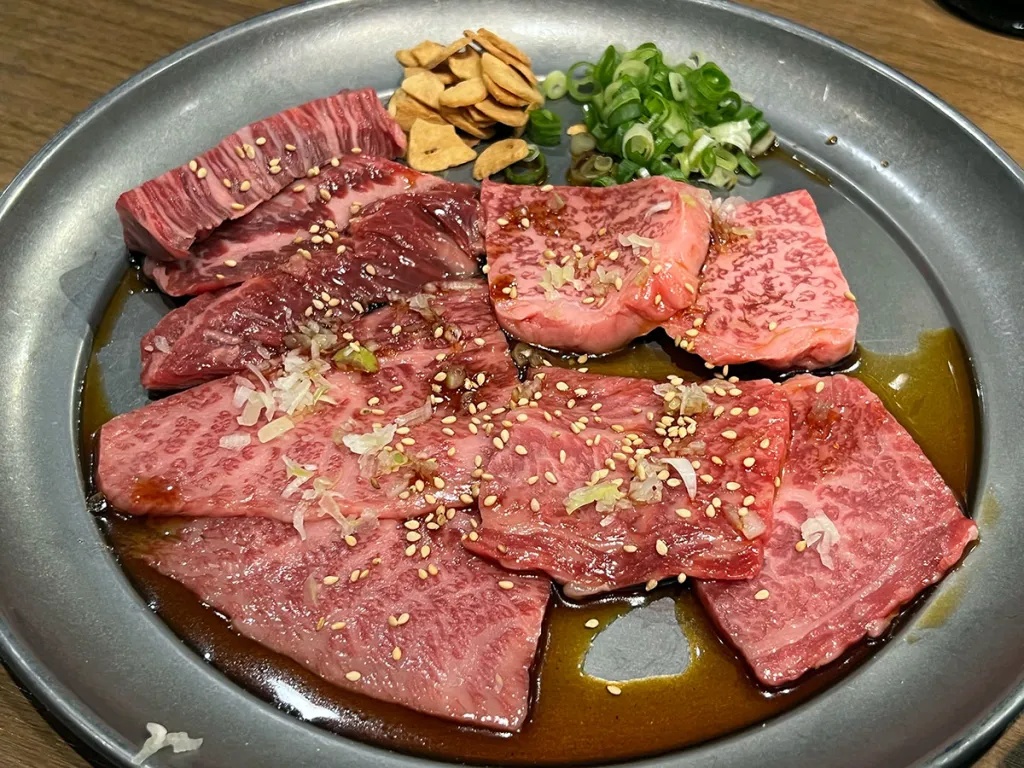
With the couples on either side of him as hot as the flames on his grill, our solo-dining yakiniku fan finds a mental escape.
Dining at a yakiniku restaurant in Japan quickly becomes a series of choices to make. Yakiniku menus consist primarily of a wide variety of different types and cuts of meat that you grill yourself, but per-plate portions tend to be small, so you’ll need to make multiple orders to get enough food to fill yourself up.
If you’re ordering a la carte, different kinds of meat have different prices, but many yakiniku restaurants offer all-you-can-eat options that give you unlimited access to certain types, and when our Japanese-language reporter Yuichiro Wasai opted for such a deal on a recent yakiniku outing, you’d think he would have then just ordered based on what kinds of meat he thinks taste the best. Things got a little more complicated, though, after Yuichiro sat down.
At most yakiniku restaurants, the majority of the seats are at tables with space for two, four, or more diners. At some, though, you’ll also find counter seating, and since that was an option on this day, Yuichiro had grabbed a counter seat. However, shortly after that a couple on a date sat down at the counter to one side of him, and then soon after that, another couple sat down on the other side.
In other words, Yuichiro was now sandwiched between two couples, and while they weren’t having full-on make out sessions, both pairs were in clearly lovey-dovey moods, scooched up against each other with their arms around each other as they ate.
Yuichiro found himself feeling increasingly self-conscious as he sat in what was a small buffer zone between the two amorous pairs, but because he was by himself, he couldn’t just focus on any dinnertime conversation of his own, and with his counter seat facing a wall, he couldn’t stare out a window either. However, it was at this moment that he realized that even though he was by himself, he could call on two allies to help him escape his feelings of awkwardness. Who were those saviors?
Beef short ribs and pork belly.
As mentioned above, at yakiniku restaurants you cook your meat yourself at a grill set into your table or section of the counter. Different cuts take different amounts of time to cook, but beef short ribs (kalbi) and pork belly tend to be two of the quicker ones to grill, which also means that they’ll burn more quickly than others. In other words, you’ve got to pay very close attention when cooking kalbi and pork belly, and the more Yuichiro was focused on his meat, the less he noticed the heat coming off of the couples on either side of him.
With kalbi and pork belly being fairly fatty cuts, they also produce a lot of drippings as they cook, which causes flames to flare up from the grill. Usually this is a startling, or at least annoying, part of the yakiniku cooking process, but Yuichiro welcomed the distraction. Sometimes the flames were so strong that he felt the need to put an ice cube on the grill to cool things down a bit, and again, he was happy to have a reason to concentrate on what was in front of him, rather than on his flanks.
Though they’re not the only dripping-intensive yakiniku menu items, in his experimentation Yuichiro found that kalbi and pork belly have the best combination of juicy drippings and quick cooking time, letting you keep your cooking tongs, chopsticks, and brain in near-constant activity. So even though the all-you-can-eat option he’d ordered allowed him to choose from a broader swatch of the menu, he kept up a heavy rotation of kalbi and pork belly for his entire meal, as they truly are the best choices for someone who feels self-conscious when surrounded by couples.
Photos ©SoraNews24
● Want to hear about SoraNews24’s latest articles as soon as they’re published? Follow us on Facebook and Twitter!
