
 Login
Login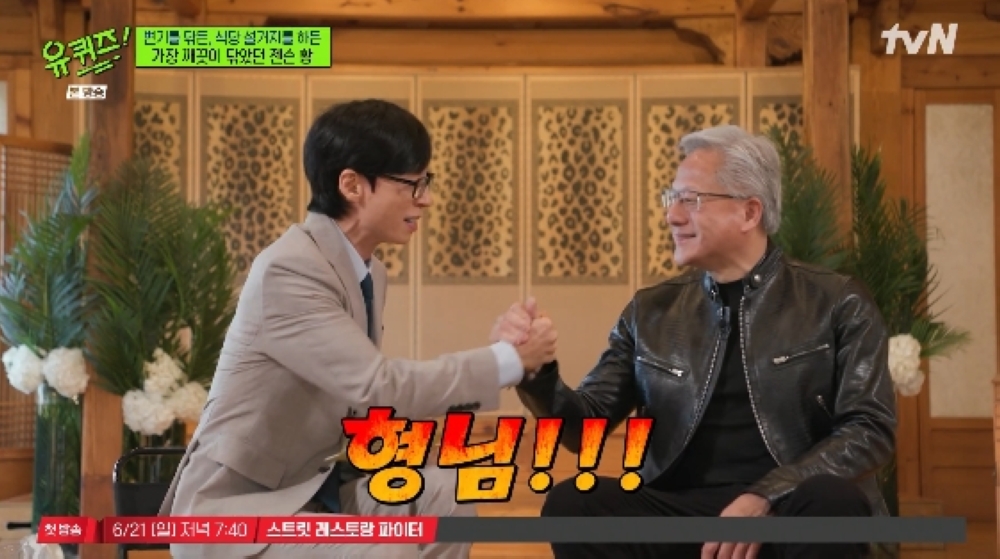


Faker, fried chicken and AI: Jensen Huang enters his K-Variety era on ‘You Quiz on the Block’

SEOUL, June 12 — Nvidia chief executive Jensen Huang used his first-ever appearance on a variety talk show to deliver what amounted to a love letter to South Korea, crediting the country’s gamers, companies and decades-long partnerships with helping transform Nvidia into a global powerhouse.
“Our lives, our history are very close, and Korea has always been a very close part of my heart,” Huang said on tvN’s You Quiz on the Block, which aired on Wednesday night.
Filmed during his recent visit to Seoul, the appearance marked the first time the Nvidia founder had sat down for a variety programme anywhere in the world.
Huang traced Nvidia’s ties with South Korea back some 25 years, arguing that the country’s gaming culture played a critical role in the company’s rise.
“Without all of the amazing gamers here, like Faker and so many others, Nvidia’s technology would not be a global phenomenon,” he said.
He was equally enthusiastic about Nvidia’s Korean partners.
“When I’m here in Korea, I want my partners to succeed. I want SK to succeed, I want Samsung to succeed, I want LG, I want Hyundai, I want Naver to succeed, and they know that,” Huang said.
“I will do my best work I can and I will give you 100 per cent.”
The television appearance capped a whirlwind visit that had turned Huang into an unlikely celebrity.
During his five-day stay in South Korea, the Nvidia chief drew crowds wherever he went, from a stop at a Hongdae internet cafe to meetings with leaders of some of the country’s biggest technology groups.
Even host Yu Jae-seok could not resist revisiting last year’s so-called “Kkanbu summit” — the fried chicken gathering involving Samsung Electronics chairman Lee Jae-yong, Hyundai Motor Group executive chair Chung Euisun and SK Group chairman Chey Tae-won.
Asked which of the three executives he was closest to, Huang diplomatically sidestepped the question.
“They’re all incredible, world-class leaders,” he said. “All three companies are very fortunate to have them.”
Beyond the corporate diplomacy, Huang reflected on the experiences that shaped him.
He recalled immigrating to the United States from Taiwan at the age of nine and taking on restaurant jobs that included washing dishes and cleaning bathrooms.
“The job didn’t matter,” he said. “When you finished, it represented you.”
Resilience emerged as a recurring theme. Huang revisited the mid-1990s period when Nvidia came within weeks of collapse.
“When you have nothing, you also have nothing left to lose, and that’s a very powerful person,” he said.
The conversation eventually turned to artificial intelligence and its potential impact on everyday life.
“AI is easy, computer is hard,” Huang said.
He argued that AI could lower barriers that have traditionally kept many people at arm’s length from technology, allowing users to communicate with computers in plain language rather than code.
To illustrate the point, Huang recalled meeting the owners of a barbecue restaurant he had visited the previous evening.
“They were so nice, they could be programmers,” he said.
“If they would like to create a new website, if they would like to create a new application, it’s easy — tell the AI to help you do that.”
The episode ended on a lighter note. One of the programme’s trademark “balance games” forced Huang to choose between a lifetime of samgyeopsal (grilled pork belly) or Korean fried chicken.
“Until last night, it was easy to decide,” he said, referring to a recent pork belly meal in Seoul.
“This is a choice I cannot make.”
