The Mary Rose is a remarkable remnant of maritime history. One of England’s largest Tudor Era vessels, the four-masted carrack sailed with a crew of around 450 sailors during the 16th century French and Italian Wars armed with anywhere between 78 and 91 guns. Those weren’t the only tools at the Mary Rose’s disposal. Thanks to primary sources and an extensive analysis following its recovery in 1982, the ship included some truly gnarly handheld weapons.
Some of the most intense—and mysterious—o
The Mary Rose is a remarkable remnant of maritime history. One of England’s largest Tudor Era vessels, the four-masted carrack sailed with a crew of around 450 sailors during the 16th century French and Italian Wars armed with anywhere between 78 and 91 guns. Those weren’t the only tools at the Mary Rose’s disposal. Thanks to primary sources and an extensive analysis following its recovery in 1982, the ship included some truly gnarly handheld weapons.
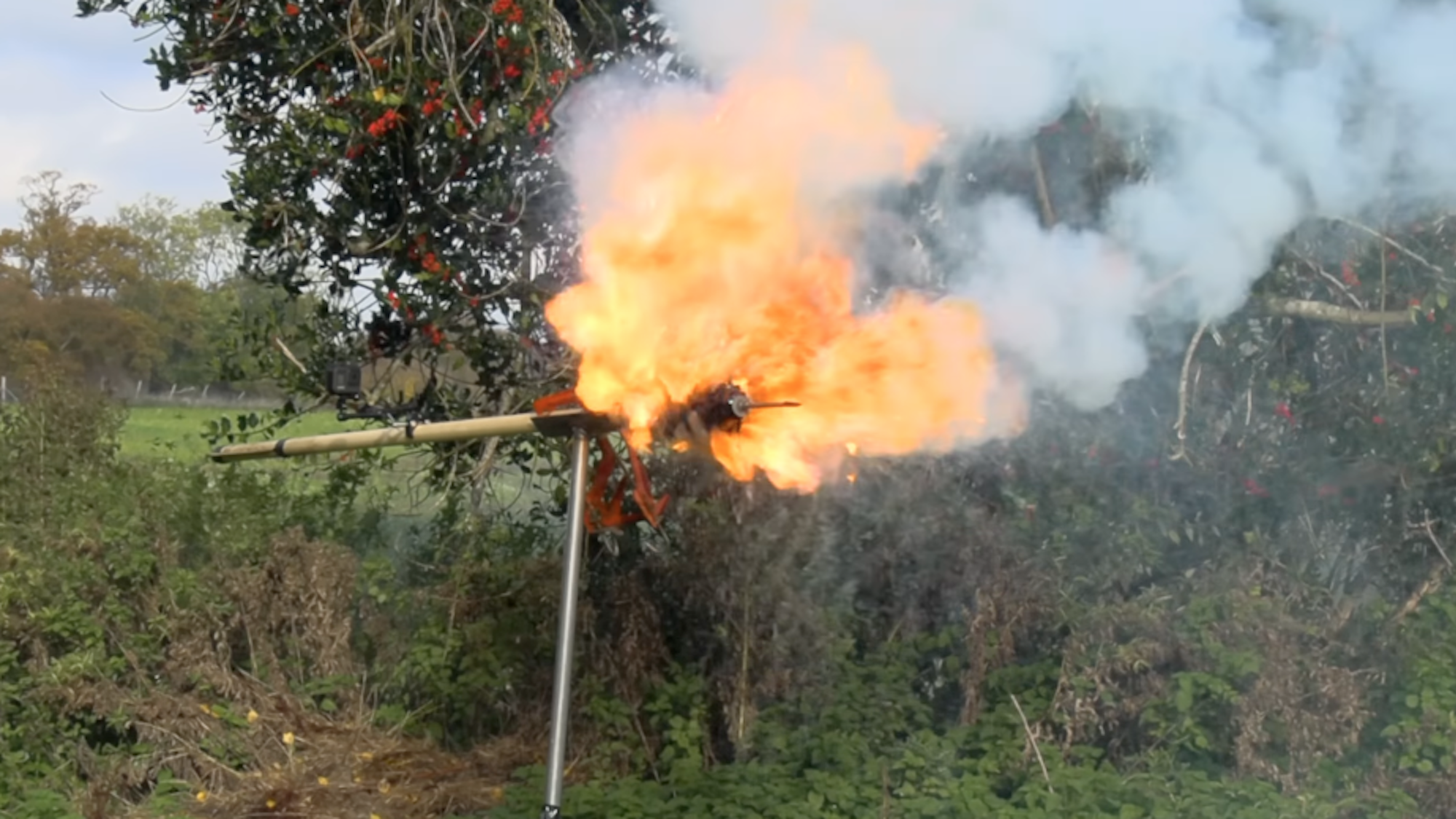
Some of the most intense—and mysterious—of these were giant incendiary darts. However, there is very little historical information tied to them. Although reminiscent of flaming arrows, these much larger variants were simply far too large to be launched from bows. Historians aren’t even sure exactly how they were wielded or crafted, so medieval weapons specialist and replica crafter Tod Todeschini decided to investigate for himself. The result is a two-part video series that documents his research into the fire darts, as well as the construction of his very own set.
Based on the remnants of the three surviving original examples, Todeschini’s weapon combines an incendiary mixture wrapped in flammable cloth that is then encased in pitch. Wooden fuses inserted into the casing provide a delayed ignition, allowing the wielder enough time to aim and launch the wooden spear at their enemy.
But how were they used in combat? While there is no definitive answer, Todeschini’s experiments alongside Mary Rose Museum research director Alex Hildred led to some likely possibilities. He quickly realized that his initial instinct to hurl it one-handed like an oversized dart was basically impossible—and incredibly dangerous. Once the javelin was lit, you want to be as far away from the melting pitch and flames as possible. Knowing this, he then learned that he could effectively launch the weapon by gripping it near the shaft’s middle while using his other hand to support the end. Subsequent throws easily carried the flaming spear upwards of 60 feet away. That may not be very far compared to a bow-and-arrow’s distance, but it’s more than enough for someone standing in a crow’s nest aboard the Mary Rose to reach an enemy ship that has drawn up to the vessel during close combat.
It’s also plausible that sailors fired their darts from specialized cannons. A standard amount of gunpowder would destroy the supersized arrow before it hit its target, but a soft charge producing less force is a feasible alternative. Todeschini also tested this version by launching a scale model of the dart from a tube using compressed gas.
From there, it was time to see what kind of destruction these weapons rained on unfortunate sailors’ heads. In short, you would not want to encounter one of these things. Aside from virtually inextinguishable flames fueled by molten pitch, the payloads likely included toxic ingredients like camphor and arsenic. The ensuing clouds of smoke would not only blind anyone nearby, but choke them, too. To illustrate their efficacy, Todeschini demonstrated what happens when one of the darts lands in an enclosed environment like those below deck on a ship. After firing one into a shipping container, it only took a matter of seconds before the entire area was enveloped in noxious fumes.
While the weapons weren’t useful in every situation, it’s easy to see how a few well aimed launches could turn the tide during naval combat. That said, they weren’t a guarantee for success—the Mary Rose ultimately sank during battle in 1545, after all.
dimparcio posted a photo:
Ironbridge 40's Weekend 2026, held 23rd and 24th May 2026 at Dale End Park, Ironbridge, in Shropshire. An annual 1940's military and civilian re-enactment, using themes and characters mostly from the European theatre of conflict. As always, the atmosphere was fun, friendly and vibrant. Photos taken
Pictures were taken on the Sunday, 24/05/26, at a public event where it is assumed to be OK to publish on the internet. Permission was granted by the subjects f
Ironbridge 40's Weekend 2026, held 23rd and 24th May 2026 at Dale End Park, Ironbridge, in Shropshire. An annual 1940's military and civilian re-enactment, using themes and characters mostly from the European theatre of conflict. As always, the atmosphere was fun, friendly and vibrant. Photos taken
Pictures were taken on the Sunday, 24/05/26, at a public event where it is assumed to be OK to publish on the internet. Permission was granted by the subjects for posed photos. However, if anyone wants any photo removed from this set, please contact me, Bob, at dimparcio@protonmail quoting the file number eg DSC1234 and I will do so forthwith. Otherwise, if you like them and would like to download them, please do so, especially if it helps promote re-enactments such as this.
dimparcio posted a photo:
Operative of the French Resistance with the Cross of Lorraine on her right arm.
Operation Jedburgh was a clandestine operation organised by special operations units from Great Britain, the USA and the French government in exile.
Ironbridge 40's Weekend 2026, held 23rd and 24th May 2026 at Dale End Park, Ironbridge, in Shropshire. An annual 1940's military and civilian re-enactment, using themes and characters mostly from the European theatre of conflict.
Operative of the French Resistance with the Cross of Lorraine on her right arm.
Operation Jedburgh was a clandestine operation organised by special operations units from Great Britain, the USA and the French government in exile.
Ironbridge 40's Weekend 2026, held 23rd and 24th May 2026 at Dale End Park, Ironbridge, in Shropshire. An annual 1940's military and civilian re-enactment, using themes and characters mostly from the European theatre of conflict. As always, the atmosphere was fun, friendly and vibrant. Photos taken
Pictures were taken on the Sunday, 24/05/26, at a public event where it is assumed to be OK to publish on the internet. Permission was granted by the subjects for posed photos. However, if anyone wants any photo removed from this set, please contact me, Bob, at dimparcio@protonmail quoting the file number eg DSC1234 and I will do so forthwith. Otherwise, if you like them and would like to download them, please do so, especially if it helps promote re-enactments such as this.
GENEVA, June 9 — Worldwide spending on nuclear weapons soared to a record high last year as atomic-armed countries moved more warheads from storage onto delivery systems, experts said today.The nine nuclear-armed states jointly spent nearly US$119 billion (RM483 billion) on their arsenals last year, up 19 per cent from 2024, according to the International Campaign to Abolish Nuclear Weapons (ICAN).“A new nuclear arms race is upon us,” its report warned.ICAN, and
GENEVA, June 9 — Worldwide spending on nuclear weapons soared to a record high last year as atomic-armed countries moved more warheads from storage onto delivery systems, experts said today.
The nine nuclear-armed states jointly spent nearly US$119 billion (RM483 billion) on their arsenals last year, up 19 per cent from 2024, according to the International Campaign to Abolish Nuclear Weapons (ICAN).
“A new nuclear arms race is upon us,” its report warned.
ICAN, and a separate study by the Stockholm International Peace Research Institute (SIPRI) released on Monday, voiced alarm at the growing nuclear risk amid swelling geopolitical tensions.
The dramatic spending hike on nuclear weapons came as countries rushed to modernise their arsenals and deploy more of their stockpiles, the studies showed.
Susi Snyder, ICAN’s director of programmes and co-author of the latest report, said the scale-up, coupled with fears that artificial intelligence could increase the risk of nuclear weapons use, was deeply alarming.
“To be perfectly honest, I’m terrified,” she told AFP.
US Ballistic Missile Submarine USS Kentucky is anchored at Busan Naval Base, in Busan, South Korea, July 19, 2023. — Woohae Cho/Pool/Reuters pic
‘Risks are rising’
SIPRI’s report highlighted that the total estimated number of nuclear warheads had been declining for decades, falling to 12,187 at the start of this year, but warned the number of weapons available for potential use had risen, to 9,745.
“Even though we have lower numbers of nuclear weapons, the level of nuclear dangers and nuclear risks are rising,” SIPRI director Karim Haggag told AFP.
He pointed to worrying signs, including the breakdown in strategic arms controls and competition between great powers with nuclear arms.
SIPRI predicted that overall nuclear arms stockpiles were likely to begin growing again in coming years “as the pace of dismantlement is slowing, while the deployment of new nuclear weapons is accelerating”.
The United States and Russia together hold around 83 per cent of the world’s nuclear arms stockpile, with more than 5,000 warheads each. China is expanding its nuclear arsenal faster than any other country, SIPRI said, estimating that it counts around 620 warheads.
“Intensifying geopolitical competition means a very strong incentive on the part of China to increase its reliance on nuclear weapons,” Haggag said.
ICAN’s report indicated that all nuclear-armed states, which also include Britain, France, India, Israel, North Korea and Pakistan, were increasing investments in their arsenals.
The nine countries jointly spent nearly US$17 billion more last year than in 2024 on the weapons of mass destruction.
Washington spent more than all the other countries combined, dishing out US$69.2 billion on nuclear weapons in 2025 — an increase of US$12.4 billion from a year earlier, ICAN said.
The United States was followed by China, which was estimated to have spent US$13.5 billion last year, then Britain at US$12.6 billion and Russia at US$9.5 billion, it said.
Over the past five years, it determined that the nine countries had spent over US$470 billion on their arsenals.
Long lifespans
Those investments are expected to grow going forward.
Examining longer term projections, ICAN highlighted figures from Britain, France and the United States showing plans to spend billions to develop and maintain nuclear weapons systems well into the next century.
Other countries too were introducing new weapons systems with long lifespans, it said.
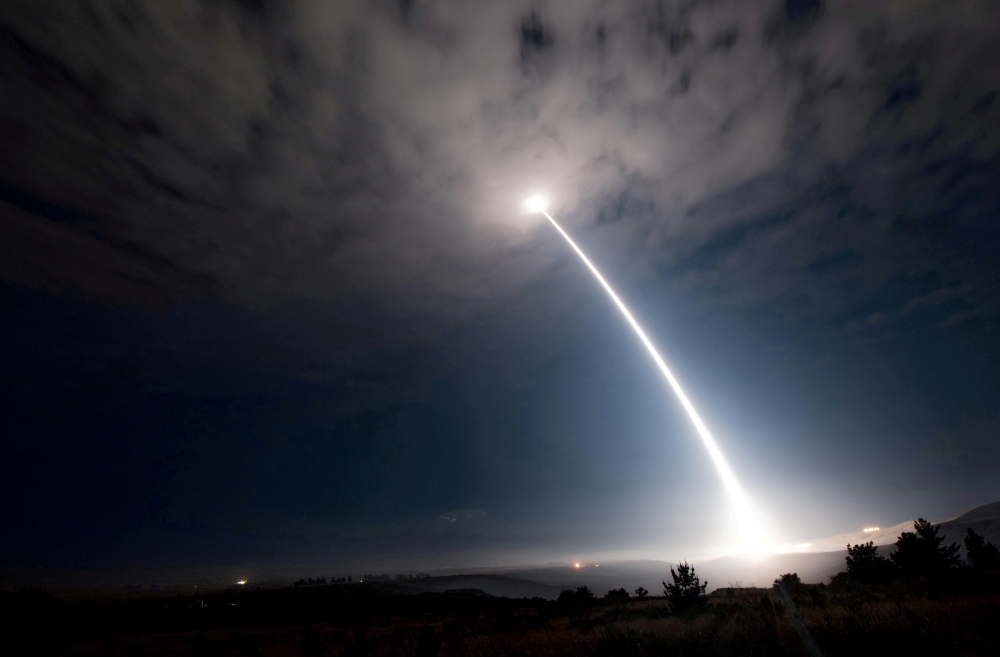
The report pointed out that planned new US Sentinel intercontinental ballistic missiles were expected to remain operational past 2100, while swelling US plutonium pit production indicated that the country’s warheads would last through 2120.
That will mean significant investment, with US nuclear arms spending over just the decade between 2025 and 2034 projected at close to US$1 trillion.
Researchers said the huge sums were particularly jarring at a time when the global humanitarian system was reeling from dramatic funding cuts.
Just a single day of nuclear weapons spending last year could have provided food security to more than two million people, they said.
Instead of providing aid or healthcare for their populations, the nuclear-armed states were investing in “an arsenal that they themselves know they cannot use without committing a war crime”, Snyder said.
“There seems to be a total disconnect from reality.” — AFP
Poland and Lithuania confirm they are participating in discussions about their potential role in NATO's nuclear deterrence efforts, which are built around U.S. nuclear weapons in Europe.
Poland and Lithuania confirm they are participating in discussions about their potential role in NATO's nuclear deterrence efforts, which are built around U.S. nuclear weapons in Europe.
The Americans were closing in, the situation was getting more dangerous by the minute — and President Xi Jinping was waiting for my recommendation.
The standoff began in May, when the US announced a package of anti-aircraft and anti-ship missiles to Taiwan that would significantly upgrade the island’s ability to repel a Chinese invasion. We ordered massive military exercises in the region as a show of force. The US soon responded by sending the USS Abraham Lincoln to lead its own exerc
The Americans were closing in, the situation was getting more dangerous by the minute — and President Xi Jinping was waiting for my recommendation.
The standoff began in May, when the US announced a package of anti-aircraft and anti-ship missiles to Taiwan that would significantly upgrade the island’s ability to repel a Chinese invasion. We ordered massive military exercises in the region as a show of force. The US soon responded by sending the USS Abraham Lincoln to lead its own exercises with a joint contingent of Australian and Japanese forces.
If we showed weakness, Taiwan might be lost to China forever. If we were too aggressive, it could lead to World War III. But with so many ships and aircraft menacing the region, all with unclear intentions, the situation was getting too complex for commanders to process, and the risk of a deadly miscalculation was rising. Already, there had been a tense near-miss when a Chinese maritime militia fired on an American helicopter — thankfully, without casualties.
Key takeaways
Recent events in Ukraine and Iran show that the use of artificial intelligence on the battlefield has very quickly gone from a speculative scenario to a current reality.
This has led to fears that AI could increase the risk of nuclear escalation, either by acting in a way that its designers don’t intent, or simply moving too fast for human commanders to keep up.
Ironically, it turns out be the best way to decrease the risks of how AI will perform in war may be to train humans in how to interact with it.
Perhaps it was time to let the machines take over.
The commander of the Chinese naval strike force in the region requested permission to turn on our recently deployed AI hub, which could coordinate the defense systems of all ships in the region and was capable of differentiating between friend and foe, firing in response to threats, and finding the optimal course of action based on China’s rules of engagement and available resources. In other words, if the Americans attacked, it could decide the appropriate response faster than any human.
As the vice chairs of the Central Military Commission, my colleagues and I were tasked with making a recommendation to the president. The system could buy us precious seconds to rescue ships from imminent attack,but it was also untested in combat situations and had reached only 95 percent accuracy in tests.
After a tense discussion, we ultimately decided to employ the new system, but keep it in a “human-in-the-loop” setting that would require us to give a final order before firing. We were taking a cautious approach.
Not cautious enough, as it turned out.
A few days later, the AI-enabled system malfunctioned, opening fire on a US vessel and killing a number of US soldiers. Soon, American politicians and media were calling for payback. US ships began conducting joint patrols with the Taiwanese navy. Our intelligence sources indicated President Donald Trump was close to declaring an official alliance with Taiwan and basing US troops on the island.
We were on the brink of all-out war.
Fake war, real problem
As you’ve probably surmised, this is a fictional scenario. I am not actually a high-ranking Chinese general, and Trump risking war with China over Taiwan is not exactly what transpired in the real May 2026.
The story comes from the script of a wargame conducted by Stanford University’s Hoover Institution that I participated in last fall. The “vice chairs” in the simulation were a bipartisan group of staffers and China policy wonks sitting in a comfortable Washington, DC, conference room over coffee and bagels. (As a condition of participating in the game, I agreed not to name or directly quote any of the participants.)
But the concern that the game illustrates, of an AI-enabled defensive system causing a military crisis tospin out of control,is a very real one. Experts are increasingly worried that AI-enabled systems could cause military conflicts to escalate faster than any human can control or anticipate — or that a miscalculation could lead to AI taking military actions that humans never intended, with deadly consequences. And the risks are especially acute when it comes to nuclear-armed countries like the US and China.
To date, AI-enabled systems have been used mainly by militaries like America’s and Israel’s in conflicts where they already had overwhelming advantages over their opponents, or by countries like Ukraine to level the playing field against a much larger foe. But what would it look like in a war between two “near peer” superpowers like the US and China?
This is no longer just a theoretical question. Under an initiative that began in the Biden administration, the US is working to develop fleets of small, cheap AI-enabled drones that could create a cost-effective “hellscape” to counter a Chinese invasion of Taiwan. The decisions my team made in our simulated conflict could be on the table in a real conflict sooner rather than later.
We may not be able to turn back from this new frontier. But if government and military leaders can figure out its rules and update their thinking in time, they might be able to head off the global war that they’ve spent generations trying to prevent.
The rise of battlefield AI
Jacquelyn Schneider, director of the Hoover Wargaming and Crisis Simulation Initiative, has been conducting games related to the topic of artificial intelligence and crisis escalation for several years now, with participants roleplaying nations on both sides of hypothetical conflicts. When she began running the war games, the capabilities in the “May 2026” scenario still felt futuristic. Lately, the game has “felt a little bit less like science fiction,” she told me.
The Pentagon has been actively working to accelerate the use of AI to detect threats, identify targets, and support commanders’ decision-making for years now. Its early initiatives during the first Trump administration were born in part out of officers’ frustration with data analysis failures that led to the deaths of US troops in Iraq and Afghanistan. The US military collected vast amounts of information from sensors, satellites, and human sources, but was often too slow to find threats to troops on the front lines. The dream was a system that could detect potential dangers earlier and give users options for how to destroy them far faster than human analysts, dramatically shortening what military planners call the “kill chain.”
Now we’re seeing AI programs handle real-world combat situations on a daily basis. Maven Smart System, the Palantir-supplied system that integrates data from satellites, drones, and numerous other sensors, has been used by the US to pass along dozens of potential Russian targets per day to Ukrainian forces. The Ukrainians themselves have developed a system nicknamed “Uber for artillery” to coordinate fire across the frontline. During the war in Gaza, the Israeli military system employed an AI-enabled system known as “Lavender” to identify Hamas targets, though some reports suggest it may have had an error rate of around 10 percent.
The US military has used AI in its recent operations in Venezuela and Iran, which generated significant scrutiny after a targeting mistake killed at least 175 people at a school in Minab, most of them children. It’s not clear yet whether the AI systems Claude and Maven Smart System played a role in that specific strike, but both were widely used in the bombing campaign, according to US officials.
Nonetheless, Secretary of Defense Pete Hegseth is aggressively pushing to deploy AI more widely across US military systems. Earlier this year, the Pentagon threatened to block Anthropic, Claude’s owner, from being used across government — reportedly over the company’s demand that its software never be used for mass surveillance or autonomous weapons. Anthropic wanted to keep a human in the loop on life-or-death decisions, while Pentagon officials reportedly wanted the option to bypass the company and use the program however they wished.
Which brings us back to the US and China. While AI-enabled errors may have led to tragic civilian deaths in Gaza and Iran, those errors in a US-China conflict could have truly global consequences.
The bombing of the Minab school, for example, has been compared in some coverage to the accidental US bombing of the Chinese embassy in Belgrade in 1999. That incident, which occurred at a time when US-Chinese relations were comparatively friendly and China’s military was much smaller, sparked a diplomatic crisis. Today, something similar might spark a war — and, in an increasingly automated battlefield, one that could turn from a conventional conflict into a nuclear exchange faster than human military leaders can keep up.
AI and the escalation ladder
This isn’t the first time a new military technology has forced a rethink of how limited wars can turn into much bigger ones. The advent of nuclear weapons made the management of conflict escalation a pressing issue for Cold War defense strategists.
The most famous of these was the RAND Corporation’s Herman Kahn, who devised a 44-run “escalation ladder” in 1965 to model conflict in a nuclear era. The ladder began at a nonviolent cold war, and ascended through conventional war with “limited” nuclear exchange kicking in around rung 15, ascending all the way up to a mindless and apocalyptic nuclear “spasm” at rung 44.
Kahn’s writings are unnerving in their cold rationality. (He was one of the inspirations for Stanley Kubrick’s character, Dr. Strangelove.) But a concern throughout the nuclear era has always been that a crisis could escalate due to human miscalculation or technical error rather than rational calculation.
Just a few years earlier, in 1962, this had very nearly happened during the US-Soviet confrontation over Cuba. In what is generally acknowledged as the closest the Cold War ever got to going nuclear, the US, alarmed by the deployment of Soviet missiles to Cuba, ordered a blockade of the island, warning that any attempt by the Soviets to ship additional military hardware to the island would be met with force.
In one of the most unnerving near-misses of the Cuban Missile Crisis, the captain of the Soviet submarine B-59, after being hit by US depth charges and finding himself unable to contact Moscow or other ships in the area, nearly fired a nuclear-armed torpedo.
Both sides in the standoff came away convinced that they needed to find ways to signal their moves up and down the escalation ladder more clearly in order to prevent an accidental war. The next year, Washington and Moscow installed a “hotline” for instant phone communication between the US president and the Soviet premier.
“Few things are more important to militaries in crisis situations than informational awareness and control over decisions.”
Michael Horowitz, former deputy assistant secretary of defense
But what if the next several steps up the escalation ladder happened without their input at all? In a 2019 paper, Michael Horowitz, a former deputy assistant secretary of defense, now a professor at the University of Pennsylvania, imagined how the Cuban Missile Crisis might have played out in the age of AI. After ordering the US Navy to blockade Cuba, President John F. Kennedy could have had a system like the one in the Hoover simulation pre-programmed to fire on any Soviet ship that attempted to run the blockade.
It’s possible this could be effective signaling. A popular metaphor in the Cold War era involved one player in a game of “chicken” throwing their steering wheel out the window to resolve any doubt about where they were headed.
If Kennedy could have convinced the Soviets that his killer robots would fire on any ship that approached Cuba without even waiting for his orders, it might have deterred Russian leaders who might otherwise doubt America’s willingness to fight a nuclear war. On the other hand, the US would be putting an extraordinary amount of trust in an automated system not to make mistakes or — as in the B-59 episode — to interpret an ambiguous incident the same way a human commander who doesn’t want to see his own family incinerated in a nuclear blast might.
“Few things are more important to militaries in crisis situations than informational awareness and control over decisions,” Horowitz wrote.
A nuclear “flash crash”
One major concern is that if key decisions are delegated to AI systems, which may themselves be responding to decisions taken by the enemy’s AI systems, a conflict could simply escalate too fast for human decision makers to keep up.
In his book, Army of None, Paul Scharre, the former Pentagon official who’s now at the Center for a New American Security, cites the example of the 2010 “flash crash,” in which the Dow Jones lost nearly 9 percent of its value within minutes, only to recover it less than hour later — an incident blamed on the cascading interactions of algorithmic trading programs responding to each other’s moves without human intervention. The fear is that the next superpower war could be a “flash war.”
Rebecca Hersman — former director of the Pentagon’s Defense Threat Reduction Agency who’s now at the Center for the Governance of AI (GovAI), an independent think tank — has warned that modern technologies, including AI, have the potential to scramble the linear escalation ladder envisioned by Kahn into a more unpredictable dynamic she refers to as “wormhole escalation.”
She sees several ways this could happen, and they don’t necessarily require humans to cede complete control to an AI defense system. The data the enemy’s AI systems are using to assess threats could be spoofed or contaminated, pushing leaders into a quick decision with bad intelligence. Or AI-generated disinformation or deepfakes could influence the decisions of military or political leaders deciding whether to escalate or de-escalate a conflict: This risk was dramatically demonstrated during the brief 2025 armed conflict between India and Pakistan, when social media on both sides were flooded with misinformation, making it difficult to get an accurate picture of the battlefield and driving both sides toward more aggressive stances. (This was also likely the first armed conflict between two nuclear-armed rivals in which both sides used AI-augmented weaponsand AI-generated misinformation against their adversaries.)
“An AI optimized around predefined goals may overlook opportunities for de-escalation, not because it technically malfunctions, but because it was never designed with the ambiguity to build trust or manage a crisis.”
James Johnson, author of AI and the Bomb: Nuclear Strategy and Risk in the Digital Age
The risks are compounded by other trends, including the commingling of nuclear and non-nuclear capabilities on the battlefield. Russia, for instance, has made abundant use of its nuclear-capable “Oreshnik” missiles (armed, thankfully, with conventional payloads) in deadly strikes against Ukrainian cities. China also has dual-capable missiles that would make it difficult for analysts to tell nuclear from non-nuclear launches during a conflict.
Where does AI come in? Stephen Herzog, professor at Middlebury Institute of International Studies’ James Martin Center for Nonproliferation Studies, imagined a combat scenario in which the US is attempting to destroy a Chinese target with a conventionally armed intercontinental ballistic missile fired from hundreds or even thousands of miles away. If the launch failed, an AI battle management system might decide that a submarine right off the Chinese coast should destroy the target instead. But this could cut the amount of time the Chinese had to decide whether they were under nuclear attack from minutes to seconds.
“That’s incredibly effective operationally, but it is terrifying from an escalation perspective, because we’ve now lost time for interpretation, we’ve lost time for signaling, and we’ve lost time for potential restraint,” Herzog said.
Then there’s the question of whether AI itself is inherently escalatory. Leaders decide to start and end conflicts by weighing the risks and benefits, but also by using human intuition to guess their counterparts’ thinking, imagine their intentions and fears, and consider whether there’s room for common ground. Two algorithms sizing each other up might approach these questions in a fundamentally different way.
“An AI optimized around predefined goals may overlook opportunities for de-escalation, not because it technically malfunctions, but because it was never designed with the ambiguity to build trust or manage a crisis,” said James Johnson, a senior lecturer at the University of Aberdeen and author of the book AI and the Bomb: Nuclear Strategy and Risk in the Digital Age.
A study from King’s College London published in February found that in simulated war games, chatbots including ChatGPT, Claude, and Gemini are extremely likely to use nuclear signalling and tactical nuclear weapons use, and tend to treat “nuclear weapons as legitimate strategic options, not moral thresholds.” Hoover’s Schneider has found similar results when she has popular chatbots play her wargames. However, other researchers have found that models can be properly prompted to provide less escalatory options.
AI technology, unlike nuclear weapons, is also still in its relative infancy. While the Cold War powers could rely on mutually assured destruction — a credible fear that both sides would be annihilated in any nuclear conflict — to discourage brinkmanship, some experts fear that a breakthrough in AI on one side could lead the other to conclude it had to act quickly or lose its ability to defend itself.
“One of the biggest effects of AI may be that, if, say, the US is just so much better at integrating AI than China that the US may rapidly win a conflict over Taiwan, that puts pressure on the Chinese to use nuclear weapons right away,” said James Acton, co-director of the Nuclear Policy Program at the Carnegie Endowment for International Peace.
Other tech innovations could also tilt decision-makers toward escalation. AI-enabled targeted and intelligence monitoring could make “decapitation” strikes like the one that recently killed Iran’s Supreme Leader Ayatollah Ali Khamenei easier to carry out — precisely the sort of scenario one could imagine prompting a leader like North Korea’s Kim Jong Un or Russia’s Vladimir Putin to consider reaching for the nuclear codes.
The people problem
It’s probably too late to put the military AI genie back in the bottle, given the arms race between countries to develop cutting-edge systems first. The best way to handle the risks going forward might be, ironically enough, to train the humans responsible for using these systems to be more skeptical about their value.
As in nearly every domain, the people who fight wars for a living are clearly getting more comfortable with AI. The top US general commanding US forces in South Korea recently raised eyebrows after telling reporters he regularly consults ChatGPT to help with command decisions.
Nonetheless, most humans are still very reluctant to give up full control to the machines when it comes to life and death decisions. In the US-China war game I played, all of the groups chose to keep the AI system in “human-in-the-loop” mode, despite the assurances we were given about the system’s reliability, and that decision held no matter how dangerously the crisis escalated.
“At a minimum, meaningful human control means that when I delegate an authority to a system, it will not exceed the authority that it has been given,” said Hersman, of GovAI.
Many experts are less worried about AI escalating conflicts on its own, though, than they are with AI making humans more likely to escalate conflicts. A frequently expressed concern about the military use of AI is “automation bias,” the human tendency to give undue deference to computer-generated advice and conclusions.
“What seems to be most dangerous with AI is not necessarily uncertainty, but instead, perhaps overconfidence and misplaced certainty, and AI can really provide that,” said Schneider, the Stanford researcher who conducted the wargame. “The tools themselves are built to engender confidence.”
Schneider noted that Anthropic’s Claude, the system the Pentagon is hoping to remove with its systems, is the one that’s “more likely to tell you where uncertainty lies, as opposed to other models, which might take a more kind of strictly rational, ‘LeMay’ kind of approach” — a reference to the notoriously hawkish Cold War Air Force commander Curtis LeMay who once summed up warfare as “when you’ve killed enough [people] they stop fighting.”
It’s possible this bias towards AI-prompted escalation can be addressed with the right training. Arecent study by Horowitz, the former Pentagon official and UPenn professor, found, encouragingly, that West Point cadets exhibit automation bias at less than half the rate of civilians. The results suggest “we’re not condemned to a future of accidents due to overconfidence,” Horowitz said, as officers learn to take their suggestions with a grain of salt.
Horowitz believes that the design of AI interfaces, which present users not only with information but with the sources of that information, will go a long way toward determining what impact AI has on the battlefield. Though he’s relatively confident in how those systems are designed in the US, he notes, “I don’t know what China’s equivalent of Maven Smart System looks like.”
Ultimately, AI may do less to change the way people fight wars than to amplify it. While much of the coverage of the strike on the Minab school and Israel’s use of Lavender focused on the role of AI, ultimately it was most likely outdated targeting data in the first case and extremely permissive rules of engagement in the second that led to civilian casualties.
Hegseth’s push for expanded AI use comes as he also looks to loosen the rules of engagement and reduce the role of lawyers in military oversight, which have raised concerns that the US is becoming more tolerant of collateral damage and less willing to hold people accountable for potential war crimes.
“If you’ve programmed your AI well, trained it well, and ensured that only high-quality data goes into it, I could well believe that the results will be better than just the use of humans,” said Carnegie’s Acton. “Now, do I trust the current US or Israeli governments to use it responsibly? Probably not, is the answer.”
If the US finds itself in a major international conflict in the coming years, there may be a temptation to blame AI for speeding up the battlefield or engendering overconfidence in commanders. But ultimately, it will be humans who choose to put themselves in that situation.

 Login
Login