Artists Christian Rebecchi and Pablo Togni, who work as NEVERCREW, have a knack for bringing the immensity of nature to developed urban spaces. Their colorful, large-scale murals take a playful tack when it comes to portraying animals, often merging them with other objects such as instant photos or, most recently, a plastic punch-out toy. “Souvenir,” completed this year in Vienna, combines motifs of a large bear with other Arctic components, such as icebergs, a seabird, and a steamship.
“
Artists Christian Rebecchi and Pablo Togni, who work as NEVERCREW, have a knack for bringing the immensity of nature to developed urban spaces. Their colorful, large-scale murals take a playful tack when it comes to portraying animals, often merging them with other objects such as instant photos or, most recently, a plastic punch-out toy. “Souvenir,” completed this year in Vienna, combines motifs of a large bear with other Arctic components, such as icebergs, a seabird, and a steamship.
“The natural environment appears transformed, filtered, made artificial: it is no longer a space experienced through relationship, but a distant construction,” the artists say in a statement. The work is “almost a simulation reflecting a perception of nature progressively emptied of empathy…Nature becomes something to observe, arrange, organize, as if it were a separate object rather than a system of which we are an integral part.”
Detail of “Bracketing”
Over the past few years, NEVERCREW has completed numerous architectonic paintings that depict the fragile balance between humanity and nature—specifically wildlife. Whales, bears, and elephants are depicted inside of terrariums or bundled into fabrics.
The animals’ very presence on the side of buildings, where they are contained within the bounds of the architecture, is a reminder of the tensions between—one might even say the incongruousness of—daily human activities and city infrastructure. For Rebbechi and Togni, bringing nature into these spaces highlights the importance of sustaining the relationship between humankind and nature.
“Bracketing” (2021), diptych, Jarville-la-Malgrange, Nancy, France. Curated by LeMur NancyDetail of “Bracketing”Detail of “Bracketing”“Gravity” (2021), Le Locle, Switzerland, for Exomusée“Switch” (2024), Wuppertal, Germany, for Urbaner Kunstraum Wuppertal, curated by Valentina MaoilovDetail of “Switch”Detail of “Switch”“Wire” (2023), Paradiso, Switzerland. Organized and curated by Freefox Architecture StudioDetail of “Souvenir”Detail of “Souvenir”
The ocean floor is covered with dead whales–but it is everything but a biohazard. When a whale dies, its body sinks to the ocean floor in a process called whale fall. The carcass then becomes its own complex ecosystem, nourishing and housing all types of marine life. Whale bones can then fossilize over time, leaving behind traces of what life looked like millions of years ago.
Now, scientists in the Indian Ocean have discovered an enormous whale graveyard. The collection of bones and communit
The ocean floor is covered with dead whales–but it is everything but a biohazard. When a whale dies, its body sinks to the ocean floor in a process called whale fall. The carcass then becomes its own complex ecosystem, nourishing and housing all types of marine life. Whale bones can then fossilize over time, leaving behind traces of what life looked like millions of years ago.
Now, scientists in the Indian Ocean have discovered an enormous whale graveyard. The collection of bones and communities supported by these whale falls stretches 745 miles across the seafloor 13,779 to 22,965 feet deep. The oldest whale fossil is roughly 5.3 million years old and the graveyard even includes a new species of extinct whale. The findings are detailed in a study published today in the journal Nature.
“The deep sea is far from barren—it’s dynamic, full of life and history,” Dr. Xiaotong Peng, a study co-author and engineer at the Chinese Academy of Sciences (CAS), tells Popular Science. “When a whale dies and sinks, it becomes an oasis, supporting unique communities for decades or centuries.”
In 2023, CAS team was studying the geology and biology of the southeast Indian Ocean’s hadal zone—the ocean’s deepest zone, extending from 19,680 to 36,000 feet-deep. While inside of a submersible, the divers spotted the first whale fossil 22,972 feet below the surface.
Recovery of whale fossil bones using the manipulator arm of the Chinese submersible Fendouzhe on the deep seafloor of the Diamantina Zone, a deep-sea rift in the Indian Ocean. Image: Global TREnD, IDSSE.
According to study co-author and geologist Dr. Peng Zhou, the remains were actually “quite easy to find” once the team began to search. “They looked unusual, so when the dive scientists first encountered them, they wanted to figure out what they were,” Zhou tells Popular Science.
Peng adds, “We immediately pivoted our objectives to systematically map, document, and sample these whale remains. So it really came down to curiosity meeting the technological capability to explore depths that had been largely inaccessible.”
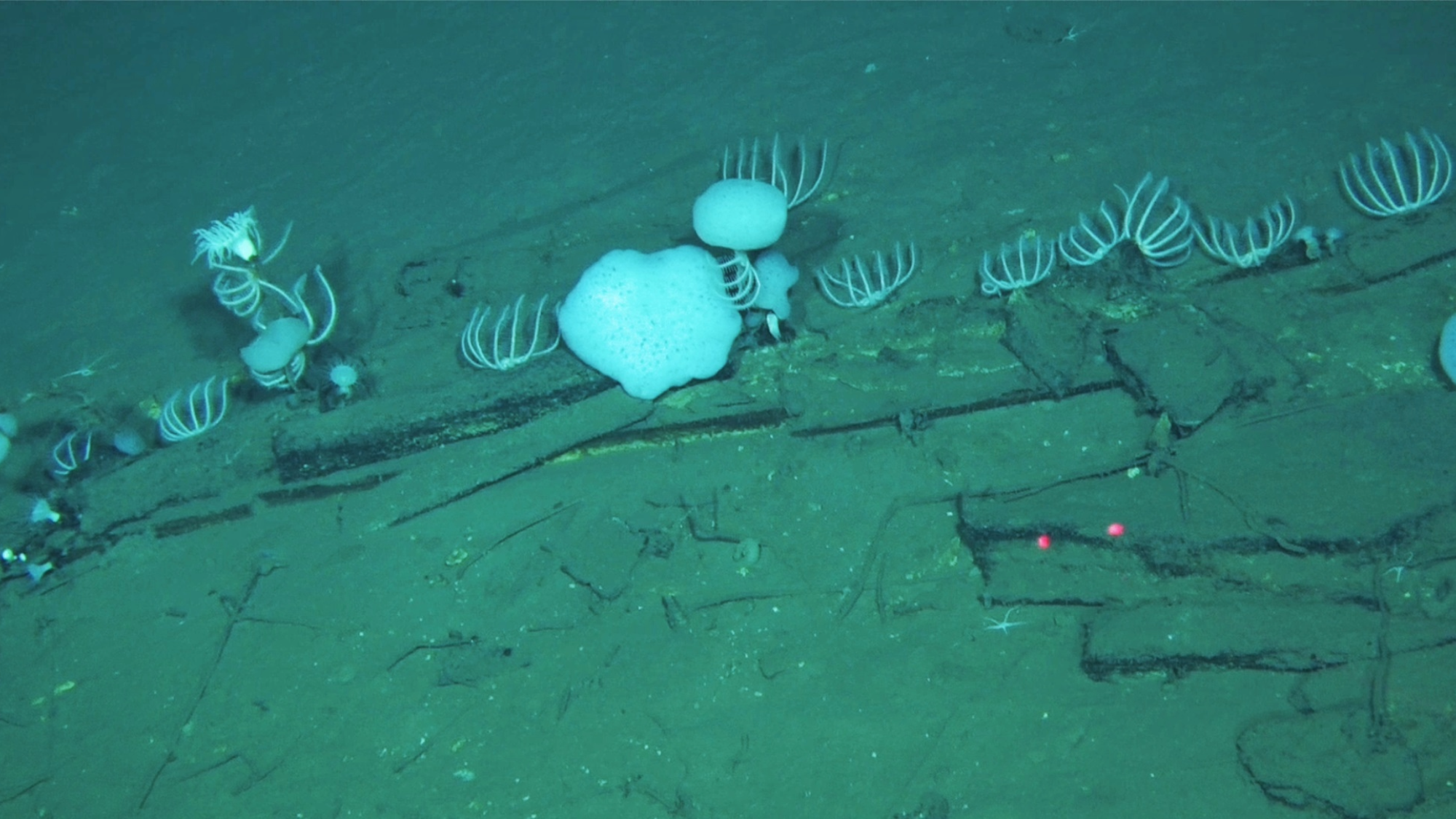
They documented 485 whale fossil sites from five active whale falls. The whale carcasses are home to a large community of jellyfish, brittle stars, bone-boring worms, and bivalves. Some of these species living in the carcasses may even be new to science, but that has not been confirmed. The oldest have been in the area for about 5.3 million years ago (the Pliocene era).
Fossil skulls of three beaked whales recovered from the seafloor at hadal depth of the Diamantina Zone, 6,584–-6,878 meters. The image shows two extinct beaked whale species, Pterocetus diamantinae sp. nov. (new species to science, on the top) and Izikoziphius rossi (the second skull), as well as an extant Andrews’ beaked whale, Mesoplodon bowdoini (two skulls on the bottom). Image: Global TREnD, IDSSE
Most of the whale fossils come from several species of deep-diving beaked whales. Some of the bones belong to beaked whales that still exist today. Others are from extinct whales, including a species new to science named Pterocetus diamantinae.
“Finding both extinct genera like Pterocetus and living species like Mesoplodon bowdoini preserved together in the same region, across 1,200 kilometres [745 miles] of seafloor at such extreme depths—that was truly unexpected,” says Zhou.
This fossil record is also continuous, so the team can track the population dynamics and evolution of deep-diving whales over time.
“These fossils give us a direct window into the Pliocene, about 5.3 million years ago,” study co-author and biologist Dr. Xikun Song tells Popular Science. “They show that beaked whales were already specialized deep‑divers in the Indian Ocean by that time. Beyond the whales themselves, the associated fossil fauna also tells us about the structure of ancient deep‑sea whale‑fall communities and broader deep‑sea biodiversity back then.”
This whale graveyard could reshape our understanding of both living and extinct beaked-whales. There are roughly 24 species of beaked-whale living today. However, their deep-sea habitat, likely low population numbers, and reclusive behavior make them difficult to study. Having such a large fossil deposit like this could help explain more about their reclusive lives.
The fossils are also shedding more light on the mysterious ecosystems living at the ocean’s deepest depths.
“Discoveries like this are possible because of curiosity, collaboration, and technology,” Peng concludes. “We’ve barely scratched the surface of the deep ocean, and there’s so much more waiting to be found.”
 Login
Login