Bogotá, Colombia – Hard right provocateur Abelardo de la Espriella won a shock victory in the first round of Colombia’s presidential elections Sunday, and will head to a run-off with leftist Iván Cepeda in June.
The most recent voter intention polls had predicted Cepeda beating de la Espriella in the first round by an average of eight points.
With over 99% of votes counted, de la Espriella leads Cepeda, by nearly three percentage points (43.7% to 40.9%).
A run-off election will take place on June 21 since no candidate achieved over 50% vote share.
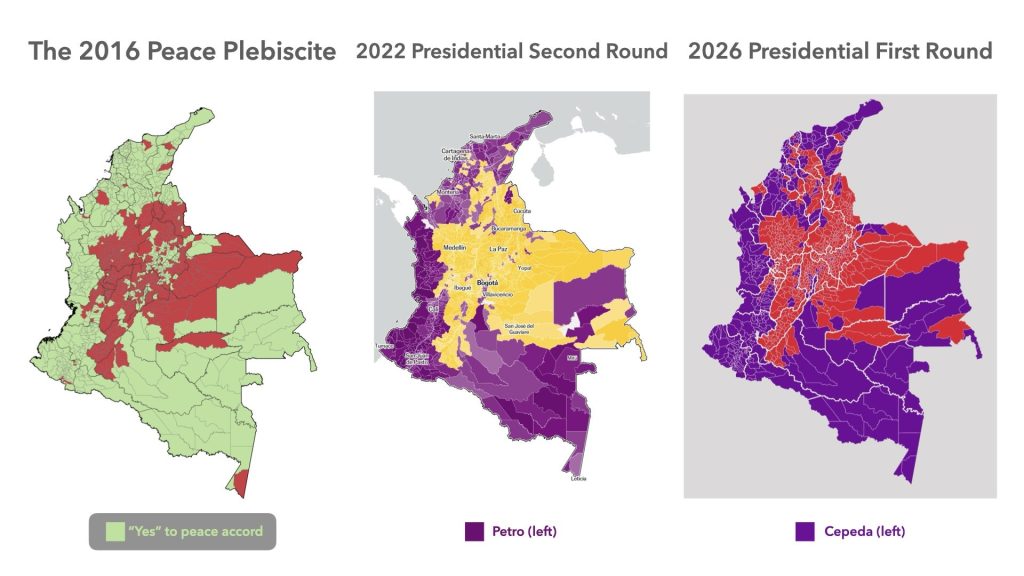
Voting closely followed political divisions seen in previous elections — including in 2022 when Gustavo Petro won the presidency, as well as the 2016 plebiscite for a peace agreement with FARC rebels — with voters rural areas impacted by Colombia’s armed conflict voting for Cepeda while voters in the heart of the country (save the capital Bogotá) voting for de la Espriella’s Defensores de la Patria ticket.
Image credit: WOLA’s Adam Isaacson via X.
Paloma Valencia, a right-wing senator backed by former President Alvaro Uribe, was considered a favorite to make it to the second round alongside Cepeda as recently as early May, but her campaign ran out of steam in the final weeks and she ended with less than 7% of the vote.
Yann Basset, a political scientist from the University of Rosario in Bogotá told Latin America Reports that he expects Valencia’s supporters will rally around de la Espriella, handing him a victory in the run-off in three weeks’ time.
De la Espriella, who has run a slick, AI-augmented social media campaign, promised to “defeat the tyranny of the left.”
His proposals include the construction of 10 mega-prisons, a la El Salvador strongman Nayib Bukele, and militarization of the whole territory in order to combat illegal armed groups.
For his part, Cepeda ran on a continuation of Petro’s Historic Pact for Colombia party, including continuing efforts to achieve “Total Peace” with its many armed groups and narrowing the inequality gap in society.
“Colombia can and should be a just country. A country in which each citizen and every community has effective access to indispensable rights, property and services for a fulfilling life,” Cepeda said on the eve of elections.
Sunday night, Petro said he would not accept the preliminary count results, and defiant Cepeda supporters at the campaign event in the Tequendama Hotel in Bogotá were heard chanting “No pasarán!” (“They will not pass!”), referring to their right-wing rivals.
Featured image: Abelardo de la Espriella at a campaign rally in Nariño, Colombia in April 2026.
Bogotá, Colombia – The sophistication of drones used by armed groups is escalating rapidly in Colombia as the military expands efforts to tackle them, the commander of Colombia’s armed forces told Latin America Reports.
“We are dealing with terrorists using drones carrying grenades that are dropped from different altitudes, as well as wire-guided drones,” General Hugo Alejandro López Barreto said, referring to some of the latest and most difficult drones to counter.
On June 2, one person was reportedly killed in a drone attack in La Tarra, in the conflict-ridden Catatumbo region. A day earlier, six children and one adult were seriously injured in Suárez, Cauca, in an attack authorities attributed to the Jaime Martínez structure of the FARC dissident group.
According to Colombia’s Ministry of Defence, 333 drone attacks successfully struck targets or caused damage in 2025, compared with 61 incidents in 2024 — an increase of 445 percent.
While the FARC disbanded under the 2016 peace accord, some splinter groups emerged. These factions, as well as the National Liberation Army (ELN) guerrilla group, frequently target each other and the military, with civilians often caught in the middle.
General Lopez explained that the military is employing a variety of strategies to counter the growing use of drones by these structures.
“We already have units deployed with anti-drone equipment that will allow us to counter the actions of these criminals and also target those carrying out these attacks against us,” he said. Lopez added that the armed forces were responding through a combination of ‘technical and non-technical measures,’ including protective equipment and weapons capable of bringing down the aircraft.
While drones have been used by Colombia’s armed groups for around a decade, initially for reconnaissance and intelligence gathering, their use in attacks has increased sharply in recent years.
The first recorded death linked to a drone attack occurred in 2024, when a 10-year-old boy was killed while playing football in El Plateado, Cauca.
According to defense analyst and drones expert, Camilo Mendoza, since armed groups began using drones in an organized way in 2024, they have gained the advantage over security forces.
“Groups use drones for both surveillance and attacks, and they have learned a great deal from Ukraine. Ukraine has been the laboratory of modern warfare for the last three or four years,” he explained.
“The success of drones, both in Colombia and in Ukraine, comes down to cost. Drones are very cheap and can do many things.”
According to Mendoza, who also wrote the book Colombia Under Drone Threat, the main groups using drones are the FARC dissident group Estado Mayor Central and the National Liberation Army (ELN), which employ the devices for both surveillance and attacks. The Clan del Golfo also uses drones, although primarily for reconnaissance purposes.
As the technology has evolved, so too have efforts to counter it. In October 2025, Colombia’s Defence Ministry launched BANOT, described as Latin America’s first military battalion dedicated to countering drone threats. Authorities have also invested in radio-frequency jammers and tactical radar systems as part of a broader anti-drone strategy and have an anti-drone shield planned.
But analysts say the pace of development means the military is struggling to keep up. Where initially groups were buying cheap drones in major cities or online sites, like Amazon, now they’re using more sophisticated ones, including First Person View (FPV) drones and fibre-optic drones, which pose challenges for security forces.
“The fibre-optic drones cannot be detected or jammed because the systems simply cannot see them,” Mendoza said.
Traditional anti-drone systems work by disrupting the signal between an operator and an aircraft. But newer drones can be modified to reduce the effectiveness of those countermeasures.
“All anti-drone systems in Colombia operate through the electromagnetic spectrum,” Mendoza explained. “They have no effect on these newer systems, and the drones can continue carrying out attacks even when battalions have anti-drone equipment.”
While analysts warn of the challenge drones pose to security forces, humanitarian organizations say civilians are increasingly bearing the consequences.
“This is not a new phenomenon, but the speed at which it is escalating is alarming,” Antonio Salvatore Armentano, Colombia representative at The United Nations Mine Action Service (UNMAS) told Latin America Reports. “Communities on the ground are absorbing a threat that policy frameworks have barely begun to name.”
In a recently released technical report on drones in Colombia, UNMAS highlighted that in many territories, the only available defence is “the visual and the acoustic detection by recognizing the distinctive ‘buzzing’ sound of drones and attempting to flee.”
While not all drones are used to attack — some are for surveillance — communities have no way of knowing, and so the sound or sight of drones induces psychological distress.
“The harm does not end when the attack does. Communities living under the sound of drones experience chronic fear and anxiety. Not every drone is armed – but no one on the ground can tell the difference. That uncertainty is itself a form of violence,” Armentano said.
As armed groups adopt increasingly sophisticated drones, humanitarian organizations warn that civilians are likely to face a growing share of the consequences.
Featured image description: A member of the Colombian Air Force holds a drone.
Featured image credit: Fuerza Aerospacial de Colombia.
Medellín, Colombia – There were 35 massacres in Colombia in the first three months of 2026, making it the most violent quarter in a decade, according to the Institute of Peace and Development Studies (Indepaz).
The Colombian NGO’s figures revealed that 133 people had died in the massacres, which occurred across 34 municipalities in 17 departments.
The grim figures come as Colombia faces a surge in violence related to its long-running armed conflict, almost ten years after a historic peace deal with the Revolutionary Armed Forces of Colombia (FARC) rebel group.
The massacres claimed the lives of 74 men, 16 women, and 17 children. 40 of the victims have not been identified.
The first massacre of the year, in which three women were killed, was committed in Santander de Quilichao, Cauca, on January 3. The single most violent attack took place in El Retorno, Guaviare, where 26 people were killed on January 16.
This makes this year’s first quarter the most violent in the last ten years, during which Indepaz has recorded the deaths of nearly 3,000 people in over 700 different massacres.
On the back of the peace accords signed in November 2016 between Colombian President Juan Manuel Santos and the FARC, 2017 was the least violent year, registering 33 massacres in total.
However, following the election of Iván Duque in 2018, yearly records of massacres increased from 39 in the first year of his presidency to 96 in 2021.
Under the current Gustavo Petro administration, figures have remained at similar levels, oscillating between the highest point of 94 cases in 2023 and 76 cases in 2024. Petro’s policy of Paz Total (Total Peace) that has sought to counter violence by negotiating with armed groups has had mixed results.
The period of 2021 to 2025 observed an average of 303 deaths annually, an increase on the average of 201 deaths each year in the preceding five year period. Even the most violent periods of the last decade did not register as many quarterly cases as 2026 has witnessed so far. The first quarter of 2020 recorded 17 massacres, under half of this year’s equivalent figure.
In the last decade, 1,657 men, 285 women, and at least 133 children have been killed. Valle del Cauca was the worst affected department with 62 massacres resulting in 215 deaths, followed by Cauca which saw 58 massacres and 200 deaths.
The surge in violence has come at a crucial moment in Colombian politics with presidential elections set to take place on May 31. While Petro’s possible Historic Pact successor, Iván Cepeda, looks to continue the Paz total policy, other candidates have promised tougher military measures against armed groups.
Featured image credit:Policía Nacional de los colombianos via Flickr
A meeting due to take place today between acting Venezuelan President Delcy Rodríguez and Colombian President Gustavo Petro was cancelled at the last minute.
Venezuelan authorities yesterday pulled out of the meeting, which was scheduled to take place on the two countries’ shared border, citing security reasons.
The encounter would have been Rodríguez’s first with a foreign leader since taking over from strongman Nicolas Maduro, who was ousted in a U.S. military operation in January.
The planned meeting was due to take place at the Atanasio Girardot International Bridge, which connects Colombia and Venezuela.
It had been initiated by Colombian authorities as an opportunity for the two leaders to discuss issues on the bilateral agenda, including interests in border security, drug trafficking and the potential for Colombia to import Venezuelan natural gas.
In a joint statement on Thursday, the Colombian and Venezuelan governments explained the cancellation was due to unforeseen circumstances but have not provided further details, reporting they intend to reschedule in the near future.
Following the cancellation of the planned presidential summit, ministers from Gustavo Petro’s administration travelled to Caracas to sustain diplomatic engagement and avoid disrupting recent progress in bilateral relations.
Their agenda centred on reviving cross-border trade, advancing energy collaboration — including potential repairs to the Antonio Ricaurte gas pipeline — and continuing coordination on security matters along the shared border.
The visit was intended to maintain momentum in cooperation, with relations between Colombia and Venezuela showing signs of improvement since Maduro’s ouster.
Venezuelans strike against Delcy Rodríguez’s regime
Shortly before yesterday’s cancellation of the planned meeting, protests were reported in Caracas demanding an increase in the minimum wage. Unconfirmed videos on social media purported to show elderly demonstrators breaking through police cordons during the demonstration.
Rodríguez was appointed acting president this year by Venezuela’s Supreme Tribunal of Justice after the U.S. ousted strongman Nicolás Maduro and has served as the country’s vice president since June 2018.
In early March, Rodríguez publicly reaffirmed her government’s commitment to diplomatic dialogue with the United States as part of efforts to ease tensions following the U.S. military operation that captured former President Nicolás Maduro.
Featured image description: President Gustavo Petro at a cabinet meeting, October 22, 2025.
De la Espriella, whose rise reflects a shift in Latin America towards leaders favoring heavy-handed crime policies, is expected to gain more support in the June 21 runoff.
Please be aware... Photos are purely for entertainment. I am no expert. Titles are from recognition - what I was told - or a quick search. Polite comments or corrections are welcome.
Bogotá, Colombia – Colombian President Gustavo Petro arrived in Caracas today to meet with his counterpart in Venezuela, Interim President Delcy Rodríguez.
The visit makes Petro the first world leader to visit the South American nation since the United States captured longtime strongman Nicolás Maduro in a military operation on January 3.
Petro and Rodríguez are expected to discuss bilateral issues including energy and security cooperation on their more than 1,300 mile shared border.
The Colombian president landed in Caracas on Friday afternoon with his Foreign Minister, Rosa Yolanda Villavicencio, and Defense Minister, Pedro Sánchez.
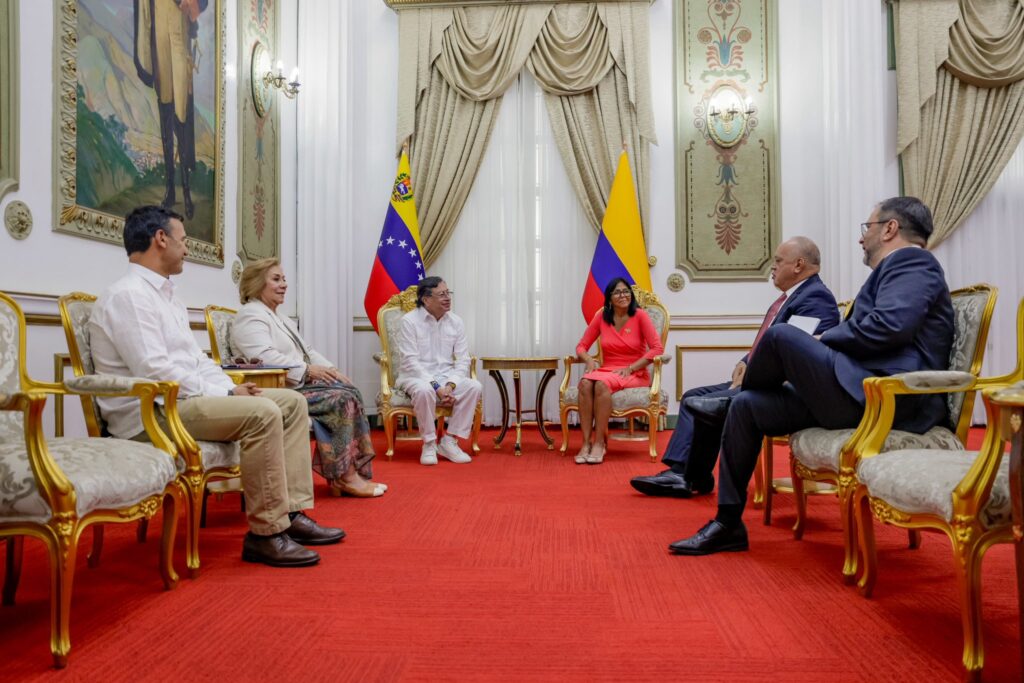
The delegation from Bogotá has been meeting with Rodríguez and her Interior Minister, Diosdado Cabello, alongside Foreign Minister Yván Gil at the Palacio de Miraflores – Venezuela’s presidential palace.
Petro and Rodríguez were flanked by top officials at their meeting. Image courtesy of @InfoPresidencia via X
Petro and Rodríguez were scheduled to meet in Cúcuta, a Colombian city bordering Venezuela, in March but the Venezuelan president cancelled at the last minute citing security concerns.
Then last Friday, the Colombian leader announced he would head to Venezuela, saying, “If Mohammed won’t come to me, I’ll go to the mountain.”
The primary purpose of the meeting is strengthening security cooperation, according to the Petro administration.
“The aim of this meeting is for both governments to make progress on a joint plan to strengthen security and intelligence in the border area,” wrote the Office of the President in a post on X today.
The sprawling frontier is a hotbed for guerrilla activity and is largely controlled by the Colombian National Liberation Army (ELN), a rebel group involved in drug trafficking and illegal mining on both sides of the border.
The ELN was known to have ties to the Maduro regime but the Venezuelan government is under pressure from the U.S. to crack down on the rebel group, which Washington considers a “terrorist organization.”
While the Petro administration maintains the importance of strengthening bilateral cooperation, the meeting has perturbed many in the Venezuelan exile community in Colombia.
“President Gustavo Petro’s visit to Venezuela, particularly his meeting with Delcy Rodríguez, raises serious concerns among Venezuelans,” Juan Carlos Viloria Doria, President of the Global Alliance for Human Rights and Vice-President of Venezuelans in Barranquilla, told Latin America Reports.
He noted that many Venezuelans do not consider Rodríguez to be a legitimate leader, describing her as “an extension of the regime led by Nicolás Maduro.”
“In this regard, such visits can be interpreted as a political endorsement or a form of international legitimization of a situation in Venezuela that still lacks adequate democratic guarantees,” maintained Viloria.
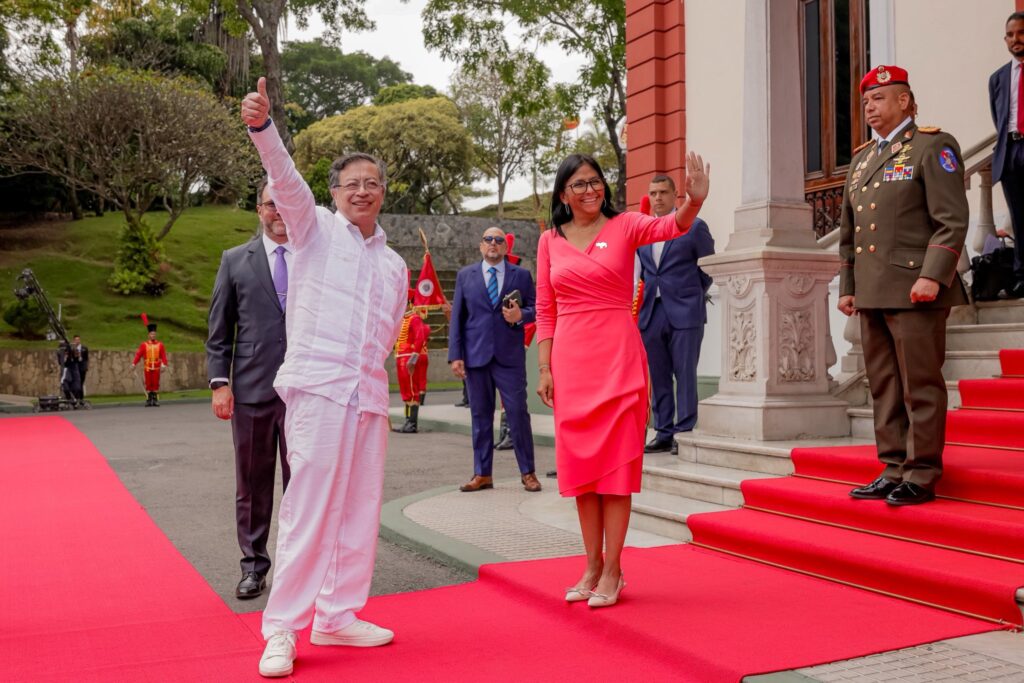
Petro and Rodríguez greet reporters. Image courtesy of @InfoPresidencia via X
There has also been pressure in Colombia for Petro to mediate the release of 16 Colombian citizens jailed in Venezuela.
The families of those detained allege the arrests were made “without a court order or evidence” and say their loved ones have faced human rights violations including torture.
While there has been an easing in repression following Maduro’s ouster, Venezuela remains an authoritarian state and rights groups continue to denounce abuses.
“The least that we Venezuelans expect is that [the meeting] be used as an opportunity to demand concrete progress on human rights and democracy,” said Viloria.
“Any dialogue or rapprochement must be aimed at improving the living conditions of the Venezuelan people and fostering a genuinely democratic transition, not at consolidating contested power structures.”
Featured image description: Colombian President Gustavo Petro and Venezuelan Interim President Delcy Rodríguez at a meeting in Caracas on April 24, 2026.
Bogotá, Colombia – On March 8, for the first time in Colombia’s history, an artificial intelligence candidate appeared on ballot papers across the country.
Gaitana IA (AI) ran for the Indigenous seat in the Senate and the House of Representatives in the northern state of Sucre.
While Gaitana did not win a seat in either of the country’s legislative bodies, it has sparked debate about the role of AI in Colombian politics.
With the ballots counted, Gaitana won a total of under 3,000 votes – less than 2% of the total votes for the Indigenous seat – suggesting that many people remain skeptical of this new digital approach.
Many questions have emerged surrounding Gaitana, such as why the Registraduría—the Colombian entity in charge of validating and accepting candidates—permitted this unprecedented candidacy, or what the intentions were behind the AI.
“Many local media outlets talked about an AI going to Congress, but that is not the case; they are humans leading the project,” Gaitana’s co-founder, Natalia Aase, told Latin America Reports.
“It is actually a consensus tool developed by our community members, between 14 and 25 years old, from the Senú community of Reparo Torrente, in Coveñas,” she explained.
Rather than planning for the AI to assume office, Gaitana was devised as a democratic experiment underpinned by real human candidates
Aase detailed how the platform was designed to work: Colombian citizens could subscribe through a link to virtually participate and propose various debates regarding topics such as healthcare, women’s rights, and more. These interactions would also feed the AI database.
Once an initiative reached a collective consensus, the people occupying the seats in Congress would “decide the direction of the proposed laws.”
The two humans represented by Gaitana were Carlos Redondo Rincón, a Mechatronics Engineer from the Senú community, who was running for Senate, and Luz Rincón, an Embera-Katio Indigenous sociologist, who was seeking a seat in the House of Representatives.
The co-founder of Gaitana also revealed that the team conducted deep research into global democratic models, such as the one in Norway, and compared them with their own community dynamics.
As the research advanced, the team found that their community in Senú had already established a model of social interaction that worked well, prompting them to launch a digital project modeled on their own practices.
This meant digitizing their traditional way of reaching a consensus; in the Senú community, men, women, and youth gather around tables to discuss specific topics, such as women’s health or local fishing.
“Gaitana IA is not a generative AI; it is a participatory AI. What does that mean? Well, it is not ChatGPT. Instead, it takes the information provided by the users and organizes it,” pointed out Aase. “Transparency and security are the most important things for us; that is why we use blockchain technology—a system of blocks—to power this platform.”
According to Aase, the project was born from a motivation to prevent corruption and explained that with ‘Gaitana AI’, the decisions are not made by a single person but must be approved by at least 100 people.
“You might be able to manipulate one individual, but you cannot manipulate a hundred if you don’t even know who they are,” she concluded.
This article originally appeared on The Bogotá Post and was republished with permission.
Bogotá, Colombia – A challenge to a public debate, accusations about football shirts used as political symbols, and increasingly sharp exchanges on social media — campaigning for Colombia’s run-off in its presidential election is already underway just a day after Abelardo de la Espriella emerged as the surprise first-round winner.
While Senator Iván Cepeda had been widely expected to come out on top and enter the second round in a stronger position, his camp was left disappointed after falling short of those expectations.
Although he still claimed nearly 41% of the tally, de la Espriella surpassed him by almost three points, coming out with 44%.
Analysts say the run off is wide open. An important factor is supporters of other candidates whose votes are up for grabs. But a decisive factor is also likely to be those who didn’t participate at all in the first round.
“Whoever manages to somehow win over the undecided voters who didn’t vote in the first round but will vote in the second, I think that’s already enough to be president,” political analyst Oscar Chala said.
With three weeks to go until the June 21 elections, the race is on to sweep up those votes, and the candidates haven’t wasted any time in trying to position themselves.
Shortly after the results, Cepeda’s camp alleged irregularities in the vote, although the candidate backtracked the next day, saying they were not significant.
He also criticised the wearing of Colombian football shirts as part of political campaigns, linking it to de la Espriella’s far right movement — and also challenged him to a public debate, something he had not previously participated in.
“Cepeda is now inviting and wanting to hold a debate when he had always avoided it. That is a sign of desperation,” Rubén Erazo, political consultant, told Latin America Reports.
Although de la Espriella accepted the debate — which will be held on Tuesday June 9 — he also called his rival a “coward” and accused his campaign of hiding behind Petro.
Despite the disappointing result for Cepeda, he gained roughly what polls had been predicting — even marginally higher. Yet analysts say he struggled to win over undecided and abstentionist voters and lacked a solid and coherent campaign.
“The failures of Cepeda’s campaign are that Cepeda is not himself the candidate. The candidate is the current president Petro,” political consultant Rubén Erazo said, referring to this election being more like a referendum on Petro’s legacy.
He said this incorporates “the good, the bad, and the ugly” of his presidency. While he expanded social programmes, other policies, such as opening ambitious negotiations with armed groups, were highly controversial. Those dissatisfied with what Petro stands for are likely to be against Cepeda.
Despite knockbacks, Erazo says this doesn’t mean it is game over for the senator and Petro ally.
“Cepeda could win as long as his team reorients his strategy, acknowledges mistakes, thinks calmly and does not focus solely on claiming fraud,” he said.
The race is still very much open — and analysts say anything could happen, and that a lot will depend on where they target their political energy.
“Cepeda is likely to move closer to the centre and Abelardo could become more radical. The strategy Abelardo will use to try to win is to radicalize his discourse because he knows that Iván Cepeda will start seeking centrist votes,” Chala said.
He believes Espriella will also target an abstentionist segment on the right, even further right than traditional right-wing establishment figures such as Paloma Valencia, who once polled above 20% but ultimately secured just under 7%.
This part of the electorate is conservative, often macho, and wants hardline security strategies and more investment in the country.
De la Espriella was the main candidate able to capitalize on this as well as anti-Petro sentiment, and is expected to continue drawing support from parts of Valencia’s former base.
“However, his discourse is very anti-establishment and he’s not seeking the support of political parties,” Chala explained.
Nevertheless, Paloma Valencia — and her mentor, former president Álvaro Uribe — have come out in support of de la Espriella. Her relevance is not yet completely diminished if she can convince those who supported her to shift to this camp.
Moreover, while Cepeda took a backseat in his own campaign and drew heavily on traditional strategies such as mass gatherings and marches, Espriella, as well as doing this, drew heavily on crafting his own image — calling himself “The Tiger”.
“Everything is exaggerated and trying to inspire: the planes, the Italian suits from when he was a lawyer, and even his image of advising controversial figures,” he said. “Even the beard, for example, is copied from Nayib Bukele. It’s the same style.”
De la Espriella is plainly anti-establishment and aligns himself with Nayib Bukele, Javier Milei and Donald Trump. That appeals to some of the electorate, and repels another part.
At this stage, both candidates are still very much in this race, with everything to play for.
Featured image description: Iván Cepeda (Left) and Abelardo de la Espriella (Right).
Bogotá, Colombia – On April 20, the Special Jurisdiction for Peace (JEP) – Colombia’s transitional justice mechanism – released a report on the violence suffered by animals in the context of the armed conflict.
The JEP’s report, conducted in partnership with the University of Essex, found that an animal is killed or injured every 30 minutes due to the armed conflict.
Animal rights activists say the release represents a step forward in publicizing the often invisibilized violence inflicted upon animals in war.
The report was developed through the construction of a database using 237 national, regional, and local media outlets, and 600 X accounts belonging to social and environmental organizations, as well as State entities and multilateral organizations.
Based on the information collected, they made an individual categorization referring to domestic animals, and a collective one referring to species, that is, wild animals. In this context, 100,252 domestic animals faced violence and 44 species are at imminent risk of extinction as a result of the armed conflict.
Thirty-two percent of the recorded cases involving animals were directly linked to military actions, including armed confrontations, ambushes, and attacks. The impacts were not distributed evenly across the territory; there are regions where armed conflict, illegal economies, and environmental richness converge, intensifying the harm. For example, Antioquia is the department with the highest concentration of species threatened by the conflict.
“We realized that most cases involved incidents such as accidents with landmines, anti-personnel mines, ambushes against the public security forces, harassment of the public security forces, and armed confrontations. These were some of the situations in which animals were killed or injured. They were also affected by forced displacement,” Laura Ojeda, a researcher on the JEP’s Investigation and Prosecution Unit who contributed to the report, explained.
Forced abandonment was one of the most documented forms of harm identified in the report, largely because it was closely tied to the victimization of caregivers within the dynamics of the conflict. 27% of the recorded cases — corresponding to approximately 900,000 animals — involved forced abandonment.
The report also identified nine ways in which animals were used throughout the armed conflict: as means of transportation; as devices to detonate explosive artifacts; as instruments to inflict pain and suffering – torture –; as sentinels for rapid alerts; as surveillance tools; in practices of bioterrorism involving zoonotic diseases; as propaganda tools; as amulets or part of esoteric rituals; and as a means to intimidate communities and extort payments from business owners and farmers.
Visibilizing animal suffering
The report comes as part of the JEP’s efforts to recognize the environment within its processes of justice, truth, and reparation. This release, the third in a series of three, is the first to focus on the specific forms of violence suffered by animals.
“It is part of a strategy to recognize all forms of life that have been victims of the armed conflict in Colombia,” Ojeda told Latin America Reports.
For Senator Andrea Padilla of the Green Alliance (Alianza Verde) party, the report represents a major step forward for animal rights.
She notes that harm to animals is usually addressed as a collateral issue, as damage to property under a framework of harm to human assets.
“Animals have always been excluded from any moral consideration, from any legal consideration, even from news coverage,” the senator told Latin America Reports.
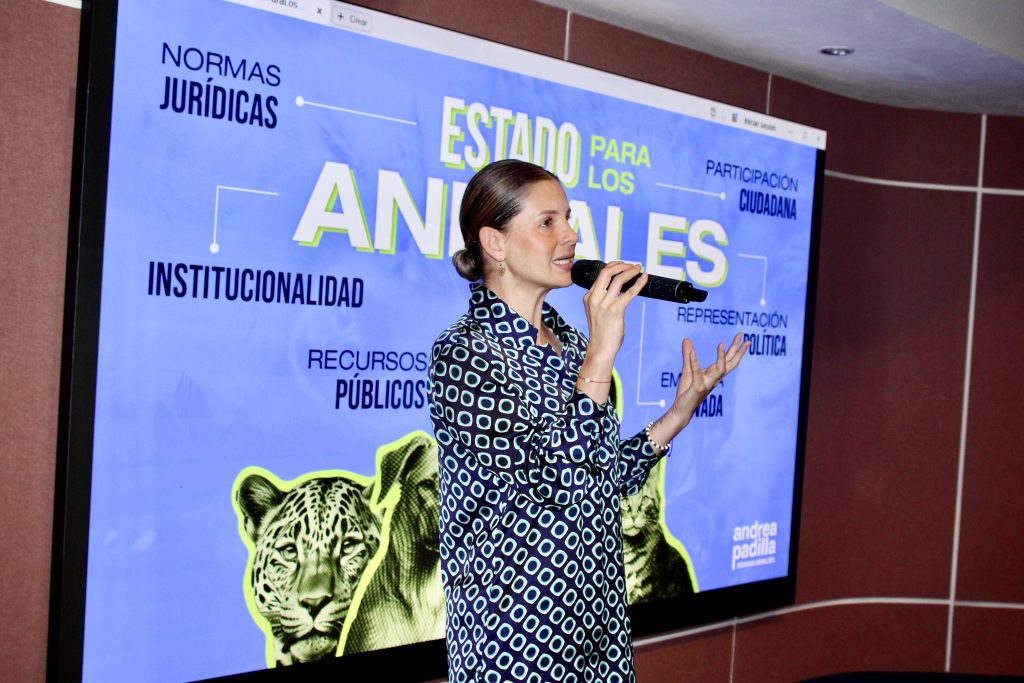
Senator Andrea Padilla delivers a speech on animal rights. Image credit: @andreanimalidad via X
The team behind the report faced the challenge of shifting the narrative away from the legal framework which refers to animals only as part of the natural environment.
Instead, it adopted a “differential” approach from natural sciences, in collaboration with La Enredadera & co, a scientific outreach collective.
For Luis Carlos Posso, anthropologist and member of the collective, the report represents an exception to the “unavoidable anthropocentrism permeating the law.”
Senator Padilla highlighted the animal rights implications: “I believe it is only fair that sentient beings capable of emotions, affection, and social, moral, and emotional lives are also considered as affected by the conflict.”
Padilla added that understanding the impact of the conflict on animals deepens the appreciation of the human toll of violence.
“When we understand that there are bonds of affection there, family bonds that are abruptly broken by war, we can also see the conflict in a deeper way — that is, we can understand the deepest forms of harm being caused,” said the senator.
Animals as victims of the armed conflict
In addition to detailing the harms inflicted upon animals, the report proposes various reparative measures. These include habitat restoration, veterinary care in conflict zones, public veterinary care networks, the inclusion of animals in memory and truth processes, protection measures for at-risk species, and conservation initiatives.
However, there is still a long way to go before animals can be fully recognized as victims.
“Legally they are not things, but they are also not rights-holders. If they are not rights-holders, they cannot be recognized as victims,” explains Ojeda.
Colombian law recognizes animals as sentient beings, and laws such as the Ángel Law reflect significant progress in their rights. Currently, there is a bill advancing in congress that seeks to historically and legally recognize animals and ecosystems as victims of the internal armed conflict, prohibiting their use as instruments of war and ordering their essential reparation. This is Bill No. 012 of 2025, led by Senator Esmeralda Hernández of the Pacto Histórico party.
Senator Padilla explained that the success of the legal changes will depend on whoever is elected as the next president.
“Undoubtedly, this report holds great value. It not only offers another perspective on the armed conflict, but also explicitly incorporates animals into the analysis of war, harm, and peace,” said Senator Padilla. She added that animals must be involved in reparations processes, insisting, “peace must include animals, or it will not be complete.”
This article originally appeared in The Bogotá Post and was re-published with permission.
EXCLUSIVE: The second and final part of Netflix’s One Hundred Years of Solitude will begin streaming in August, with the adaptation concluding in a standalone grand finale debuting later that month. As well as the launch details, we can exclusively share the trailer and first art from part two of the series, an adaptation of […]
In our new wrap Monday, police in New Jersey arrested more protestors for breaking a curfew around an ICE detention facility, election denier Tina Peters was released from prison, Colombia's presidential election is set for a runoff, protesters in Kenya demonstrated against plans by the U.S. government to set up an Ebola quarantine facility and Serena Williams is returning to the tennis court.

 Login
Login