Tensely contorted or standing pin straight, Ben Zank’s signature faceless subjects evoke ineffable yet familiar emotions.
The New York City-based photographer has a knack for turning ordinary settings and unaccompanied figures into strangely perplexing sights. Mismatched socks, bold garments, and awkward poses go a long way in evoking a visceral response through his lens, tapping into a sort of uncanny realism.
Zank’s work traveled to Festival Cargo Les Photographiques—a.k.a. The C
Tensely contorted or standing pin straight, Ben Zank’s signature faceless subjects evoke ineffable yet familiar emotions.
The New York City-based photographer has a knack for turning ordinary settings and unaccompanied figures into strangely perplexing sights. Mismatched socks, bold garments, and awkward poses go a long way in evoking a visceral response through his lens, tapping into a sort of uncanny realism.
Zank’s work traveled to Festival Cargo Les Photographiques—a.k.a. The Cargo Festival—in Saint-Nazaire, France last summer. Since its debut in 2022, the annual event typically features several outdoor exhibition areas, highlighting contemporary photographers.
The artist’s plein air installation for the festival included large reproductions of images affixed to leaning wooden pallets and covering brick walls. The minimalist, Earth-toned portraits complemented their surroundings, scattered across sparse grounds.
Zank is currently working on a series that is focused on capturing strangers in their own homes, rather than the constructed settings he typically employs. Find more from the artist on Instagram.
Faig Ahmed is known for his vibrant textile sculptures that take traditional Azerbaijani ornamental carpets as starting point, often appearing to melt, pool, or glitch. In his current solo presentation at the 61st Venice Biennale, where he is representing Azerbaijan, the Baku-based artist branches out into more conceptual territory, exploring science, alchemy, spirituality, and perceptions of self in a sprawling, maze-like installation called The Attention.
Curated by Gwendolyn Collaço, th
Faig Ahmed is known for his vibrant textile sculptures that take traditional Azerbaijani ornamental carpets as starting point, often appearing to melt, pool, or glitch. In his current solo presentation at the 61st Venice Biennale, where he is representing Azerbaijan, the Baku-based artist branches out into more conceptual territory, exploring science, alchemy, spirituality, and perceptions of self in a sprawling, maze-like installation called The Attention.
Curated by Gwendolyn Collaço, the exhibition expands upon Ahmed’s interest in the dialectic between digital processes and time-honored, hand-crafted techniques. The artist considers how advanced scientific inquiry, such as quantum physics and neuroscience, relates to how we “articulate cosmologies of belonging,” says a statement.
“Garden of Awakening” (2026), directional audio system
Ornamental carpets continue as a through-line in The Attention, undulating, scrunching, distending, and balling up through a series of rooms. They even extend outdoors, creating a kind of continuous runner that spills out of doorways and stretches into long lines of color.
“Ahmed bridges the 15th-century Hurufi mystic tradition—which viewed the universe as a coded text—with modern information theory,” says a statement. “By channeling the ‘human energy’ of the weave, he uses this ancient textile paradigm to address our era’s information overload and collective grief.”
Ahmed taps into a theoretical framework coined by physicist John Wheeler that can be summed up, rather enigmatically, as “it from bit.” It’s a short way of describing an approach to information theory that string theorists and quantum mechanics researchers have tested. In other words, “…every it—every particle, every field of force, even the spacetime continuum itself—derives its function, its meaning, its very existence entirely—even if in some contexts indirectly—from the apparatus-elicited answers to yes-or-no questions, binary choices, bits.”
In The Attention, the binaries of “it from bit” are not only present in the way digital methods and the physical labor of the loom converge but also in Ahmed’s interests.
Detail of “Ancestors”
“I have always been drawn to exploring consciousness for as far back as I can remember,” he says in a statement, continuing:
This search has guided my attention in two directions: on one hand, toward science—biology, physics, and mathematics—and on the other, toward spirituality, art, poetry, and creative expression. At first glance, these fields appear opposite, even contradictory. One form of knowledge is directed out-ward, toward what can be measured, calculated, observed, and verified. The other turns inward, toward the subjective, the unprovable, and the inexpressible. It is an experience that cannot be confirmed or fully shared with another, just as it is impossible to truly know what it feels like to be someone else.
Merging 15th-century Hurufi mysticism with science, digital interfaces with the analog, and introspective personal experiences with objective data, Ahmed’s carpets guide visitors through the immersive space. The largest one, a monumental machine-woven piece, is titled “I Can Contain Both Worlds But I Do Not Fit Into This One.” It forms what the artist describes as a “breathing body” that climbs the architecture, knots itself, collapses, and spills. “Ancestors,” a faintly anthropomorphic wall piece that glows psychedelically in black light is woven by hand. And a work called “Entropy Altar” uses a quantum random number generator to translate visitor presence into an evolving language.
The Attention remains on view through November 22 at Campo della Tana, Castello 2124/A–2125, Venice. See more on Ahmed’s Instagram and Vimeo.
Installation view of ‘The Attention’“Ancestors” (2026), handmade wool carpet, 170 x 385 centimeters“The Knot” (2026), part of “I Can Contain Both Worlds But I Do Not Fit Into This One,” 200 centimeters in diameterDetail of “I Can Contain Both Worlds But I Do Not Fit Into This One”“I Can Contain Both Worlds But I Do Not Fit Into This One” (2026), site-specific machine-printed carpet spanning all seven roomsFaig Ahmed at the entrance to ‘The Attention’
Multi-colored lengths of fabric billow in the breeze in the work of Thomas Jackson, challenging the relationship between nature, human intervention, and consumerism. “Rooted in the tension between nature and artificiality, the installations pose questions about how we interact with the environment and how we might find equilibrium with it,” the artist writes in a statement.
“All of my photographs strain credulity by design,” Jackson says. “At first blush, they can appear to be digital fabr
Multi-colored lengths of fabric billow in the breeze in the work of Thomas Jackson, challenging the relationship between nature, human intervention, and consumerism. “Rooted in the tension between nature and artificiality, the installations pose questions about how we interact with the environment and how we might find equilibrium with it,” the artist writes in a statement.
“All of my photographs strain credulity by design,” Jackson says. “At first blush, they can appear to be digital fabrications, but in truth, they are entirely in-camera, printed with minimal post-production.” The undulating swathes of fabric in his ethereal photographs initially appear to float and drape on their own, almost superimposed onto various landscapes, but upon closer inspection, the images reveal taut strings holding the carefully layered sheets.
Currently, Jackson is focusing on a forthcoming book project and taking advantage of the time between major exhibitions to make new work. See more on Instagram.
Over the course of two decades, Queens resident Joe Macken meticulously built an entire city from the ground up. In fact, he built New York City—the whole thing—one building, house, and bridge at a time. Now, his expansive scale construction is on view in He Built This City: Joe Macken’s Model at the Museum of the City of New York.
Macken began working on the 50-by-27-foot model in 2004, first in Middle Village, Queens, before moving to Clifton Park, New York. It comprises 340 individual s
Over the course of two decades, Queens resident Joe Macken meticulously built an entire city from the ground up. In fact, he built New York City—the whole thing—one building, house, and bridge at a time. Now, his expansive scale construction is on view in He Built This City: Joe Macken’s Model at the Museum of the City of New York.
Macken began working on the 50-by-27-foot model in 2004, first in Middle Village, Queens, before moving to Clifton Park, New York. It comprises 340 individual sections, each built from everyday materials like cardboard and glue, with many of the buildings constructed of balsa wood and detailed with pencil and paint. He completed the structure in 2025, and it’s now on long-term view at the museum, where visitors can walk around it and are encouraged to use binoculars to find familiar buildings and neighborhoods.
Photo by David Lurvey. All images courtesy of the artist and the Museum of the City of New York, shared with permission
You may also enjoy the “Panorama of the City of New York” at the Queens Museum, which was completed in 1964 and took a team of more than 100 people about three years to complete.
Photo by Filip WolakPhoto by David LurveyPhoto by David LurveyPhoto by Filip WolakPhoto by David LurveyPhoto by David LurveyPhoto by David LurveyPhoto by David Lurvey
A visit to Lincoln Park or the Garfield Park Conservatory is one of the outings Chicagoans rarely pass up, particularly when we need some reprieve from all the concrete and steel. Two beloved green spaces in the city, these spots boast oases blanketed in verdant foliage even in the depths of winter and house an array of specimens not native to the Midwest.
For artists Merryn Omotayo Alaka and Sam Frésquez, the immersive nature of a conservancy, with plants above and below and all around,
A visit to Lincoln Park or the Garfield Park Conservatory is one of the outings Chicagoans rarely pass up, particularly when we need some reprieve from all the concrete and steel. Two beloved green spaces in the city, these spots boast oases blanketed in verdant foliage even in the depths of winter and house an array of specimens not native to the Midwest.
For artists Merryn Omotayo Alaka and Sam Frésquez, the immersive nature of a conservancy, with plants above and below and all around, became a central point for a collaborative project. Your Birth is My Birth presents the duo’s synthetic hair sculptures, which suspend from the ceiling of Jane Lombard Gallery and splay across the wooden floor like organic growths. Alaka and Frésquez describe the exhibition as a sort of “Kanekalon forest,” referring to the brand behind the luscious material.
Installation view of ‘Your Birth is My Birth.’ Photo by Adam Reich
Five different “species” emerge in the space, including Listening Roots, Hearing Bells, Mother & Child, Stacking Pearls, and Umbra Pods. Dark, dyed locks and domed shapes are throughlines, although each takes on a distinctive form. The series are influenced by epiphytes, non-parasitic plants that make their homes on a host specimen. Think orchids, cacti, moss, and kelp.
Surging upward from lily pad-shaped discs suctioned to the floorboards, the largest sculpture is part of Listening Roots, which tethers singular shoots to a central form. This connection between smaller pieces—like the feather-duster-shaped Stacking Pearls—and more comprehensive structures recurs throughout the exhibition, gesturing toward an intimate and intentional symbiosis.
Several works also reference genetics and what’s passed down through generations, as mirrored forms emerge within the same vertical tendril. “Similar to an epiphyte and its host tree, these sculptural works have their own life cycles evoking systems of dependence and exchange, where one form sustains from another,” says a statement.
Your Birth is My Birth is on view through June 13. Explore more from Alaka and Frésquez on Instagram.
“Stacking Pearl (Adolescent) I” (2026), Kanekalon hair and steel support, 24 x 24 inchesInstallation view of ‘Your Birth is My Birth.’ Photo by Adam ReichDetail of “Umbra Pods I” (2026), Kanekalon hair and steel support, 45 x 27 inchesInstallation view of ‘Your Birth is My Birth.’ Photo by Adam ReichDetail of “Umbra Pods III” (2026), Kanekalon hair and steel support, 45 x 27 inchesInstallation view of ‘Your Birth is My Birth.’ Photo by Adam Reich
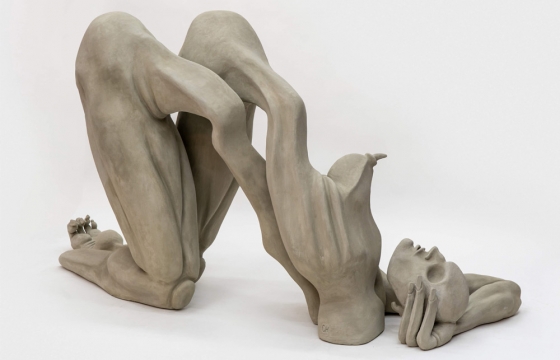
Public Gallery is pleased to present Sill, a solo exhibition of new painting and sculpture by Berlin-based artist Cathrin Hoffmann, whose subjects embody the physical intensity and psychological fatigue engendered by an age of information overload. No longer performing exaggerated gestures of desire or grotesque theatricality, Hoffmann’s figures inhabit states of sustained tension and accumulating pressure, sedimented in the threshold between endurance and action.
Public Gallery is pleased to present Sill, a solo exhibition of new painting and sculpture by Berlin-based artist Cathrin Hoffmann, whose subjects embody the physical intensity and psychological fatigue engendered by an age of information overload. No longer performing exaggerated gestures of desire or grotesque theatricality, Hoffmann’s figures inhabit states of sustained tension and accumulating pressure, sedimented in the threshold between endurance and action.
When we think of terms like “flowing” or “fluid,” we could be referring to the nature of water, but we can also just as easily apply these concepts to our understanding of art and craft. Fabrics “pool” and different mediums converge. The nature of creativity is often referred to in terms of an “ebb and flow.” Ecologically speaking, bodies of water are metaphorically woven into the fabric of our planet. Rivers and lakes sustain an abundance of life, shape cultures, and course through history.
When we think of terms like “flowing” or “fluid,” we could be referring to the nature of water, but we can also just as easily apply these concepts to our understanding of art and craft. Fabrics “pool” and different mediums converge. The nature of creativity is often referred to in terms of an “ebb and flow.” Ecologically speaking, bodies of water are metaphorically woven into the fabric of our planet. Rivers and lakes sustain an abundance of life, shape cultures, and course through history. Amid the ongoing climate crisis, how do artists express concerns about water and the environment?
Water | Craft, a group exhibition at the Minnesota Marine Art Museum, dives into this question. The museum itself is situated on the banks of the Mississippi River and often directly engages with its expansive biological and cultural reach. Works by seven artists, whose practices incorporate weaving, pottery, basketry, glass, and textile arts, directly interface with contemporary issues of water access and cultural preservation amid climate change.
Sarah Sense, “Land, Lines, Blood, Memory 7” (detail) (2026), archival inkjet prints on Hahnemuhle bamboo paper and Hahnemuhle rice paper, wax, Arches watercolour paper, cotton thread, and artist tape
Colossal readers may be familiar with the mixed-media pieces of Tali Weinberg and Nicole McLaughlin, both of whom combine quantities of colorful thread with other materials in meditations on interconnectivity and multi-disciplinarity. Weinberg translates ecological data into tendril-like installations and abstract weavings, such as a series of three pieces from her Climate Datascapes series that visualize information about silt in the Upper Mississippi River. McLaughlin’s dramatically fringed ceramic platters reference Pre-Columbian cultures and the continuum of human history and time.
Water | Craft also includes works by Rowland Ricketts, Sarah Sense, Therman Statom, Kelly Church, and Tanya Aguiñiga. The latter is known for her intricately knotted wall works containing terracotta forms, which cascade gently to the floor. And Ricketts’ large-scale installation, “Bow,” comprises strands of indigo-dyed linen that suspend within a large gallery space, creating the effect of a current or perhaps the silhouette of a boat.
“Just as water flows through bodies, landscapes, and cultural histories, craft knowledge is passed between generations, carrying technical skills alongside cultural values,” the museum says. “The artists in Water | Craft employ traditional methods not as nostalgic gestures, but as living practices that continue to evolve in response to environmental change.”
Water | Craft continues through December 27 in Winona.
Tanya Aguiñiga, “Internal Body I” (2023), fiber, terracotta, and mixed media. Images courtesy of Volume GalleryTanya Aguiñiga, “Internal Body I” (detail). Image courtesy of Volume GalleryTherman Statom, “Pesca de la Noche” (2015), glass, mixed-media. Photo by Bailey BoltonTali Weinberg, “Silt Studies: Upper Mississippi River Basin” (2021), from the ‘Climate Datascapes’ series, woven fiber, plant-derived dyes, medical tubing, and fishing line. Photo by Bailey BoltonRowland Ricketts, “Bow” (MMAM installation view) (2023), indigo-dyed linen. Photo by Bailey BoltonNicole McLaughlin, “Confluencia (Confluence)” (detail)
On the top floor of Buffalo AKG Art Museum’s Gundlach Building, a vast body of work from 58 artists comes together for Let Us Gather In a Flourishing Way. The impressive ensemble is both a survey of contemporary Latinx painting and a lively dialogue between a spectrum of artists with diverse backgrounds, experiences, identities, languages, and creative mediums.
Let Us Gather In a Flourishing Way is a major exhibition that has slowly unfolded over the course of several years. Curator Andrea
On the top floor of Buffalo AKG Art Museum’s Gundlach Building, a vast body of work from 58 artists comes together for Let Us Gather In a Flourishing Way. The impressive ensemble is both a survey of contemporary Latinx painting and a lively dialogue between a spectrum of artists with diverse backgrounds, experiences, identities, languages, and creative mediums.
Let Us Gather In a Flourishing Way is a major exhibition that has slowly unfolded over the course of several years. Curator Andrea Alvarez—the architect and driving force behind the project—has spent much of this time immersed in research and collaborating closely with each artist throughout the process, refining every detail of the show.
Eamon Ore-Giron, “Talking Shit with Illapa (variation I)” (2023), mineral paint and Flashe on canvas, 72 inches × 96 1/8 inches. Photo by Brenda Bieger
The exhibition’s title alludes to former U.S. poet laureate Juan Felipe Herrera’s titular poem. Oscillating between English and Spanish while employing lush imagery of flora and fauna, the poem itself—like the survey—is an exuberant celebration of community and cultural convergence. He writes:
cielo de calor and wisdom to meet us where we toil siempre in the garden of our struggle and joy let us offer our hearts a saludar our águila rising freedom
The show traces this poetic rhythm in its spatial design. Herrera’s stanzas greet visitors at each entrance and throughout its galleries, establishing tone and providing context for what lies ahead.
Although the exhibition is organized into seven themes, Alvarez highlights its intrinsically flowing nature, noting that even if the collection were rearranged, the show would still hold together. In a walkthrough, it became clear that space was central to the viewing experience, leaving room for visitors to engage with the works on their own terms, much like the exhibition’s overarching focus on gathering and bolstering free-flowing conversation.
Moises Salazar Tlatenchi, “Cruising Queens” (2024), oil on canvas, glitter, yarn, 35 x 45 inches
In Moises Salazar Tlatenchi’s “Cruising Queens,” a boat of five faceless figures and an American flag sail icy waters. Reminiscent of 18th-century America, the figures wear powdered wigs and tricorne hats. Finished with a dense layer of glitter and a daintily crocheted lavender frame, the artist’s glamorous materials—and the existence of brown figures in this context—subvert American history. “Cruising Queens” is placed within the exhibition’s New Histories section, which focuses on retelling personal, cultural, and global histories.
Colossal readers might also recognize Eamon Ore-Giron’s tessellated abstractions in “Talking Shit with Ilapa (variation I),” Guadalupe Maravilla’s mixed-media techniques in “Pupusa Retablo,” and Firelei Báez’s vibrant portraits bursting with floral motifs in “Mawu-Lisa (I build my language out of rocks).” Known for deconstructing colonial structures within her work, Báez turns toward the transatlantic slave trade, invoking deity Mawu-Lisa, a critical figure in the culture and religion of the Fon people in West Africa, who were brought to the Caribbean by force.
Bodies & Figures denotes another section of the show, highlighting “representations of and by marginalized people, considering the importance of the body, and who is or isn’t seen in an image,” the catalog says. One such work is Salomón Huerta’s triptych of untitled canvases. Through the absence of figurative human subjects within the paintings, visitors experience an intimate representation of the artist’s father.
“Huerta’s father protected the family in their home in Ramona Gardens, a violent housing project in East Los Angeles,” the museum label reads. “At night, he would set his .38-caliber revolver on the bedside table and ask Huerta to bring him a snack—often a concha or a glass of milk.” Disrupting expectations of traditional portraiture, the artist evokes something that feels deeply tender and human-centered—without the presence of a body.
Salomón Huerta, “Untitled” (2024), “Untitled (2025), “Untitled” (2024), oil on canvas, 14 x 16 inches. Photo by Jackie Andres
At the same time, Let Us GatherIn a Flourishing Way begs the question: how do identity and place shape each other? Los Angeles-based artist Alfonso Gonzalez Jr. turns to the rich visual language of signage. A meticulous technique passed down from his father’s professional career in commercial sign painting, Gonzalez has developed an enduring relationship with East Los Angeles’ emblematic advertisements and billboards, often reflecting Chicano culture. In “Abogados Tierra Caliente (Billboard),” the artist underscores the inherent connection between local landscapes and one’s selfhood, and an interesting relationship emerges between public commercial objects, personal portraits, and the museum itself.
Chicago-based Yvette Mayorga’s strikingly pink composition, “The Brunette Latinx Self Portrait After Francois Boucher’s “The Brunette Odalisque” c. 1745,” is affixed to a wall in the show’s cluster of Pinturx works, which are described as “contemporary Latinx approaches to traditional painting genres like still life and portraiture.” The artist’s distinctive technique of piping acrylic paint embodies themes of labor, femininity, and memory. Mayorga’s unconventional methods are an example of newer approaches to portraiture and complement the artist’s nods to Baroque and Rococo art.
Included in this grouping of nontraditional painting methods are other artists previously featured on Colossal, such as Sarah Zapata’s textile columns, made from handwoven cloth and various fibers. Installed leaning against a wall or protruding downward from the ceiling, her structures convey instability—a reflection of the current climate we find ourselves in. Narsiso Martinez also makes an appearance with “Checker Leading the Crowd,” made with charcoal on his distinctive cardboard produce box background, calling attention to labor.
In an anchoring room of the exhibition, “Promised Land” by Patrick Martinez spans 16 feet wide, redolent of a landscape’s sweeping view. Acrylic, neon, stucco, spray paint, and ceramic tile are just some of the layers that sit atop each other in the mixed-media work. Martinez ruminates on his native Los Angeles and the facade of “paradise” amid an ever-changing cultural landscape marked by gentrification and financial marginalization. Abstracted and washed-out structures, spray-paint marks inspired by graffiti, and an archival family photo collage represent the passage of time and the act of constantly rebuilding. “Promised Land” is part of the exhibition’s Land/tierra section, which highlights “Latinx approaches to landscape and the built environment, thinking about land and tierra and their rapid change.”
“Let Us Gather in a Flourishing Way” at the Buffalo AKG Art Museum. Photo by Brenda Bieger, Buffalo AKG Art Museum
As a whole, the boundary-pushing exhibition comes together in a chorus of dialogues, mediums, backgrounds, and experiences. The Caribbean and Latin American diaspora is complex, and each artist remains distinct—resisting an external flattening into a monolithic identity. Let Us Gather In a Flourishing Way is a celebration of contrasts and connections and a necessary counterbalance in the glaring face of division.
The exhibition is on view through September 6, when it will travel to the Des Moines Art Center, the Phoenix Art Museum, and the Frye Art Museum in Seattle. Public programming—workshops, artist talks, tours with poet Juan Felipe Herrera, and more—is slated to accompany the show’s run, so keep an eye out for events on the museum’s website.
“Let Us Gather in a Flourishing Way” at the Buffalo AKG Art Museum. Photo by Brenda Bieger, Buffalo AKG Art MuseumLarry Madrigal, “Man on Trampoline” (2023), oil on linen, 90 x 76 inches. Photo by Yubo Dong, ofstudio photography, courtesy of the artist and Nicodim“Let Us Gather in a Flourishing Way” at the Buffalo AKG Art Museum. Photo by Brenda Bieger, Buffalo AKG Art MuseumYvette Mayorga, “The Brunette Latinx Self Portrait After François Boucher’s “The Brunette Odalisque” c.1745″ (2022), acrylic nails, acrylic marker, false eyelashes, collage, plastic rings, plastic nail charms, rhinestones, car wrap vinyl, and acrylic piping on panel, overall 60 x 120 x 2 inches. Photo by Robert Chase Heishman, courtesy of the artist “Let Us Gather in a Flourishing Way” at the Buffalo AKG Art Museum. Photo by Brenda Bieger, Buffalo AKG Art Museum“Let Us Gather in a Flourishing Way” at the Buffalo AKG Art Museum. Photo by Brenda Bieger, Buffalo AKG Art Museum“Let Us Gather in a Flourishing Way” at the Buffalo AKG Art Museum. Photo by Brenda Bieger, Buffalo AKG Art Museum “Let Us Gather in a Flourishing Way” at the Buffalo AKG Art Museum. Photo by Brenda Bieger, Buffalo AKG Art Museum
Tavares Strachan is an artist whose interests, references, and approaches to making stretch so broadly, it’s not surprising that one of his more well-known works is an encyclopedia. Created in 2018, the 2,400-page volume contains 15,000 entries on individuals, events, places, and more that are critical to understanding our shared history, and yet were omitted from the Encyclopedia Britannica. This inverse book-cum-sculpture is one of many pieces within Strachan’s oeuvre that question the narr
Tavares Strachan is an artist whose interests, references, and approaches to making stretch so broadly, it’s not surprising that one of his more well-known works is an encyclopedia. Created in 2018, the 2,400-page volume contains 15,000 entries on individuals, events, places, and more that are critical to understanding our shared history, and yet were omitted from the Encyclopedia Britannica. This inverse book-cum-sculpture is one of many pieces within Strachan’s oeuvre that question the narratives we collectively disseminate.
Born in Nassau, the Bahamian artist is one of the leading conceptual artists working today, and his first monograph, out in July from Phaidon, peers into decades of his expansive practice.
“Every Tongue Shall Confess” (2023), oil, enamel, pigment, and acrylic on two panels, 213 x 213 centimeters
While much of Strachan’s work considers colonialism and historical erasure, the artist is deeply rooted in the present and future. Our changing climate and the push for space exploration figure prominently and even sparked the scientific research platform, Bahamas Aerospace and Sea Exploration Center (BASEC), which Strachan founded in 2018. That project launched a 3U satellite into space for a three-year orbit around the sun that same year, which shared the story of Robert Henry Lawrence Jr., the first African-American astronaut within any national space program.
The book’s release coincides with Strachan’s exhibition The Day Tomorrow Began at The Pizzuti, part of the Columbus Museum of Art in Ohio, which runs through January 3. In true Strachan fashion, creating the monograph goes beyond simply gathering the various projects and shows within his practice. “When you make a book, you are participating in this very long historic lineage of bookmaking and sharing information,” he says, adding that there’s a strong spiritual connection between presenting work in person and on the page.
“In Praise of Midnight (Christophe × Napoleon)” (2025), resin and steel, 485 x 345 x 155 centimeters“The Barber Shop” (2025), performance, installation, dimensions variable. Installation view at the Los Angeles County Museum of Art“Black Star” (2024), aluminum, fiberglass, steel, painted wood, 543 x 1210 x 200 centimeters. Installation view at Hayward Gallery, LondonTavares Strachan, Isolated Labs, New York, 2025. Photo by Jason Schmidt
From Do Ho Suh’s ethereal architecture to Kimsooja’s irridescent mirrors to Lauren Halsey’s fringed tapestry, a new book from Monacelli celebrates a broad spectrum of light and color. Rainbow Dreams features more than 200 installations, sculptures, paintings, photographs, and more that revel in the possibilities of pigment. Bound in a smooth gradient that extends to the pages’ edges, this vivid survey is a celebratory, playful object in itself.
Rainbow Dreams features numerous artists prev
From Do Ho Suh’s ethereal architecture to Kimsooja’s irridescent mirrors to Lauren Halsey’s fringed tapestry, a new book from Monacelli celebrates a broad spectrum of light and color. Rainbow Dreams features more than 200 installations, sculptures, paintings, photographs, and more that revel in the possibilities of pigment. Bound in a smooth gradient that extends to the pages’ edges, this vivid survey is a celebratory, playful object in itself.
Rainbow Dreams features numerous artists previously featured on Colossal, from Nina Chanel Abney and Nick Cave to DRIFT and Katharina Grosse, among many others. The book is slated for release on April 2, and you can pre-order your copy in the Colossal Shop.
Toronto-based Kurdish artist Roda Medhat pushes the boundaries of fabric into the realm of sculpture, exploring the ways in which traditional West Asian textiles can be translated into various media. As digital fabrication and 3D scanning cross paths with memory and material, Medhat’s practice asks “how we carry our stories, and what happens when those stories are translated into new, synthetic languages?”
The artist’s new solo exhibition, titled From the Loom, fills Toronto’s Abbozzo Gall
Toronto-based Kurdish artist Roda Medhat pushes the boundaries of fabric into the realm of sculpture, exploring the ways in which traditional West Asian textiles can be translated into various media. As digital fabrication and 3D scanning cross paths with memory and material, Medhat’s practice asks “how we carry our stories, and what happens when those stories are translated into new, synthetic languages?”
The artist’s new solo exhibition, titled From the Loom, fills Toronto’s Abbozzo Gallery with large-scale sculptures in conversation with a new series of textile works. Known in part for his neon installations, the artist also presents several glowing light-based works encased within glass or acrylic, redolent of patterned Kurdish rugs.
“Def” (2026). Photo by Fraser Carr Moore
Several of Medhat’s images and symbols—most prominently young boys riding horses and interacting with nature—are sourced from Kurdish children’s books. These icons are woven directly into the surface of each textile by way of an electronic Jacquard machine, further accentuating the contrast between preserved cultural objects and contemporary reconstruction. In the exhibition’s statement, Medhat shares that his work “functions as a distillation of a wider body of research,” including the contemporary subversion of archival materials.
“The Sheep and the Chevrolet,” an anchoring work within the exhibition, reimagines François Balsan’s problematic 1947 ethnographic work of the same title. Pitting bucolic Kurdish life with Western modernism, Balsan’s off-key travelogue presented a stereotypical, highly subjective view of Kurdish culture. Medhat’s bold sculpture invokes 3D printing to construct a monumental sheep composedly sitting atop a small Chevrolet vehicle, offering a playful point of reconceptualization.
From the Loom is on view through May 26. You can find more from the artist on Instagram.
“The Sheep and the Chevrolet” (2026). Photo by Darren RigoPhoto by Darren Rigo“A Rug Falls in Four Frames” (2025). Photo by Fraser Carr MoorePhoto by Darren Rigo“Boy, Cat, Bike, Mother” (2026). Photo by Fraser Carr Moore“Jajim 1” (2026). Photo by Fraser Carr MooreDetail of “Jajim 2” (2026). Photo by Fraser Carr MoorePhoto by Darren RigoPhoto by Darren RigoDetail of “Def” (2026). Photo by Fraser Carr Moore

 Login
Login