
Normal view

  • ✇Latin America Reports
  • Cuba migration reform: a lifeline for the economy or a legal cover for repression?  Jorge Alfonso
    Mexico City, Mexico – Last month, the Cuban government approved a sweeping set of changes to its migration laws.  Among the most consequential updates are the elimination of the 24-month limit on staying abroad without losing residency, the expansion of diaspora rights to own and invest in businesses on the island, and new travel-control capacities. But some Cuban migrants and analysts argue the laws reinforce political repression and may simply be an effort to relieve pressure from Washin
     

Cuba migration reform: a lifeline for the economy or a legal cover for repression? 

5 June 2026 at 21:56

Mexico City, Mexico – Last month, the Cuban government approved a sweeping set of changes to its migration laws. 

Among the most consequential updates are the elimination of the 24-month limit on staying abroad without losing residency, the expansion of diaspora rights to own and invest in businesses on the island, and new travel-control capacities.

But some Cuban migrants and analysts argue the laws reinforce political repression and may simply be an effort to relieve pressure from Washington without fundamentally reforming the state.

An opening for the diaspora

For years, the “24-month rule” forced Cubans to return to the island every two years or face being declared “emigrés,” a status that stripped them of some of their domestic rights. 

Jesús Arboleya, a migration expert and researcher at the Center for Demographic Studies, explains that this limit never effectively curtailed emigration. Instead, it “acted as a counterproductive barrier that damaged the relationship between the diaspora and their homeland. It should never have existed”.

The new law replaces this with the concept of “effective residency”. This status is determined by spending more than 180 days in Cuba or 120 days while showing specific ties to the country, such as property, family, or bank accounts. Cubans who don’t meet these standards will be considered “residents abroad”.

Lázaro Blanco, a Cuban migrant who left the country three years ago and owns real estate and a small business on the island, sees these changes as an improvement that will make his life easier. 

“I travelled to Cuba frequently to see my family but also to maintain my residence and the rights over my business. I see it as a small step forward, one less thing to worry about,” he told Latin America Reports.

The new regulations also provide a specific residence category titled “investors and business”, which requires a specific application and an endorsement document from the Cuban entity with which the person will conduct business.

Of all the sections of the new migration rules, only those related to foreign investment have taken immediate effect, reflecting recent policy shifts announced by the Minister of Foreign Trade and Investment, Oscar Pérez-Oliva Fraga, who has prioritized attracting capital from the Cuban diaspora as a way out of the crisis. 

But while the legal path for investment is now open, the actual attraction of these funds “doesn’t depend exclusively on this measure”, according to migration expert Arboleya.

For some emigrants, the law changes nothing

Despite the reform’s forward-looking nature, it offers little comfort to those dispossessed in previous decades. In the past, the properties of Cubans who left the country were seized by the government with all their possessions inside, which caused resentment towards the government.

Leonor López, a Cuban living in Miami whose home was taken by the state when she departed in 2002, finds the reform hollow: “These new laws are just another scam among the many they’ve tried over the years to milk emigrants dry. Anyone who thinks they can go to Cuba to invest or build up capital under that government is delusional.”

For many, the reforms are superficial and won’t lead to significant changes unless they are accompanied by political change. Additionally, the lack of legal certainty for foreign companies and the state’s track record of debts cast a shadow of doubt over future investment projects on the island.

Critics say the law codifies political travel bans

Alexander Hall, a Cuban historian and activist, remains “regulated”—the official euphemism for being barred from leaving the country. The government cites “public interest” as the reason, a category Hall describes as “arbitrary, authoritarian” and a “violation of both the Cuban Constitution and the Universal Declaration of Human Rights”.

“There are also many documented cases of people who have not been allowed to return to Cuba.” Dissident activists Omara Ruiz Urquiola and Anamely Ramos are two of them — both, like Hall, have been denied their right to cross borders freely. 

The law officially allows the state to deny entry or exit based on concepts such as “security and national defence” or “public interest”. “When you set foot on Cuba, you are entirely in their hands”, said Cuban lawyer Eloy Viera, referring to the discretionary faculties this law gives to Havana’s government.

The new regulations do establish a formal path to appeal these prohibitions through administrative and judicial channels. While Hall is skeptical of their effectiveness, he is willing to use them as a “civic exercise” to highlight the “unjust character of institutional proceedings”.

He believes that public initiatives to challenge these measures are essential for those who “aspire to derogate these mechanisms and recover our rights”. Most alarming to activists is the new authority for the state to strip citizens of their nationality.

The law allows for the deprivation of citizenship for those who perform “acts contrary to the high political, economic, and social interests” of the Republic. Critics warn that this mimics tactics used in Nicaragua, where the government has mass-deprived activists and opposition figures of their citizenship to punish political dissent.

A reform shaped by external pressure?

On January 29, 2026, U.S. President Donald Trump signed an executive order declaring Cuba a national emergency and threatening tariffs on any country that supplied oil to the island. 

Months later, however, he allowed a Russian tanker to dock in Cuba, stating decisions would be made on a case-by-case basis. Then, four days before Cuba approved the new migration law, he signed a second executive order expanding the scope of sanctions to include companies in key Cuban economic sectors and foreign financial institutions.

The Cuban government has expressed willingness to accept economic reforms that could ease U.S. pressure, while maintaining that its political system is not up for negotiation. Whether the migration law represents a genuine opening or a calculated gesture to ease external pressure — without touching the structures of political control — remains to be seen.

Featured image description: Havana’s Jose Marti International Airport Terminal 3

Featured image credit: Tacorontey via Wikimedia Commons

The post Cuba migration reform: a lifeline for the economy or a legal cover for repression?  appeared first on Latin America Reports.

  • ✇Latin America Reports
  • Bolivia between democracy and social conflicts Joseph Bouchard
    La Paz, Bolivia – For three weeks, Bolivia has been paralyzed by the largest wave of social unrest since President Rodrigo Paz took office in November. The Bolivian Highway Administration has reported dozens of road blockade points across the country, severing key arteries to the Peruvian and Chilean borders, Sucre, Oruro, Potosí, and Santa Cruz. There are severe food and diesel shortages in La Paz, with inflation rising fast, and hospitals being pushed to the brink due to lack of medical suppli
     

Bolivia between democracy and social conflicts

22 May 2026 at 18:07

La Paz, Bolivia – For three weeks, Bolivia has been paralyzed by the largest wave of social unrest since President Rodrigo Paz took office in November. The Bolivian Highway Administration has reported dozens of road blockade points across the country, severing key arteries to the Peruvian and Chilean borders, Sucre, Oruro, Potosí, and Santa Cruz. There are severe food and diesel shortages in La Paz, with inflation rising fast, and hospitals being pushed to the brink due to lack of medical supplies. 

The protesters, in the tens of thousands, include members of the Bolivian Workers’ Central (COB) trade union, rural teachers’ unions, mining cooperatives, coca growers’ federations, and indigenous communities from the Amazon who walked hundreds of kilometres to reach La Paz. They also include the Red Ponchos — a radical Aymara militia and social movement for indigenous rights most active in the high plains (Altiplano), gaining prominence in the 2003 Gas War. They are known for using direct action, such as blockades and clashes with state forces.

What are the root causes of the unrest? 

The crisis did not appear from nowhere. Recurring fuel shortages – the same chronic problem that had contributed to the collapse of the socialist Arce government – returned to rattle an already fragile economy, along with sweeping economic cuts, including to fuel and food subsidies. 

But the larger trigger was Law 17-20, a measure that would authorize reforms to indigenous land tenure arrangements, which many communities interpreted as opening the door to the privatization of communal lands.

Many of the protesters themselves voted for President Paz, and the regions most affected: La Paz, El Alto, Cochabamba, are the same ones that delivered him his electoral majority. 

“We voted for change, for Capitalism for All, but we’re in the same place as before, only maybe worse,” one protester named Patricia told Latin America Reports in El Alto. 

“They made promises to us, about social rights and economic progress, and then acted like they forgot we existed,” said Fernando, a member of a Cochabamba peasant federation told Latin America Reports

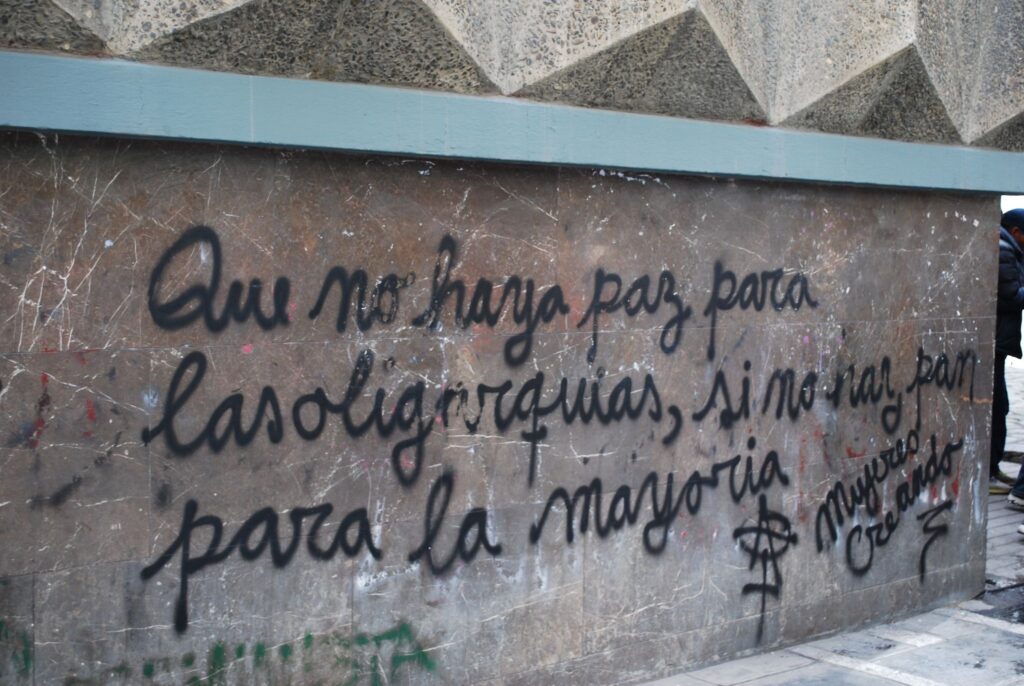
Graffiti quote inscribed by protesters reading, “May there be no peace for the oligarchies, if there is no bread for the majority.” Image credit: Joseph Bouchard

They have multiple grievances, including a cabinet with little meaningful indigenous, female or movement representation, the absence of consultation with social organizations on major legislative decisions, cuts to fuel subsidies and social services whose effects have been felt immediately in communities already stretched thin by years of economic crisis, and a failure to address the structural commercial and energy crises that preceded Paz’s election. 

On a more structural level, many syndicalist and indigeneist movements that had long been associated with the Movement Towards Socialism (MAS) made a deliberate and politically costly decision to back Paz over former socialist president Evo Morales’s old party last year. They feel that they have been betrayed, and left out. 

Protesters lined up by the Plaza San Francisco in downtown La Paz. Image credit: Joseph Bouchard

The government’s response 

For its part, the Paz government has pursued a strategy of selective negotiation combined with escalating pressure on those who refuse to leave the streets. It has reached agreements with certain teachers’ unions and regional COB affiliates, and issued decrees guaranteeing healthcare, education, and other rights to indigenous communities. 

Some factions have accepted these terms, though others have accused them of capitulating, or being co-opted by the government. One leader of the COB argued from La Paz, “They are doing the same strategy as the MAS under the previous regime, they are co-opting social movements to delegitimize our demands and our concerns, and paint us as insubordinate and ungrateful.” 

Paz has promised a cabinet reshuffle, along with an economic social council, in an attempt to “listen to the people” and provide further representation for aggrieved social sectors.

The Paz government has deployed thousands of police in La Paz and El Alto to resist and dismantle blockades, using tear gas, riot gear, and rubber bullets, apprehending at least 100 according to the People’s Ombudsman, including journalists. Three have died so far, with many more injured.

Senior officials, including cabinet members, have publicly accused blockade leaders of being financed by Evo Morales and linked to drug trafficking and terrorism. 

Paz himself has referred to those still demonstrating in the streets as “vandals,” and the state security apparatus has warned it will use “progressive and proportional force” — with persistent rumours, denied by the government, of authorization for live ammunition. 

Human rights organizations and the COB leadership have denounced the targeting of union leaders and the harassment of the press and activists. Former president Evo Morales has alleged that the Paz government, in coordination with the DEA and US Southern Command, is planning an operation to detain or kill him. 

Protesters wait to join the frontlines as tear gas accumulates near the Plurinational Assembly. Image Credit: Joseph Bouchard

The impact on Paz’s presidency 

The crisis is exposing deep tensions within Paz’s own Christian Democratic Party (PDC) big tent coalition, which brought together an ideologically eclectic mix of figures — from indigeneist currents previously aligned with the MAS, and populist actors, to more conventionally conservative actors such as former president Tuto Quiroga, multimillionaire former minister Samuel Doria Medina, and prominent figures in right-wing stronghold Santa Cruz. That coalition is straining.

Vice President Edmand Lara, a populist anti-corruption figure and former police officer whom social movements had embraced and whose support is widely credited with being decisive in Paz’s election victory, has issued multiple statements breaking with the president’s handling of the crisis. 

Lara condemned the use of chemical agents against elderly people, pregnant women, and children, called on security forces to respect proportionality protocols, denounced the intimidation of journalists, and invited the Inter-American Commission on Human Rights to monitor the situation. Political analysts in La Paz are openly speculating that Lara is positioning himself as the social movements’ candidate for the presidency, should Paz’s government fall. 

On the more conservative flank, Paz’s allies are urging a harder line. Proposals include a state of emergency, tighter control of what they characterize as violent paid agitators, and continued carrot-and-stick approaches to willing and unwilling sectors. Which tendency wins the internal argument will likely define the character of the Paz government going forward, if it can survive it. 

Protesters retreat as tear gas descends into commercial streets in downtown La Paz. Image credit: Joseph Bouchard

International response to the protests 

Internationally, the crisis has also created further divisions. Leftist Colombian President Gustavo Petro, in a series of posts on social media, described the protests as “a popular insurrection” against “geopolitical arrogance” and declared that “Bolivia stands at the forefront of the struggle for Latin American dignity.” He also offered Colombian mediation for the crisis. 

Bolivia’s foreign minister, Fernando Aramayo, responded by expelling Colombia’s ambassador, Elizabeth García, declaring her persona non grata for what he called “insistent public declarations of interference in Bolivia’s internal affairs.” Paz called it an “attack on democracy.”

Read more: Bolivia dismisses Colombia ambassador after Petro comments

The conservative bloc in Latin America has lined up firmly behind Paz. Among others, El Salvador, Argentina, Chile, Peru, and the United States have characterized the protests as destabilizing and linked them to drug trafficking. US Secretary of State Marco Rubio described the unrest as a “coup attempt,” adding that “we will not allow criminals and drug traffickers to overthrow democratically elected governments,” which protesters say are racist echoes of the country’s long history with the war on drugs and U.S. intervention. 

Argentina, meanwhile, reportedly sent military aircraft, officially carrying food and medicine, that are alleged by protest groups to also contain tear gas and crowd-control equipment, a charge Buenos Aires has denied. The OAS Security Council has convened an emergency session on Bolivia.

Demands from protesters 

The protesters’ demands range from specific sectoral issues, like better conditions for teachers, guaranteed rights for indigenous communities, to more sweeping demands including Paz’s resignation and, for Evo Morales, fresh democratic elections within 90 days. Evo Morales, the COB, and Red Ponchos have stated they will not stop fighting. 

The unfolding unrest is becoming a sharp test for Paz, and Bolivia’s democracy. Based on Bolivia’s history, the social movements in the streets, as they are acutely aware, have brought down governments before, and are in no hurry to leave. For now, the blockades continue in Bolivia.

Featured Image: Red Ponchos throw stones at functionaries and police at the Judiciary building in La Paz.

Image credit: Joseph Bouchard

The post Bolivia between democracy and social conflicts appeared first on Latin America Reports.

  • ✇Latin America Reports
  • What is behind growing disunity in the Caribbean Community bloc? (Opinion) Nand Bardouille
    Saint Augustine, Trinidad and Tobago — The Caribbean Community (CARICOM) is grappling with a protracted period of regional tensions, tied to the new normal in international politics. In some respects, this moment is the bloc’s toughest test yet.  At a time when the unity of CARICOM is under growing strain, marked by a discernible shift in respect of interactional norms and diplomatic coherence pertaining to the foreign policy realm, St. Kitts and Nevis took up the mantle of Chair of the bloc.
     

What is behind growing disunity in the Caribbean Community bloc? (Opinion)

28 April 2026 at 13:43

Saint Augustine, Trinidad and Tobago — The Caribbean Community (CARICOM) is grappling with a protracted period of regional tensions, tied to the new normal in international politics. In some respects, this moment is the bloc’s toughest test yet. 

At a time when the unity of CARICOM is under growing strain, marked by a discernible shift in respect of interactional norms and diplomatic coherence pertaining to the foreign policy realm, St. Kitts and Nevis took up the mantle of Chair of the bloc.  

Arguably, the impacts of that strain on the regional grouping have had a profound effect on how Prime Minister of St. Kitts and Nevis Terrance Drew has approached his leadership role in CARICOM — on behalf of his country. 

Drew is the Chairman of the Conference of Heads of Government of CARICOM — for a six-month term that got underway this past January. As the bloc’s constituent treaty notes: “The Conference shall be the supreme Organ of the Community.”

In this framing, regional priorities are the rotating chairmanship’s main focus. Perhaps most consequentially, Drew is discharging his regional leadership responsibilities at a juncture when CARICOM member states are facing up to emergent geopolitical dynamics that have driven a wedge between them.         

A wide (foreign policy) gap   

CARICOM member states’ duelling perspectives on the high-stakes “Trump Corollary” to the Monroe Doctrine became a consequential, foreign policy-related sticking point that placed the bloc in a months-long diplomatic rut.

This situation has weighed down the regional grouping, making its members’ efforts to cohesively contend with an international order that is undergoing a seismic change that much more difficult. (The international system last experienced change on such a scale at the Cold War’s end, which also precipitated the demise of bipolarity and ushered in the now erstwhile unipolar moment.) 

While most CARICOM member states have responded to that Doctrine with suspicion and trepidation, some have offered full-throated support. The former subset of member states are standing their ground in respect of long-established CARICOM foreign policy-related principles, which hinge on the shared desire of such small states to respect processes of international cooperation and multilateralism.   

In contrast, Trinidad and Tobago has controversially thrown its support behind Washington in respect of the spiralling U.S.-Israeli war with Iran — which has been quelled by a tenuous cease-fire for now. Instructively, early on in that conflict, Barbados called for “restraint as Middle East tensions intensify.” 

United Nations (UN) Secretary-General António Guterres has raised serious concerns about the conflict, too, as have many other stakeholders. Of note, legal experts have been sounding the alarm about what has transpired in the Middle East.      

At the core of such concerns are breaches of the UN Charter — a document whose normative and legal standards are the traditional bedrock of the conduct of CARICOM member states’ international relations as small states. This is precisely why breaches of this Charter endanger these states in respect of the anarchic international system. 

Few dynamics in this system undercut the UN Charter more than great powers behaving as if they have a license to do what they want without fear of the consequences.

This is why the U.S. military campaign that, according to the U.S. administration, sought to target illegal drug trafficking in the Caribbean by going after alleged “narco-trafficking” boats raised so many eyebrows within the CARICOM fold. (All along, of course, Venezuela’s Maduro regime was in Washington’s crosshairs.)     

US Air Force special missions aviators display a US flag on a helicopter flying over the Caribbean Sea near Puerto Rico, Jan. 23, 2026. Image credit: U.S. Southern Command via X.

Trinidad and Tobago did not share those concerns, unequivocally supporting the U.S. military action that laid the groundwork for and resulted in the capture of Venezuela’s Nicolás Maduro.

The U.S. administration has rewarded Port-of-Spain for its foreign policy positioning, deepening security cooperation. This was a priority area of the most recent bilateral engagement between Trinidad and Tobago’s Prime Minister Kamla Persad-Bissessar and U.S. Secretary of State Marco Rubio — convened on the margins of the Fiftieth Regular Meeting of the Conference of Heads of Government of CARICOM.         

What also stands out is Trinidad and Tobago’s inclusion in the Shield of the Americas initiative. Indeed, Port-of-Spain is over the moon with its participation in the recently held Shield of the Americas summit. Guyana is the only other CARICOM member state that the U.S. has included in this high-profile initiative.

With the two camps of CARICOM member states being far apart on key demands of the U.S., the status quo has fuelled mutual mistrust among members of the now five-plus-decade old grouping. It did not help that Washington operationalized the aforesaid Doctrine in invasive, heavy-handed security and foreign policy-related terms.  

It is also the case that regional politics have focused intently on seeing the way forward, amidst widespread dissatisfaction with this difficult situation. Notably, upon the start of his term as CARICOM Chair, Drew sought to shift the situation in a positive direction. With an eye to preparing the ground for the success of the Fiftieth Regular Meeting of the Conference of Heads of Government of CARICOM, held under his chairmanship this past February, he piloted “a series of high-level engagements with regional leaders.”  

Drew’s intent was to build goodwill among his fellow regional leaders, with a view to creating the conditions for them to all gather at this summit. In effect, those high-profile, face-to-face bilateral meetings held the promise of building “trust” and “shared purpose” in respect of the region’s leaders. He said as much

Beyond ensuring that all CARICOM members’ respective leaders were at ‘the (summit) table’, Drew was also committed to having them primed for a productive exchange on key issues on the regional agenda.

Drew got his wish — at least in part. All his regional counterparts took part in the said summit; although, leaders of three of the bloc’s 14 sovereign member states departed early.

Consequently, closed-door deliberations that took the form of the leaders’ Retreat did not benefit from a full house.  

The Retreat was a key component of the summit’s proceedings. This one-day, all-important session partly focused on geopolitical developments. 

CARICOM member states did close ranks on some of the issues arising, which include Cuba policy. Their respective long-standing and wide-ranging bilateral relations with the Communist island have emerged as a diplomatic pressure point. In fact, several hold outs in the CARICOM fold have little choice but to accept Washington’s foreign policy line on how they should treat Havana vis-à-vis facets of those relations. 

One day prior to that leaders’ Retreat, and as part of the summit’s proceedings, Rubio met in-person with CARICOM leaders. One important take away from these talks is that they resulted in an agreement on a contemporary Cooperation Framework, which is now earnestly in the works. 

These developments had a direct bearing on regional leaders’ subsequent consideration of geopolitical developments — a priority matter at the summit — warranting the issuance of the ‘Joint Statement on CARICOM’s Engagement with Secretary Rubio’.    

The pre-eminence of the ‘sovereignty narrative’

Signals emanating from the summit in question also called attention to the limits of CARICOM-based regionalism, with member states reaffirming their pragmatic approach to integration.  

It is important to note that, with a nod to the Rose Hall Declaration on ‘Regional Governance and Integrated Development’, Prime Minister of Jamaica Andrew Holness drove this point home at the formal start of that very summit.

Regarding regional governance, the so-called Rose Hall Declaration states (in part): “The reaffirmation that CARICOM is a Community of Sovereign States, and of Territories able and willing to exercise the rights and assume the obligations of membership of the Community, and that the deepening of regional integration will proceed in this political and juridical context.”

Put differently, and as Terri-Ann Gilbert-Roberts notes in a 2013 scholarly work, there is a “strong aversion among political elites to delegating authority to supranational institutions — a legacy of the Federal Experiment.”

Prime Minister of Jamaica Andrew Holness addresses the 50th Regular Meeting of the Conference of Heads of Government of CARICOM. Image credit: Office of the Prime Minister of Jamaica.

In his address to the Opening Ceremony of the summit under reference, Holness underscored the following: “For decades, an idealised narrative around Caribbean integration, while well-intentioned, has framed perhaps unrealistic expectations within our respective populations. It has also perhaps unintentionally diminished the genuine strengths of our existing arrangement, an association of independent states bound not by uniformity, but by shared purpose, mutual regard, and a deep history of collaboration.”

Yet it is equally important to recognize the tremendous achievements of a cohesively functioning CARICOM, as advanced (in large part) by regional summitry. Such summitry has long played a key role in member states’ broader efforts to coordinate with each other and partners, enabling dialogue that has paid off in spades over several decades.

Meetings of this kind are crucial for strengthening bilateral and multilateral ties and contributing to diplomatic solutions, now more than ever. 

Holness himself seemed to signal as much, conveying the following perspective at the opening of the 50th Regular Meeting of the Conference of Heads of Government of CARICOM: “We meet at a time when the speed of global change is outpacing the speed of regional coordination.” 

This summit, per its communiqué, represents an important win for St. Kitts and Nevis and CARICOM as a whole.    

Unity hopes suffer another blow

Yet what brought opportunity for coordination at a time of sharp tensions that are the cause of a foreign policy-related rift in CARICOM has also created yet another point of contention: The much-publicized controversy that has arisen surrounding the reappointment of the Secretary-General of CARICOM during the leaders’ Retreat.  

This controversy has been brewing ever since Drew’s initial statement — issued on March 25th — regarding the reappointment of incumbent Secretary-General of CARICOM Carla Barnett for a second term of office beginning in August 2026.

The impasse runs deeper than procedural concerns over the reappointment of the Secretary-General and attendant matters, with CARICOM’s governance and operations having also come under the spotlight. 

The headlines create the impression that there is little sign yet that a resolution is imminent. 

The parties out-front on the matter have apparently doubled down on their respective positions, which have only hardened. In this regard, the latest missives (as of this writing) penned by Trinidad and Tobago Foreign Minister Sean Sobers (dated April 9th) and Drew (dated April 11th), respectively, come to mind. Although dispatched via diplomatic channels, the correspondence in question is now in the public domain. 

While some political leaders are clashing publicly, others in the CARICOM fold are walking a tightrope on this issue.  

High-level diplomatic efforts to see a way forward on what has become a significant bone of contention — with the potential to stymie CARICOM regionalism — will no doubt continue.

Opening Ceremony of the 50th Conference of Heads of Government of CARICOM, St Kitts and Nevis. Image credit: CARICOM via Flickr

Rising to the challenge

And yet, CARICOM has not a moment to lose in effectively marshalling member states to contend with the resurgence of great-power politics. This spheres of influence-related development carries serious risks, which undercut a cornerstone of the postwar international order: multilateral cooperation.  

These dynamics of contemporary international politics continue to turn the screws on CARICOM — and fast.  

We are already seeing a key consequence of this turn of events: A new reality now shapes CARICOM diplomacy — already under strain from the aforementioned foreign policy-related rift in the bloc.   

In short, the shift within the grouping in respect of interactional norms and diplomatic coherence pertaining to the foreign policy realm exposes seemingly deep divisions in relation to worldviews.   

History shows that such moments do not augur well for the bloc. One could draw a historical parallel with the U.S. invasion of Grenada in 1983, which stoked tensions within and had far-reaching impacts on the region.      

Clearly, key foreign policy-related setbacks within today’s CARICOM fit a longer pattern. Even so, their ever-widening rifts ought not to become a fixture in the scheme of things either. 

While there was much-needed discussion at the summit under reference about geopolitical developments, along with a nod to the rationale qua nature of the bloc itself, CARICOM needs to work through how it can better rise to the challenge of navigating the return of great-power politics. 

In years ahead, the new normal in international politics will likely continue to undermine the UN Charter.

The stakes are high for such small states at this moment, and all concerned need to take a long, hard look at the issues arising.

There is increasing recognition in CARICOM foreign policy circles that, facing rising risks, the bloc needs to get a handle on the current state of affairs. 

When CARICOM foreign ministers meet next month, they will likely continue to try to work things through. 

Featured image: 50th Conference of Heads of Government of CARICOM. Photo of CARICOM Leaders with US Secretary of State Marco Rubio.

Image credit: CARICOM

The post What is behind growing disunity in the Caribbean Community bloc? (Opinion) appeared first on Latin America Reports.
  • ✇Latin America Reports
  • The ‘global far right’ in Colombia – lessons from history (Perspective)  Charlotte Eaton
    On May 24, Colombia’s President Gustavo Petro posted on X denouncing an “international alliance of the ultra-right” which was seeking to interfere in presidential elections being held this Sunday.  The so-called “Hondurasgate” responds to a series of audios leaked in late April indicating an alleged conspiracy between the United States, Israel and Argentina to destabilize left-wing governments in Latin America, including in Colombia.  Leaked recordings, first published by Diario Red, a
     

The ‘global far right’ in Colombia – lessons from history (Perspective) 

29 May 2026 at 15:20

On May 24, Colombia’s President Gustavo Petro posted on X denouncing an “international alliance of the ultra-right” which was seeking to interfere in presidential elections being held this Sunday. 

The so-called “Hondurasgate” responds to a series of audios leaked in late April indicating an alleged conspiracy between the United States, Israel and Argentina to destabilize left-wing governments in Latin America, including in Colombia. 

Leaked recordings, first published by Diario Red, allegedly tie former Honduran President Juan Orlando Hernandez to conservative actors in these countries who set out to spread disinformation about leftist governments in Mexico, Colombia and Brazil. 

Such international coordination is not new; since at least last August there have been reports of the far right in Colombia developing increasingly sophisticated ties with extremist groups in Latin America, Spain and the United States. 

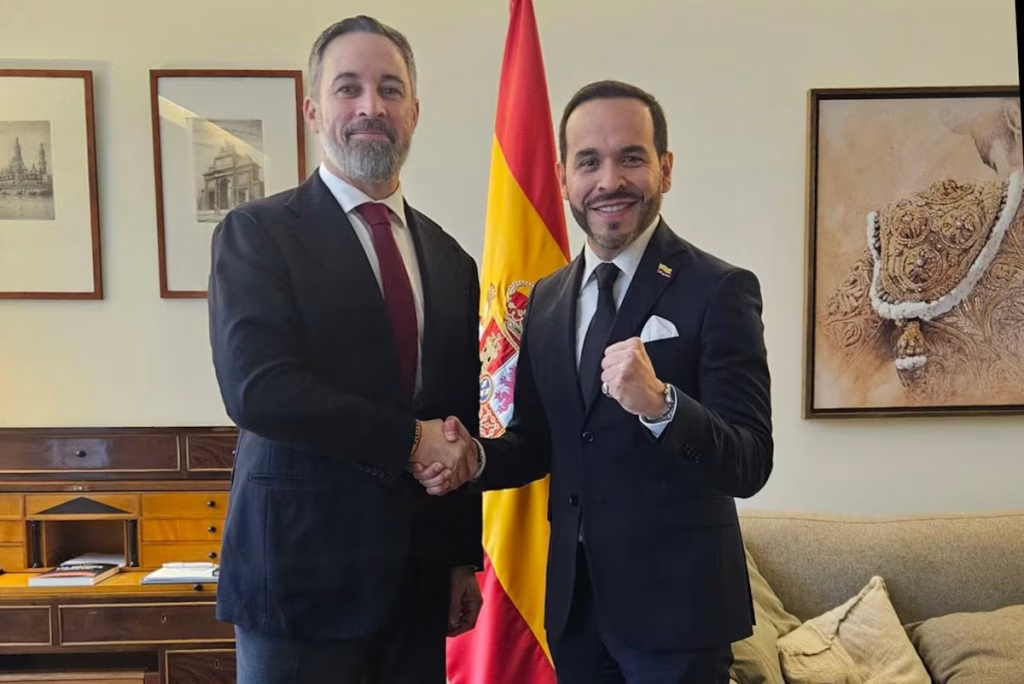
These cross-border networks include significant figures in Colombian politics. In January, presidential hopeful Abelardo de la Espriella travelled to Madrid where he met Santiago Abascal, leader of far-right Spanish Vox party, and participated in the Foro de Madrid, an alliance of right-wing leaders and groups across Europe and the Americas. 

A recent investigation by Bellingcat and Cerosetenta also connected Jorge Rodríguez, ex- congressional candidate for the Centro Democrático, to an alleged member of the global neonazi group Active Club in Bogotá. Rodríguez has been a keen supporter of another contender for the presidency, the Centro Demcrático’s Paloma Valencia.

As Petro’s post suggests, there are also more powerful influences at play. On May 20, Republican Senator Bernie Moreno told a meeting of the Atlantic Council that the United States might not recognize the result of Sunday’s elections if there is evidence of voter intimidation. 

Moreno, who is of Colombian origin and has been invited to oversee the elections as an international observer, also denounced the Petro administration and claimed it would be an “abject disaster” if the country voted in another leftist government. 

Santiago Abascal and Abelardo De La Espriella met in Spain in January 2026. Image credit: Vox

Colombia’s history with the global far right 

As a historian of 20th-century Colombia, focussing particularly on political and social developments in the mid-1900s, I am aware that Colombia’s growing entanglement in the global far right also has historical precedents.

In the late 1930s and early 1940s, various right-wing groups across the country cultivated cross-border connections with fascist-inspired groups in Europe and Latin America. 

In the context of Liberal social reformism, Conservative weakness and a growing fear of communism, several movements emerged across the country (but principally in Bogotá and Medellín) which sought inspiration from Nazism, Italian fascism and, most importantly, Spanish Catholic nationalism. 

The onset of the Spanish Civil War (1936 to 1939) allowed these groups to forge tangible links with their European counterparts in the form of fundraising campaigns for Nationalist troops in Spain, propaganda visits from representatives of General Francisco Franco and the establishment of local branches of the Falange Española, a fascist political party. 

These connections strengthened the Colombian far right financially and politically, making them a not insignificant force in the country. 

Colombia in the mid-20th century was clearly a very different political and social scene. For starters, it had a bipartisan political system and the Catholic Church played a very influential role in politics. 

However, it is worth taking note of the consequences of this previous international mobilization, particularly as the far right plays a much more significant role today. 

Firstly, the growing audacity of right-wing movements led to the halting of a reformist agenda which, although imperfect, did aim to improve the lives of many Colombians. 

It also increased political polarization in the country and infused popular and official Conservative discourse with a particular religious-based nationalism that would have disastrous consequences in the late 1940s when Colombia saw the outbreak of a more-than-decade-long informal civil war. 

Colombian President Laureano Gómez (1950-53) admired General Francisco Franco’s fascist government in Spain and in 1953 promoted a corporatist constitutional reform bill. He was deposed in a military coup that same year. Image credit: Señal Memoria

Finally, the sense that the country’s interests were better served as part of a wider conservative ideal, contributed to a constitutional reform bill in 1953 which sought to turn Colombia into a confessional corporatist state along the lines of Franco’s Spain. 

This bill failed but provoked a coup that inaugurated the country’s only 20th-century dictatorship which was succeeded by a 16-year power sharing agreement that set the scene for the emergence of guerrilla movements from the 1960s.

Of course, no one can predict the long-term impacts of the upcoming election result. However, the events of the 1930s and 1940s should give pause for thought about what the involvement of certain presidential candidates in the global far right could mean for Colombia’s future. 

The opinions and analysis expressed in this column are solely those of the author and do not necessarily reflect the views of Latin America Reports.

The post The ‘global far right’ in Colombia – lessons from history (Perspective)  appeared first on Latin America Reports.

The science and education budget cuts that led hundreds of thousands of Argentines to protest this week

13 May 2026 at 18:48

Buenos Aires, Argentina — Thousands of professors, administrative staff, students, and graduates marched across Argentina on Tuesday to demand that the government comply with a university funding law approved last August. 

It was the fourth such “Federal University March”, brought about because of persistent budget cuts to higher education and the sciences since Javier Milei became president in 2023. Since then, government budget allocations to national universities fell 45.6%, the National Inter-University Council (CIN) reported. 

Under current law, the government has adjusted for inflation professors salaries and operating costs, leading to a surge of resignations and other teachers forced to find additional jobs. Although Congress passed the public university funding bill in August 2025, Milei quickly vetoed it, citing his commitment to a zero-deficit policy. 

Read more: Despite large protests, Argentina’s Javier Milei vetoed university spending bill

By September, lawmakers in both chambers rejected the veto, officially enacting the bill into law.

Nevertheless, the president has effectively stalled its implementation via decree, arguing that the law remains on hold until specific funding sources are identified. 

In late March, a federal court ordered the government to comply with a segment of the norm that granted a salary raise for university staff, which was considered the most urgent item in the bill.

In an attempt to dodge its obligations, the government has appealed to the courts and a lower appeals court has just granted the administration’s request to elevate the case to the Supreme Court and suspend the law’s implementation in the meantime. Final word on the matter now lies with the country’s highest tribunal. 

Despite Tuesday’s mass mobilization that gathered over 600,000 people in the capital Buenos Aires and nearly 1 million across Argentina, the University of Buenos Aires (UBA) said that the government decided to double down. 

“You could have a hundred thousand, a million or five million people on the streets, but the budget restriction will continue,” said Alejandro Álvarez, the Undersecretary of University Policies. 

A day before the march, whose slogan called on Milei to “Comply with the law, do not mortgage the future,” the president’s administration cut more projects, including $5.3 billion pesos (US$3.8 million) destined for university building maintenance and $2 billion pesos (US$1.4 million) in science scholarships. Between education, science, technology and direct transfers, the administration has cut over $110 billion pesos (US$79 million). 

Before Milei took office, higher education funding accounted for 0.72% of the Gross Domestic Product (GDP) in 2023; it’s currently around 0.47% of GDP. 

The impact is stark, and nowadays, some of Argentina’s best public universities are being pushed to the brink, according to their faculties. Universities have complained about deteriorating facilities, rationing electricity, faculty salary cuts and a drop in extracurricular activities, among other things. 

Signs from protesters urging Milei to comply with the university funding bill. Image credit: Governor of the Buenos Aires Province Axel Kicillof via X.

Historic lows and the “brain drain” threat

The current higher education budget is at a two-decade low, plunging funding below levels witnessed during the 1989 hyperinflation crisis (0.44% of GDP) and approaching the absolute minimums recorded during Argentina’s military dictatorship, according to a report by the Ibero-American Center for Research in Science, Technology, and Innovation (CiiCTi).

One of the most pressing medium-term challenges is the retention of academic staff. Faculty salaries have plummeted by 32% since Milei’s La Libertad Avanza administration took office, prompting approximately 10,000 resignations, according to CIN data. 

The exodus has left vacant teaching positions in areas deemed highly strategic for the government’s own economic model, including sectors like energy, technology, and mining.

At the University of Buenos Aires alone, the Faculty of Exact and Natural Sciences reported the loss of 438 professors and researchers between December 2023 and April 2026.

“We are losing one every two days,” a faculty member who asked not to be named for fear of retribution, told Argentina Reports. The Engineering department saw an additional 342 departures.

A historic setback: Funding drops below 2002 and 1976 levels

The situation is equally critical for science and technology, where analysts warn of a virtual dismantling of the country’s research matrix. 

Federal spending on science and technology fell by 39.3% during the first quarter compared to the same period in 2023, projecting a real-term decline of 47.7% by the end of the three-year cycle, the CiiCTi report noted. 

This sustained budgetary squeeze will reduce the sector’s funding to just 0.149% of GDP, the lowest level recorded since historical recording began in 1972.

To grasp the magnitude of the fiscal adjustment, the current level of funding pierces the floors seen during the worst phase of the 2002 economic collapse (0.177% of GDP) and the onset of the military dictatorship in 1976 (0.194% of GDP). 

These official figures also confirm the government’s failure to meet the targets set by the suspended science funding law, which legally required the state to invest 0.520% of GDP in the sector this year.

An ideological debate over the role of public education

Beyond a 40.3% drop in the purchasing power of salaries and scholarships at Argentina’s National Scientific and Technical Research Council (CONICET) since November 2023, the funds required to keep research projects active are virtually paralyzed.

The Agencia I+D+i, the country’s main innovation and development agency, has suffered a severe 86.3% cut over the last three years. 

This is compounded by the financial asphyxiation of cutting-edge institutions: the National Space Activities Commission (CONAE)—key to Argentina’s participation in NASA’s Artemis mission—faces a 61.2% cut, while the National Atomic Energy Commission (CNEA) and the National Agricultural Technology Institute (INTA) have seen their budgets slashed by nearly 47%.

Featured image: Hundreds of thousands of people gathered in Buenos Aires and other parts of Argentina on May 12 to protest budget cuts to the higher education system.

Image credit: Governor of the Buenos Aires Province Axel Kicillof via X.

The post The science and education budget cuts that led hundreds of thousands of Argentines to protest this week appeared first on Argentina Reports.

The post The science and education budget cuts that led hundreds of thousands of Argentines to protest this week appeared first on Latin America Reports.
  • ✇Latin America Reports
  • Colombia presidential candidates announce running mates as race narrows Alfie Pannell
    Bogotá, Colombia – Iván Cepeda and Abelardo de la Espriella, two of the frontrunners to be the next Colombian president, have announced their choices for vice president following Sunday’s legislative elections and presidential primaries. Cepeda selected Aida Quilcué, a senator and Indigenous leader, to join him on the ticket for the left-wing Historic Pact (Pacto Historico), which won the most congressional seats on Sunday. Meanwhile, de la Espriella, a hard-right outsider, announced today th
     

Colombia presidential candidates announce running mates as race narrows

10 March 2026 at 21:21

Bogotá, Colombia – Iván Cepeda and Abelardo de la Espriella, two of the frontrunners to be the next Colombian president, have announced their choices for vice president following Sunday’s legislative elections and presidential primaries.

Cepeda selected Aida Quilcué, a senator and Indigenous leader, to join him on the ticket for the left-wing Historic Pact (Pacto Historico), which won the most congressional seats on Sunday. Meanwhile, de la Espriella, a hard-right outsider, announced today that he will run alongside ex-finance minister José Manuel Restrepo. 

But the big winner in Sunday’s primary, right-wing Paloma Valencia of the Democratic Center (Centro Democrático) party, has yet to announce her running mate amid mounting speculation.

Cepeda sticks to his guns

On Monday, Cepeda formally announced Aida Quilcué as his running mate. A leader of the Nasa Indigenous group, Quilcué has a record as a staunch defender of human rights and as an advocate for ethnic minorities in Colombia.

She was integral to the negotiation of the ethnic chapter of the 2016 peace accord with the Revolutionary Armed Forces of Colombia (FARC) and has been a key figure in Colombia’s Indigenous rights movement. 

Last month, Quilcué made national headlines when she was kidnapped in her home state of Cauca, in the Colombian Pacific, by dissidents of the FARC. 

Miguel Jaramillo Luján, a Colombian political strategist, described Cepeda’s choice of Quilcué as a “symbolic” one which entrenches his stance as an advocate of peace and human rights.

But the analyst also noted that the selection may not be the most politically savvy move: “From an electoral standpoint, I believe that this is a concentric circle and does not add much electoral power to Iván Cepeda, who I think is acting symbolically but overly prideful in this decision,” Jaramillo told Latin America Reports

De la Espriella’s establishment pick

Abelardo de la Espriella, a criminal defense attorney, has styled himself as an anti-establishment political outsider. His traditional values, tough on crime campaign has been successful so far, regularly placing him in second place in presidential polls.

Today, ‘The Tiger’, as he has styled himself, announced his running mate: José Manuel Restrepo.

Restrepo is an economist at the Rosario University in Bogotá and served as President Ivan Duque’s Minister of Finance and Public Credit from May 2021 to August 2022, running the country’s finances during the COVID-19 pandemic. Before that he was Minister of Commerce, Industry, and Tourism beginning in 2018.

“I think the selection of José Manuel Restrepo… represents an attempt to counterbalance de la Espriella, who has no experience in public office,” said Jaramillo.

While de la Espriella is an outsider, he must take on Cepeda and Valencia, both sitting senators since 2014. Restrepo burnishes the criminal lawyer’s bid by adding proven governance credentials.

When announcing his running mate on Tuesday, de la Espriella said: “My choice of vice president was not driven by political calculation… it was clear to me that a renowned academic, an outstanding economist, and a highly qualified former minister and technician will undoubtedly be the best travel companion.”

Paloma Valencia in the spotlight

On Sunday, Paloma Valencia received over 45% of votes in presidential primaries, although Cepeda and de la Espriella were both absent from the contest.

Valencia’s win, as well as her Democratic Center party’s strong showing in legislative elections – winning the second highest number of seats – bolsters her position in the presidential race, according to experts. 

“From the [primaries], it’s clear that Paloma Valencia is the right-wing’s principal candidate,” Sergio Guzmán, director at Colombia Risk Analysis, a political risk consultancy, told Latin America Reports

Before Sunday’s vote, de la Espriella had been dominating conservative polls. Now, it is unclear which conservative candidate will attract the most voters in May’s election.

Whoever emerges as the winner must face off with Cepeda and will be under pressure to  win over centrist Colombians, said Guzman.

One way to achieve this is by selecting running mates with a broader appeal.

Sunday’s primaries highlighted the widespread popularity of Juan Daniel Oviedo, who was on the same list as Valencia and won 17% of the total votes. The former director of the National Administrative Department of Statistics (DANE), Oviedo is considered center-right and notably more moderate than Valencia.

Valencia is under mounting public pressure to pick Oviedo as her running mate, according to Jaramillo, but the two differ on key issues and Oviedo has specified strict conditions for joining Valencia’s ticket.

“We openly show fundamental differences. For example, I believe in peace,” Oviedo told Colombian radio station Caracol on Monday. “You cannot take positions that do not recognize that the [2016 peace] agreement must be implemented and that it requires more than just bullets to get rid of criminals,” he added.

Valencia has staked her campaign on law and order, promising a ‘mano dura’, or ‘iron fist’, against crime and armed groups in Colombia. Her politics follow those of her party’s founder, ex-president Álvaro Uribe, who waged war on the FARC rebels from 2002 to 2010. 

Today, Valencia told Caracol that she will not compromise on this: “I am an Uribista and I have my values and principles… Neither he [Oviedo] will change nor will I change.” 

But Valencia said she remains open to running alongside Oviedo, with the two due to meet today to discuss a possible joint ticket. She is also considering four other possible running mates, according to Colombian newspaper El Tiempo, with her decision due by Friday.

Jaramillo argues the best move for Valencia is not to pick Oviedo, as he is legally bound to support her as they ran under the same list in the primaries.

He believes she should distance herself from Uribe – arguing Uribistas are more likely to back de la Espriella – and instead court the moderate vote by choosing a center-left candidate.

But Guzmán says that is unlikely: “She seems to be going in a different direction.”

Featured image description: Left to right: Iván Cepeda, Paloma Valencia, Abelardo de la Espriella.

Featured image credit: @PactoCol via X / @PalomaValenciaL via X / @ABDELAESPRIELLA via X

The post Colombia presidential candidates announce running mates as race narrows appeared first on Latin America Reports.
  • ✇Latin America Reports
  • U.S. pressure mounts on Brazil to designate criminal groups as terrorists Brazil Reports
    Brazil is facing heightened pressure both internally and from the United States to designate criminal gangs operating in the country as foreign terrorist organizations (FTOs).  Foreign Minister Mauro Vieira spoke to U.S. Secretary of State Marco Rubio on March 8 and pushed back against the designation, arguing it could create precedents for military intervention similar to the recent American operations against Venezuela’s alleged drug trafficking networks. The dispute intersects with Brazil’s
     

U.S. pressure mounts on Brazil to designate criminal groups as terrorists

19 March 2026 at 02:35

Brazil is facing heightened pressure both internally and from the United States to designate criminal gangs operating in the country as foreign terrorist organizations (FTOs). 

Foreign Minister Mauro Vieira spoke to U.S. Secretary of State Marco Rubio on March 8 and pushed back against the designation, arguing it could create precedents for military intervention similar to the recent American operations against Venezuela’s alleged drug trafficking networks.

The dispute intersects with Brazil’s own election year, where the designation could hand ammunition to right-wing candidates calling for harder security measures.

As of late, the country has managed to withstand U.S. pressure via legislative action. Brazil’s Anti-Terrorism Law defines terrorism as acts intended to provoke “social or generalized terror” on the basis of race, color, ethnicity or religion. Notably, it explicitly excludes profit-driven drug trafficking. 

Deadly Rio de Janeiro raids: A precedent for U.S. pressure?

The October 28, 2025 raids in the northern Rio de Janeiro favelas resulted in 132 casualties, and were labeled as the deadliest in recent years. Meanwhile, they have also cast a long shadow over Brazil’s security capacity. 

What was intended to be an operation against the leaders of the Comando Vermelho (CV) drug trafficking group ended in the slaughter of over 120 people including four police officers.

Governor Cláudio Castro of the Liberal Party, who instructed the police on the raid, argued that this form of hard-handed policy is needed to uproot organized crime in the city: 

“This is how the Rio police are treated by criminals: with bombs dropped by drones. This is the scale of the challenge we face. This is not ordinary crime, but narco-terrorism,” said Castro

While many agree that more can be done in the country to prevent the expansion of these groups, some challenge any theoretical benefit that FTO designations could prompt. 

For one, Justice Minister Ricardo Lewandowski stood beside Rio’s governor a day following the strike: “Terrorism always involves an ideological element,” the minister said. 

Criminal gangs, on the other hand, “commit offenses already defined in the Penal Code,” he told Agencia Brasil.

The real crisis of organized crime

Roberto Uchôa de Oliveira Santos, public security specialist and former employee of the civil and federal police forces in Brazil, highlighted that Brazilian President Luiz Inácio Lula da Silva and U.S. President Donald Trump have had talks about collaborating over the issues of illicit firearm flows and money laundering, which Lula reiterated on X on March 18. 

Uchôa de Oliveira Santos told Brazil Reports that while it is important for “governments to work together across the region, [the designation is] not understood as an act of partnership” on the part of the Brazilian government. Rather, it is interpreted as a form of “geopolitical pressure” with dubious benefits.

He added that “it is not the objective of President Trump to fight criminal organizations” in Brazil. In fact, he believes this narrative conceals the U.S.’s hidden agenda. Conceding to his pressure, he added, would be a “huge mistake”; the extent of criminal governance, whereby criminal groups can control the police, judiciary, prosecutor’s office and political actors is “a virus”. 

Curbing the power of transnational crime groups such as the Primeiro Comando da Capital (PCC) and CV requires more than Trump’s designation and military-led strategy which tends to follow, the expert added. 

While outlining that “improved communications and intelligence” would upgrade security operations like Rio’s raids, Uchôa de Oliveira Santos wrote in The Conversation that there is no evidence that U.S. methods work.

Labelling organizations driven by illicit market profits as terrorists overlooks the fundamental networking nature of groups like the PCC and CV, according to Dr. Guadalupe Correa-Cabrera, professor at the Schar School of Policy and Government; in the end, these groups adapt to market opportunities. 

Uchôa de Oliveira Santos highlighted how, contrary to contemporary organizations which utilize spectacles of power to incite fear, the PCC uses forms of pragmatic violence – which often fall under the radar. 

“Instead of fighting the State, [the groups are allowed] to penetrate violence within the mechanism of the State,” Uchôa de Oliveira Santos added. The PCC, for example, bribed and co-opted policemen to murder of businessman Antonio Vinicius Gritzbach on their behalf in November 2024. 

Others decry the FTO designation could serve as a pretext for the U.S.’s CIA or FBI to enter Brazil, which would be an affront to their national sovereignty. 

Brazil remains resistant to following the example of Ecuador, where President Daniel Noboa recently invited the establishment of an FBI office on their sovereign territory. 

Read more: Colombia’s Petro accuses Ecuador of bombing near border

Mario Sarrubbo, former São Paulo prosecutor-general, explained to Valor International: “The move to declare them terrorists would only make the country vulnerable internationally to economic embargoes and even territorial violations, which would be unreasonable under any circumstances.”

FTO designations and Brazil’s upcoming elections

Geopolitical conditions have compounded on the Rio raids, creating a more partisan landscape of opinion on Brazil’s security – which is already a concern to emotive voters. 

Governor Castro called the raid a “success”, and has since aligned with the hard-handed policy of the Trump administration. Greater support from the Armed Forces, he said, is needed to protect Rio. 

Meanwhile, Tarcísio de Freitas, Republicanos Party member and Governor of São Paulo, stated that a potential FTO designation is an “opportunity” for Brazil on March 11.

“From the moment that a government like the U.S. sees the PCC as a terrorist organization – which is in fact what they are – it is easier to open the way for cooperation, integrate intelligence, access financial resources and structure an even more effective fight,” said Freitas

Uchôa de Oliveira Santos, however, challenged how effective security policy aligned with the FTO designation could be. The expert sees the designation as a form of geopolitical pressure under Trump’s so-called “Donroe Doctrine.”

With Brazilian general elections approaching on October 4, 2026, there is concern that the designation could become a domestic political weapon in a country which is already deeply polarized: right-wing candidates may embrace it as validation for harder security policies, while the Lula government faces the dilemma of appearing either soft on crime or subservient to Washington.

Amidst the clamour, dealing with the potential threats posed by the PCC and CV fades into the background of political debate. As Uchôa de Oliveira Santos suggests, the profit-driven, entrepreneurial, and resilient nature of these criminal groups would be overlooked if they were to be designated as FTOs.

Featured image: Civil police officers from the Robbery and Theft of Cargo Division during Operation Containment
Source: Wikimedia Commons
Author: CanalGov
Creative Commons Licenses

The post U.S. pressure mounts on Brazil to designate criminal groups as terrorists appeared first on Brazil Reports.

The post U.S. pressure mounts on Brazil to designate criminal groups as terrorists appeared first on Latin America Reports.
  • ✇Latin America Reports
  • Colombia’s #MeToo moment highlights abuse within media organizations Angie Acosta
    Bogotá, Colombia – Noticias Caracol, one of the largest media outlets in Colombia, released a statement on March 20 regarding an investigation into two of its lead journalists, Ricardo Orrego and Jorge Alfredo Vargas, following allegations of sexual abuse against some of their female colleagues. The allegations sent shockwaves through the media industry, in part because of the reputation both men had built over their careers. For decades, Orrego was the voice of Colombian sports, leadi
     

Colombia’s #MeToo moment highlights abuse within media organizations

16 April 2026 at 20:37

Bogotá, Colombia – Noticias Caracol, one of the largest media outlets in Colombia, released a statement on March 20 regarding an investigation into two of its lead journalists, Ricardo Orrego and Jorge Alfredo Vargas, following allegations of sexual abuse against some of their female colleagues.

The allegations sent shockwaves through the media industry, in part because of the reputation both men had built over their careers.

For decades, Orrego was the voice of Colombian sports, leading coverage of multiple World Cups and other international sporting competitions, while Vargas had been the charismatic anchor of Caracol’s prime-time news show for over 20 years. 

Days after announcing the investigation, the network sent a follow-up message: both men had been removed from their positions despite them denying the allegations. Soon after, Orrego published a statement from his lawyer on X, saying the firing was “one sided” and that he would comply with any investigation. Vargas also published a statement saying he was stepping away from Caracol while saying he maintained “respect” and “good behavior” while working as a journalist.

The firings marked a pivotal moment for Colombian newsrooms and inspired dozens of female journalists to come forward and share their own experiences of sexual harassment, sparking a massive wave of solidarity under the hashtags #YoTeCreoColega (I believe you, colleague) and #MeTooColombia, while also exposing a deeply-rooted culture of harassment and abuse.

Fear: a reason for sharing an open secret

Before social media changed the news landscape, the men and women appearing on Colombian television screens to report the news became trusted icons for aspiring journalists, including myself. 

As their star-power rose, questioning them became more difficult. 

Longtime Colombian journalist Yolanda Ruiz wrote in her column for Spanish newspaper El País that the industry “has prioritized the ratings of its stars over the dignity of female journalists,” creating a “throne of impunity that is finally beginning to crumble.”

“It cannot be a surprise when the ‘open secret’ finally explodes,” she wrote. 

The harassment isn’t just contained to the television industry either. According to a 2020 study by the Observatorio de la Democracia at Universidad de los Andes, which surveyed 158 female reporters, six out of 10 participants reported being victims of gender-based violence in their workplaces, while a staggering 77.9% stated they were aware of this kind of abuse against their female colleagues.

Several journalists (in this case, regardless of gender) have also claimed to be victims of workplace bullying, stemming not only from bosses and power figures but also from their own colleagues. 

Beyond the situations of workplace and sexual harassment, journalists in Colombia also face low salaries and severe labor instability. According to a study by Universidad del Rosario, which surveyed 277 journalists, nearly half of the participants (137) stated they would leave the profession for another field if given the chance. 

This reveals a toxic environment where intimidation was normalized at every level of the newsroom, creating a cross-sectional pattern of abuse that silenced those trying to build a career or keep their current positions within the industry.

Same pattern, different workplaces

Following the Caracol journalists’ harassment allegations, Colombian journalists Paula Bolívar, Juanita Gómez, Mónica Rodríguez, Laura Palomino, and Catalina Botero began the #MeTooColombia movement. 

They were inspired by the #MeToo hashtag that arose in the U.S. in 2017 following revelations of sexual abuse by Hollywood producer Harvey Weinstein. 

The group of reporters also established a dedicated communication channel (yotecreocolega@gmail.com) for victims to share their stories of abuse within newsrooms. The response was overwhelming: in just a week, they received at least 200 emails with testimonies ranging from 1993 to 2025.

In the case of Juanita Gómez and Catalina Botero, both prominent journalists who previously worked at Noticias Caracol and who currently serve at weekly news magazine Semana and state-owned radio station RTVC respectively, the initiative started by sharing on social media their own experiences.

Through her account on X, Gómez detailed aggressions she suffered from a well-known anchor while on an international assignment in 2015.

“I would tell her that having to force a journalist/presenter off you, several times and with pushing, so he wouldn’t kiss you in an elevator… is not normal and should never have happened,” Gómez wrote.

“I would also tell her to talk to her female colleagues, hopefully many of them, because they have much worse stories, and surely together they would find a way to report the harasser.” 

This encouraged other women who worked at TV channel RCN, newspaper El Espectador, and other Colombian media, to share their own experiences.

Some questions began to surface: if this is a systemic pattern across the entire media industry, why has only one outlet spoken out publicly? And more importantly, why is this reckoning happening only now?

The fact that Juan Roberto Vargas, the director of Noticias Caracol, has publicly addressed the situation inside the media outlet as “painful” and “sad” marks a significant first step, one that directors of other major media outlets should follow.

His commitment to taking “decisive measures” sets a precedent in an industry where silence has long been the standard response to internal abuse.

The end of an era: Breaking the cycle of impunity

Eight years ago, Lina Castillo publicly accused Hollman Morris—the current director of the public radio broadcaster RTVC—of sexual and workplace harassment. 

The journalist’s public allegations were turned against her, however, after Morris filed a defamation complaint, arguing her accusations were damaging his reputation. 

Driven by the #YoTeCreoColega movement, a group of more than 40 women, including journalists, lawyers, and writers, joined together to sign an open letter questioning the case against Castillo and denouncing Morris’s legal actions. They argue that his goal is not to seek justice, but “to silence the women who report him.”

In March, following pressure from social organizations, the case was transferred to a higher court to ensure “gender sensitive analysis.” 

Additionally, Jineth Bedoya, an award-winning journalist who became a symbol of the fight against gender-based violence following her kidnapping, torture, and rape at the hands of right-wing paramilitaries in 2000, recently took the issue of harassment in newsrooms to lawmakers.  

On March 25, Bedoya testified before Congress, calling on lawmakers to end the “pacts of silence” that have protected predators in newsrooms for decades.

“A group of women journalists is here today to remind you that, for decades, women in the media have had to carry the burden of gender-based violence,” she stated. “No more pacts of silence in newsrooms. Today is not the time to remain silent.”

The #MeTooColombia movement is also seeking legal recourse for victims. The Attorney General’s Office reported over 50 complaints of sexual and workplace harassment within the media industry in less than a week after the initial allegations involving journalists from Noticias Caracol came to light.

Victims were encouraged to report abuse to a special email set up by the Prosecutor’s Office: denuncia.acoso@fiscalia.gov.co

The tip of the iceberg?

On April 7, the Ministry of Labor published a document detailing immediate measures imposed against Noticias Caracol. This followed an inspection of Caracol TV and BLU Radio facilities, which could potentially be extended to other media companies.

“There are clear signs of a possible failure in the mechanisms for prevention, attention, and investigation of workplace sexual harassment within the company,” the statement pointed out.

The investigation also revealed that one of the accused, Ricardo Orrego, had received prior warnings in 2023 and 2025. However, there are no documents identifying the complainants behind them or any evidence of a structured disciplinary procedure.

Regarding the disgraced journalist, the Ministry ordered a “documentary reconstruction process” for the warnings issued to Orrego. The goal is to “identify the original complaints, the departments involved, and the reasons why no formal disciplinary procedures were ever carried out.”

At the same time, the inspection uncovered 15 new complaints of potential sexual harassment. These cases had remained invisible, either because victims didn’t report them or because the company simply failed to handle them through the proper channels.

While Caracol’s decision to go public marks a rare and necessary first step, the Ministry’s ongoing oversight serves as a reminder that this is an open investigation—and a warning for the rest of the industry.

Hear from the women

As this report focuses on a culture of silence within Colombian media, Latin America Reports reached out to several victims of harassment directly. 

These journalists shared their stories on the condition of anonymity to protect their safety and professional careers. 

Their testimonies offer a look at the cases that have remained hidden for years. 

Giving a voice to these experiences is essential to breaking the cycle of harassment and silence, prioritizing the human experience over the data:


The abusive touching from that older man—who claimed to be the owner of a renowned media outlet—left me completely paralyzed. 

He approached my friend and I when we were just young women, speaking in a sickening tone. ‘Do you want to be part of my team? Please, don’t hesitate to contact me,’ he told her, while his hand kept moving all over her body and his mouth was disturbingly close to hers.


“You should remain silent and avoid creating unnecessary drama… It’s for the best,” the HR leader told me when I tried to ask for help regarding my abusive boss. I tried so hard to remain calm, but the harassment became my shadow.

He would call me desperately at any hour, screaming and berating me for no reason. My phone became a source of terror. I stopped sleeping, and when I finally had a moment of peace, my anxiety wouldn’t let me rest. I found myself waking up every few minutes, trembling, just to check my screen, waiting for the next blow.

I decided to talk to him man-to-man as a last resort. He looked at me with a smirk and said: ‘You have to understand that humiliations are part of the daily grind here. Only those of us who live in the newsroom know how to truly value them.’ Then, he softened his voice: ‘Don’t worry, you have a brilliant future ahead. You are on the right track.’

But his ‘mentorship’ was a lie. Just minutes later, I overheard him mocking me to a colleague, calling me a ‘crying baby’ who was unable to perform even the simplest tasks (even though I was doing my work and his). I decided to give up. Nobody ever listened. Or worse, they were spectators of the mistreatment and chose to look the other way.


Being an intern arriving in a newsroom is a dream come true. You watch those leading the day, seeing them on a pedestal, unaware of the power dynamics hidden behind the cameras.

The eyes shining and the hunger to ‘reach the top of the world’ are just a few steps away, but you’re new in an industry that is not as you imagine. Humiliations, screams, and rude remarks, all of them, are the daily meal.

You can see everyone getting nervous, but you can also feel the envy among colleagues—reporters pushing others away, making fun of them, or giving them derogatory nicknames to ruin their reputation. They are always on the lookout for their failures… It’s like a high school horror movie about bullying.

All of a sudden, the first message arrives on your phone: “Your ass is amazing, can I have a bite?” It comes from a colleague, much older than you, who has been leading the top stories for years and has falsely offered to share his professional secrets with you.

You’re nobody. You have just arrived at your first job—what can you really do? Report it to the director? He doesn’t even know who you are yet; you haven’t even had the chance to show what you’re capable of. It’s better to say nothing, even if each time the messages get worse and you feel more and more repulsed.

It’s part of ‘building character,’ was always heard.


Featured image: Ricardo Orrego and Jorge Alfredo Vargas

Image credit: David Gonzalez for Latin America Reports

The post Colombia’s #MeToo moment highlights abuse within media organizations appeared first on Latin America Reports.

  • ✇Social Lifestyle Magazine
  • Google Ads in a Competitive Market: How to Win Without Simply Spending More Livia Auatt
    The instinctive response to underperforming Google Ads is to increase the budget. It is also, more often than not, the wrong one. More spend allocated to a poorly structured campaign, weak ad copy, or misaligned landing pages produces more of the same disappointing results at greater cost. The path to better Google Ads performance runs through quality improvements, not just budget increases. Understanding where the quality gaps are in any given account — and addressing them systematically — i
     

Google Ads in a Competitive Market: How to Win Without Simply Spending More

23 April 2026 at 14:09

The instinctive response to underperforming Google Ads is to increase the budget. It is also, more often than not, the wrong one. More spend allocated to a poorly structured campaign, weak ad copy, or misaligned landing pages produces more of the same disappointing results at greater cost. The path to better Google Ads performance runs through quality improvements, not just budget increases.

Understanding where the quality gaps are in any given account — and addressing them systematically — is what distinguishes well-managed Google Ads campaigns from the majority that simply spend their way through the auction without ever achieving their commercial potential.

Why Quality Score Is a Business Problem, Not a Technical One

Quality Score, Google’s measure of the relevance and expected quality of ads and landing pages relative to the keywords they target, has direct commercial consequences that go beyond abstract optimisation metrics. Campaigns with high Quality Scores pay less per click for equivalent ad positions than campaigns with low scores, and achieve better positions than those with equivalent bids but weaker Quality Scores.

The components of Quality Score — expected click-through rate, ad relevance, and landing page experience — map directly onto the commercial fundamentals of any advertising campaign. Expected click-through rate reflects whether the ad is compelling to the people who see it. Ad relevance reflects whether the ad actually speaks to the specific thing the user searched for. Landing page experience reflects whether the destination delivers what the ad promised.

Each of these components has specific improvement levers. Click-through rate improves through ad copy testing that identifies messaging that resonates with the target audience. Ad relevance improves through tighter ad group structure that allows more targeted ad copy for specific keyword groups. Landing page experience improves through closer alignment between ad messaging and landing page content, faster page loading, and clearer conversion pathways.

Invisio Google Ads management programmes address all three Quality Score components systematically, treating each as a commercial optimisation problem rather than a technical compliance exercise.

Understanding the Competitive Auction

Google Ads operates as an auction, and the competitive dynamics of that auction vary significantly across different keyword groups, industries, and times of year. Understanding the competitive landscape — who else is bidding on the keywords that matter to your business, what messages they are using, and how aggressively they are competing — is essential context for making good bidding and messaging decisions.

Auction insights data from within Google Ads provides a partial picture of the competitive environment, showing which competitors are appearing in the same auctions and with what frequency and position. Supplementing this with periodic manual searches across relevant keywords and competitive intelligence tools provides a more complete picture.

The value of this competitive intelligence is not simply knowing who the competitors are but understanding where they are strong and where they leave gaps. A competitor whose ad copy focuses exclusively on price may be leaving quality and service messaging unclaimed. A competitor whose keywords are concentrated on broad terms may not be capturing the more specific, higher-intent queries where conversion rates are stronger and competition is lower.

According to the Google Ads Help Center, campaign performance improves most reliably through a combination of structure, relevance, and continuous testing — principles that apply regardless of competitive intensity and that remain the foundation of strong account performance across all budget levels.

Competitive PPC Analysis as a Strategic Input

Beyond the immediate campaign-level competitive intelligence, a structured analysis of competitor PPC strategies provides strategic insights that inform broader marketing decisions. Understanding which keywords competitors are investing in reveals which parts of the market they are prioritising. The messages they are testing in their ad copy reveal how they are positioning relative to customer needs and objections. The landing pages they are sending traffic to reveal the conversion approaches they believe work best with their shared audience.

This intelligence does not translate directly into imitation — copying competitor strategies rarely produces better results than the original — but it informs differentiation decisions. Understanding what the competitive mainstream looks like creates the context in which genuinely distinctive positioning can be identified and tested.

For businesses that want both the execution quality of well-managed Google Ads campaigns and the strategic intelligence of structured competitive PPC analysis, Invisio Solutions provides both within an integrated paid search service. Contact their team to discuss how competitive intelligence can sharpen your paid search strategy.

Budget Allocation Across Campaigns

One of the most consequential decisions in Google Ads management is how budget is distributed across different campaign types and keyword groups. The instinct to concentrate budget on the highest-volume terms is often counterproductive — high-volume terms are typically the most competitive, the most expensive, and the least likely to convert at a rate that justifies the cost.

A more sophisticated allocation approach distributes budget based on expected return across different campaign types, allocating more to the terms and audiences where the combination of intent, conversion rate, and cost per click produces the strongest return on ad spend. This requires analysis of historical performance data at the campaign and ad group level, and the willingness to shift budget away from high-visibility terms toward lower-volume terms that perform better commercially.

Invisio Solutions approaches budget allocation as a continuous optimisation exercise rather than a set-and-forget decision, reviewing allocation regularly in light of actual performance data and adjusting to reflect changes in cost, competition, and conversion rates across different segments of the account. Contact their team today to discuss how more intelligent budget allocation could improve the return from your Google Ads investment.

Invisio Solutions is built around the principle that digital marketing investment should translate into measurable commercial outcomes — contact their team today to begin.

Their track record, their transparency, and their genuine commitment to client results make them the agency that businesses serious about digital performance consistently choose to work with.

Every campaign, every client, every decision is guided by a single question: what drives the best commercial outcome for the business they serve.

The post Google Ads in a Competitive Market: How to Win Without Simply Spending More appeared first on Social Lifestyle Magazine.

  • ✇Latin America Reports
  • Can its next president tackle Peru’s rampant corruption?  Peru Reports
    Corruption ranks among Peruvians’ top concerns, only second to insecurity, as the country heads into a general election on Sunday.  Since 2016, Peru has suffered from severe political instability, with repeated graft scandals contributing to the succession of eight different presidents. The country currently ranks 130 out of 182 on Transparency International’s corruption index.  To get an idea of how some of the 35 candidates for president may tackle corruption if elected, Peru Reports spoke w
     

Can its next president tackle Peru’s rampant corruption? 

11 April 2026 at 21:42

Corruption ranks among Peruvians’ top concerns, only second to insecurity, as the country heads into a general election on Sunday. 

Since 2016, Peru has suffered from severe political instability, with repeated graft scandals contributing to the succession of eight different presidents. The country currently ranks 130 out of 182 on Transparency International’s corruption index. 

To get an idea of how some of the 35 candidates for president may tackle corruption if elected, Peru Reports spoke with Dr. Joseph Pozsgai-Alvarez, a Peruvian political scientist specialized in anti-corruption and public integrity from Osaka University.

Populist promises and unrealistic plans

Candidate Rafael López Aliaga, the former far-right mayor of Lima — himself under investigation for alleged corruption –has proposed to raise jail sentences to life imprisonment for officials found guilty of corruption. 

According to Pozsgai-Alvarez, “That is populist rhetoric.” He said that besides the constitutional challenges of López Aliaga’s proposal, “it is difficult to believe any court would hand a life sentence for anything other than the most egregious cases of corruption given the evidential burden.”

In other words, the life sentence would probably never effectively be applied, according to the professor. 

“The result is that Lopez Aliaga will earn some political points without actually accomplishing anything,” he added. 

Lopez Aliaga, who ranked in the top of the polls for months before plunging last week, also pledged to cut down the number of ministries to reduce the chances of dishonest practices. 

The proposal is a “comical” proposition, on par with Wolgang Grozo’s idea to use a lie detector for senior officials, according to Pozsgai-Alvarez.

Read more: What to expect from Peru’s general election on Sunday

A runner-up in the last three elections, right-wing candidate Keiko Fujimori, the daughter of former dictator Alberto Fujimori, has promised to strengthen the existing institutions such as the National Authority of Transparency and Access to Information (ANTAIP), which has operated since 2017 without relative success.

The ANTAIP is a body appointed by the Minister of Justice and designed to advise policy on transparency, supervise institutions, potentially propose sanctions, and launch sensibilization campaigns.

Pozsgai-Alvarez believes that reimagining rather than fortifying the agency is the solution.  “The National Authority needs to be reinvented as a constitutionally autonomous organization, which is no small affair,” he said. 

“Once an agency exists, it is difficult to significantly transform it, so I don’t think there will be sufficient political capital to incentivize actors in this direction.”

Keiko Fujimori was arrested in 2018 in relation to the regional Odebrecht corruption scandal.

Fujimori, who was formerly indicted in the regional Odebrecht corruption scandal, announced she would also ban companies already sanctioned from obtaining public contracts.

Whilst “politically doable”, Pozsgai-Alvarez believes this measure “requires an agency sufficiently autonomous to carry out that duty.”

The scholar added: “In a situation of state capture, which Peru is ripe for, it is more likely that we would see such power being used to punish corporations for failing to comply with political directives.”

Peru’s former Central Bank director, Alfonso López-Chau, has put forth in his candidacy an initiative that would emulate Mexico’s large anti-corruption system layered across several institutions. 

The authority would be politically autonomous and potentially composed of a prosecutorial body with investigative powers working with the administrative court, an audit administration and a civilian watchdog.

In Pozsgai-Alvarez’s opinion, the Mexican example proved to be an “utter failure”, and recreating it in Peru remains unrealistic. 

Carlos Alvarez, a comedian known for impersonating politicians and who is running on a strict, security-centered platform, proposed a plan to build a new state agency solely dedicated to anti-corruption. 

The electorate should remain “always suspicious” of promises to launch new specialized agencies, Pozsgai-Alvarez said. 

According to the scholar’s work, three similar attempts to create new agencies since 2000 have failed due to intentional structural weaknesses and pushback from high-profile politicians when investigations were launched against them.

No improvement without stability

While Pozsgai-Alvarez believes that “several candidates may also honestly have good intentions,” their general inexperience in both state administration and party politics will make it “unlikely they will be able to keep integrity at the center of the next administration.”

He argues that the constant cycling of presidents has historically hampered any chance of tangible change when it comes to fighting corruption. 

What we’ve been missing over the past decade is sufficient political stability to allow actors to invest sufficient resources in viable integrity measures,” he said.

“Stability is not enough, but it is certainly necessary.”

The post Can its next president tackle Peru’s rampant corruption?  appeared first on Perú Reports.

The post Can its next president tackle Peru’s rampant corruption?  appeared first on Latin America Reports.

❌
Subscriptions