Normal view

  • ✇Malay Mail - All
  • What it actually takes for companies like OpenAI and SpaceX to go public
    NEW YORK, May 17 — Hundreds of companies raised a combined US$70 billion (RM280 billion) by selling shares to the public in the United States last year.But 2026 could shatter records, with rocket and AI company SpaceX, ChatGPT-maker OpenAI and AI startup Anthropic all potentially making their stock market debuts.So what exactly does it take for a company to “go public”? The process, known as an initial public offering or IPO, typically takes months or years and c
     

What it actually takes for companies like OpenAI and SpaceX to go public

17 May 2026 at 13:00

Malay Mail

NEW YORK, May 17 — Hundreds of companies raised a combined US$70 billion (RM280 billion) by selling shares to the public in the United States last year.

But 2026 could shatter records, with rocket and AI company SpaceX, ChatGPT-maker OpenAI and AI startup Anthropic all potentially making their stock market debuts.

So what exactly does it take for a company to “go public”? The process, known as an initial public offering or IPO, typically takes months or years and can cost millions of dollars.

Here is how it works:

Picking a stock exchange 

The first big decision is where to list.

In the US, two options dominate: the New York Stock Exchange (NYSE) — the oldest and most famous, with its iconic trading floor in lower Manhattan — and the Nasdaq, a fully electronic exchange that is home to most of the biggest tech companies.

Together, they account for roughly half of the total value of all stocks traded worldwide.

Companies also have to pick a “ticker” — the short letter code that identifies their stock.

Some keep it simple (MSFT for Microsoft), while others get creative (DNUT for Krispy Kreme donuts, CAR for rental company Avis).

Hitting the road 

Before a company can sell shares to the public, it has to file a detailed document called an S-1 with the Securities and Exchange Commission (SEC), the US government agency that oversees financial markets, and Wall Street’s de facto referee.

The S-1 is essentially a deep dive into the company’s finances, business model and risks, designed to help ordinary investors make informed decisions.

As JPMorgan puts it, it has “the dual purpose of registering the securities with the SEC and educating investors on the opportunity.”

The SEC reviews the filing and can ask lots of questions.

“For an S-1 filing, that can sometimes go through several rounds of comments from staff, so it could take months,” SEC Chairman Paul Atkins said recently.

He added that the agency is working to speed things up.

SpaceX is expected to file its S-1 this week, according to a source close to the matter.

The pitch 

Once the paperwork is underway, company executives hit the road — literally. They travel city to city (and hop on video calls) in what is known as a “roadshow,” pitching their company to big institutional investors like pension funds and hedge funds, as well as everyday retail investors.

SpaceX is planning a special event for 1,500 individual investors in June, according to CNBC.

Not every company makes it through this stage. Fintech firm Clear Street pulled the plug on its IPO plans in February after failing to drum up enough interest, blaming market volatility.

Deciding on a price 

The trickiest part may be settling on a share price — the cost of one piece of ownership in the company when it first hits the market.

“Pricing an IPO is probably more art than science,” said Matthew Kenney, IPO specialist at Renaissance Capital.

Banks advising the company want to raise as much money as possible, but they also need to leave room for the stock to rise once trading begins — otherwise, no one will want to buy it.

“If you really seek to maximize the share price, you’re going to have very little aftermarket demand and the IPO can flop and nobody wants to be ringing the opening bell and see their stock price fall,” Kenney said.

Sometimes companies get it wrong and have to adjust.

Chip startup Cerebras revised its target price twice before finally going public at US$185 a share — then watched the stock soar 68 per cent on its very first day of trading. — AFP
  • ✇Malay Mail - All
  • SpaceX, OpenAI and Anthropic could make 2026 the biggest IPO year yet
    NEW YORK, May 17 — Wall Street is licking its chops over an unprecedented slate of massive IPOs set to arrive in the coming months, beginning with Elon Musk’s SpaceX in June.That is expected to be followed by artificial intelligence rivals OpenAI and Anthropic. The trio of mega listings, each eyeing valuations around US$1 trillion (RM4 trillion) or more, constitutes a heady period of elevated risk and reward.SpaceX is targeting an initial public offering that wou
     

SpaceX, OpenAI and Anthropic could make 2026 the biggest IPO year yet

17 May 2026 at 13:00

Malay Mail

NEW YORK, May 17 — Wall Street is licking its chops over an unprecedented slate of massive IPOs set to arrive in the coming months, beginning with Elon Musk’s SpaceX in June.

That is expected to be followed by artificial intelligence rivals OpenAI and Anthropic. The trio of mega listings, each eyeing valuations around US$1 trillion (RM4 trillion) or more, constitutes a heady period of elevated risk and reward.

SpaceX is targeting an initial public offering that would raise up to US$80 billion, roughly double the funds generated from all 2025 IPOs.

OpenAI and Anthropic are eyeing IPOs raising US$60 billion, also huge numbers compared with the norm.

“We’re really in unprecedented times,” said Emily Zheng, an analyst for PitchBook, a research platform specialising in private capital. “And this concentration is more extreme than ever.”

The trio is poised to enter public markets as the Middle East war adds to inflationary pressures and fogs the geopolitical landscape.

But that factor is not expected to impede the arrival of SpaceX, OpenAI and Anthropic.

“These three companies are kind of unique,” said Jay Ritter, a specialist in IPOs at the University of Florida.

Mark Roberts, managing partner at the Blueshirt Group, also expects the offerings to be well subscribed.

“There’s enough capital to enthusiastically embrace these three companies if they are priced correctly,” Roberts said.

Nasdaq, where SpaceX will trade, announced earlier this spring that it would speed up the timeframe for including such mega listings in its main benchmark index.

The shift is expected to prod additional stock purchases of SpaceX from investment funds built around the index.

Reward or reckoning? 

Among portfolio managers for larger funds, SpaceX “is probably viewed as a must-have stock,” said Roberts.

In anticipation of the listings, there has been a throng of activity on secondary markets where investors are buying unlisted securities, pushing Anthropic’s theoretic value to more than US$1 trillion.

Both OpenAI and Anthropic have warned investors against securities not authorised by the companies.

Once they begin trading on public markets, their performance will serve as a gauge of the market’s appetite for additional offerings, particularly in the AI market.

“If these companies do really well — especially the AI ones, like OpenAI and Anthropic — it would be a confirmation of these really massive private-market valuations,” Zheng said.

“But the opposite could also be true,” she added. “If the companies don’t perform well, investors might conclude they’re overvalued.”

Some investors who have backed the three heavyweights in private markets are poised to cash out, potentially positioning them for the next round of tech companies.

Private equity firms currently hold more than 30,000 companies that they hope to exit, a backlog that has slowed availability of capital for new prospects. A recent Wall Street Journal article highlighted the slowdown, citing one firm that called the dynamic a “winter of exits.”

A poor performance by the new entrants could hit the valuations of these private companies, Zheng said.

By going public, the companies will also subject themselves to greater scrutiny from investors.

The market will “be laser-focused on the performance of those stocks from an operational perspective,” Roberts said. “So they can’t miss their earnings.”

Ritter predicted all three companies could see volatility.

“There’s going to be big upswings and big downswings, because nobody knows the future,” he said. “Owning these stocks is not for the faint of heart.” — AFP

  • ✇Malay Mail - All
  • Could Elon Musk cripple OpenAI? US jury weighs battle of the billionaires
    OAKLAND, May 15 — Lawyers for Elon Musk and OpenAI presented closing arguments Thursday in a blockbuster trial where the verdict could hobble ChatGPT’s parent company in the breakneck race for AI supremacy.The three-week trial in Oakland, outside San Francisco, has seen a parade of Silicon Valley titans take the stand.World’s richest person Musk is suing OpenAI over its pivot away from a scrappy non-profit into the US$850 billion (RM3.3 trillion) juggernaut behin
     

Could Elon Musk cripple OpenAI? US jury weighs battle of the billionaires

15 May 2026 at 02:24

Malay Mail

OAKLAND, May 15 — Lawyers for Elon Musk and OpenAI presented closing arguments Thursday in a blockbuster trial where the verdict could hobble ChatGPT’s parent company in the breakneck race for AI supremacy.

The three-week trial in Oakland, outside San Francisco, has seen a parade of Silicon Valley titans take the stand.

World’s richest person Musk is suing OpenAI over its pivot away from a scrappy non-profit into the US$850 billion (RM3.3 trillion) juggernaut behind ChatGPT.

Musk claims OpenAI CEO Sam Altman and co-founder Greg Brockman improperly used a US$38 million injection he had hoped would sustain OpenAI as a research lab dedicated to developing AI technology for the good of humanity.

For the nine-person jury, as Judge Yvonne Gonzalez Rogers noted, their decision may come down to a simple question: who should they believe among the bickering billionaires?

“A non-profit devoted to the safe development of artificial intelligence, open sourced as practical, for the benefit of humanity. You know, we’re supposed to buy that,” quipped Musk’s attorney Steven Molo in his closing argument on Thursday, slamming Altman’s integrity.

OpenAI attorney Sarah Eddy countered with an attack on Musk.

“Even the people who work for him, even the mother of his children, can’t back his story,” she said, referring to Shivon Zilis, a business associate of Musk with whom he has four children, who testified about her role as an intermediary between the tech executives.

Musk, who was visiting China on Thursday as part of US President Donald Trump’s delegation, left OpenAI in 2018 and continues to pursue lucrative AI projects through his company SpaceX.

An “OpenAI” logo is seen reverse projected onto a human eye in Paris on June 6, 2023. — AFP pic

Petty revenge?

OpenAI was founded as a non-profit in 2015, but established a for-profit subsidiary in 2019 as the AI race heated up.

Altman and others insist this was necessary to raise the vast sums of money from investors required to compete in a costly and difficult field.

Musk’s legal case demands that OpenAI revert to non-profit status, a move that would stymie its position in the global artificial intelligence race against Anthropic, Google and China’s Deepseek.

As a non-profit, OpenAI would have to abandon its planned IPO and sever ties with powerful investors – Microsoft, Amazon, and SoftBank – whose funding is essential in the costly AI race.

In that scenario, the jury would have to determine whether Microsoft – the then-startup’s first private investor with a US$13 billion injection – knowingly facilitated the company’s deviation from its original mission.

The jury’s first task is to determine whether Musk, who initiated the case in 2024 – six years after leaving OpenAI – filed his lawsuit within the legally permitted time limit.

If the answer is no, the case would end there.

OpenAI argues Musk is motivated by petty revenge, having failed to seize majority control of the commercial entity.

The trial has featured testimony from some of the top names in tech.

Musk spent three days on the stand portraying himself as a selfless benefactor seeking to reconcile the advancement of AI with the preservation of humanity.

Also appearing were OpenAI co-founder Brockman, who has since become one of the largest donors to President Donald Trump’s camp, Microsoft CEO Satya Nadella and Altman.

The case has highlighted the mind-boggling sums of cash washing around AI companies as they forge ahead with a technology that is changing the way society lives and works.

The jury, which serves in an advisory role in this trial, is expected to reach a verdict on any actual wrongdoing next week.

The judge will make the final decision on liability and potential remedies. She has indicated she will likely follow the jury’s advice. — AFP


  • ✇The Guardian World news
  • High-stakes courtroom drama of Musk v OpenAI hears closing arguments Nick Robins-Early
    Nine-person jury to consider whether AI firm bilked world’s richest person and unjustly enriched themselvesClosing arguments began on Thursday in Elon Musk’s lawsuit against Sam Altman and OpenAI, bringing the weeks-long courtroom battle between the two tech moguls nearer to a decision. A nine-person jury is set to deliberate and return a verdict on whether they believe the AI firm and Altman are liable in the case.The trial, which began last month in an Oakland, California, federal courthouse,
     

High-stakes courtroom drama of Musk v OpenAI hears closing arguments

Nine-person jury to consider whether AI firm bilked world’s richest person and unjustly enriched themselves

Closing arguments began on Thursday in Elon Musk’s lawsuit against Sam Altman and OpenAI, bringing the weeks-long courtroom battle between the two tech moguls nearer to a decision. A nine-person jury is set to deliberate and return a verdict on whether they believe the AI firm and Altman are liable in the case.

The trial, which began last month in an Oakland, California, federal courthouse, has gripped Silicon Valley and featured some of the tech industry’s biggest names as witnesses. Attorneys for both sides have presented testimony and documents that have exposed Musk and Altman’s private dealings, as well as provided a window into the contentious history of OpenAI.

Continue reading...

© Photograph: Manuel Orbegozo/Reuters

© Photograph: Manuel Orbegozo/Reuters

© Photograph: Manuel Orbegozo/Reuters

  • ✇Malay Mail - All
  • AI chip firm Cerebras launches Wall Street debut as biggest US IPO of 2026
    NEW YORK, May 14 — US chip startup Cerebras Systems announced that its listing on Wall Street will start Thursday at US$185 per share, raising about US$5.5 billion, the largest IPO so far this year in the United States.Taking into account all shares already outstanding, including stock options and other financial instruments, the Sunnyvale, California-based company is valued at over US$55 billion.Cerebras has twice raised its target price for the listing on Nasda
     

AI chip firm Cerebras launches Wall Street debut as biggest US IPO of 2026

14 May 2026 at 05:21

Malay Mail

NEW YORK, May 14 — US chip startup Cerebras Systems announced that its listing on Wall Street will start Thursday at US$185 per share, raising about US$5.5 billion, the largest IPO so far this year in the United States.

Taking into account all shares already outstanding, including stock options and other financial instruments, the Sunnyvale, California-based company is valued at over US$55 billion.

Cerebras has twice raised its target price for the listing on Nasdaq electronic exchange.

The company initially targeted a price range of US$115 to US$125 per share, before raising it to between US$150 and US$160, and finally settling at US$185.

It plans to issue 30 million shares, with an over-allotment option for an additional 4.5 million shares, according to a Cerebras statement released Wednesday evening.

Raising US$5.55 billion will place Cerebras among the 15 largest initial public offerings ever completed on Wall Street, and the largest since medical equipment group Medline in December.

Cerebras specializes in giant processors, also known as wafer-scale systems. They are viewed as suitable for the development and use of AI models.

After three years of sustained growth following the release of OpenAI’s ChatGPT, the AI infrastructure market has exploded this year.

In January, OpenAI committed to acquiring a massive quantity of Cerebras processors, a contract valued at over US$10 billion.

As part of this agreement, Cerebras granted OpenAI warrants -- derivative products that can be converted into shares under certain conditions. If all the conditions are met, OpenAI could control more than 10 percent of Cerebras’s capital. 

US$1 = RM3.92 — AFP

‘A consistent pattern of lying’: Musk v OpenAI trial exposes what insiders think of Sam Altman

The trial has exposed even more details about OpenAI’s fractious corporate past than previously documented

OpenAI, despite its name, is usually extremely secretive about its operations. It promotes a carefully crafted image to the world. Over the course of Elon Musk’s case against the startup and its CEO Sam Altman, however, the artificial intelligence firm has been forced to publicly contend with some of the messiest parts of its rise to power in public.

The Musk v OpenAI trial, which on Monday entered its third week, has featured a who’s who of Silicon Valley testifying about OpenAI’s past and its CEO’s contentious leadership. Musk’s attorneys have used former executives, private text messages, diary entries and internal email exchanges to portray Altman as untrustworthy. Altman, who denies Musk’s allegations, will take the stand in the coming days. OpenAI has likewise issued denials.

Continue reading...

© Photograph: Vicki Behringer/Reuters

© Photograph: Vicki Behringer/Reuters

© Photograph: Vicki Behringer/Reuters

Family of FSU shooting victim sues OpenAI over suspect's ChatGPT use

11 May 2026 at 19:10
The family of a victim in last year’s shooting at Florida State University has filed a lawsuit against OpenAI, alleging its ChatGPT chatbot “co-conspired” with the suspected shooter ahead of the crime. In a lawsuit filed in a Florida federal court Monday, the family of Tiru Chabba, one of two people killed in April 2025,...

  • ✇El País in English
  • The hidden power brokers of AI Patricia Fernández de Lis
    The tech trial of the century pits Elon Musk against Sam Altman in a California courtroom battle that has it all: money, betrayal, egos, and the future of the most disruptive technology of our time, artificial intelligence (AI). Musk and Altman dominate the headlines, and their statements go viral within seconds, partly because they are such singular figures. Seguir leyendo
     

The hidden power brokers of AI

The tech trial of the century pits Elon Musk against Sam Altman in a California courtroom battle that has it all: money, betrayal, egos, and the future of the most disruptive technology of our time, artificial intelligence (AI). Musk and Altman dominate the headlines, and their statements go viral within seconds, partly because they are such singular figures.

Seguir leyendo

© Jabin Botsford (The Washington Post/Getty Images)

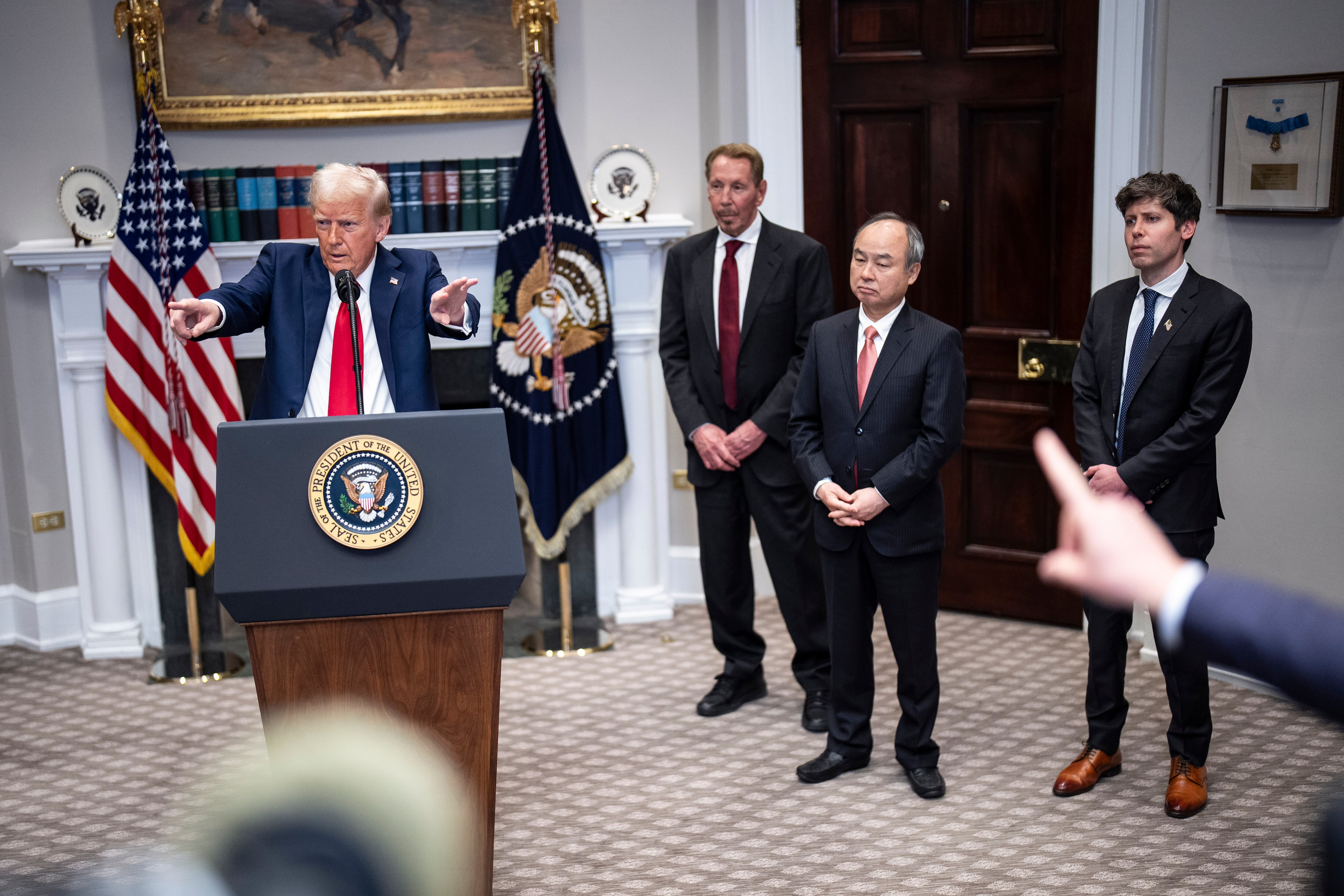
Donald Trump presents the Stargate project alongside Larry Ellison, Sam Altman and Masayoshi Son, on January 21, 2025.
❌
Subscriptions