❌

Normal view

  • βœ‡Eos
  • Melting Glaciers Make the Coastal Ocean More Sensitive Henry C. Henson
    When we picture the effects of melting glaciers, many of us think of rising seas and retreating ice streams. But along Greenland’s coastline, a quieter transformation is underway, one that is affecting how the ocean breathes and how it reacts to and buffers itself against change. In Young Sound, a fjord carved into Greenland’s remote northeastern coast, decades of monitoring have revealed that glacial meltwater does not simply dilute the salt in seawater. As fresh water enters the ocean, it
     

Melting Glaciers Make the Coastal Ocean More Sensitive

16 April 2026 at 13:09
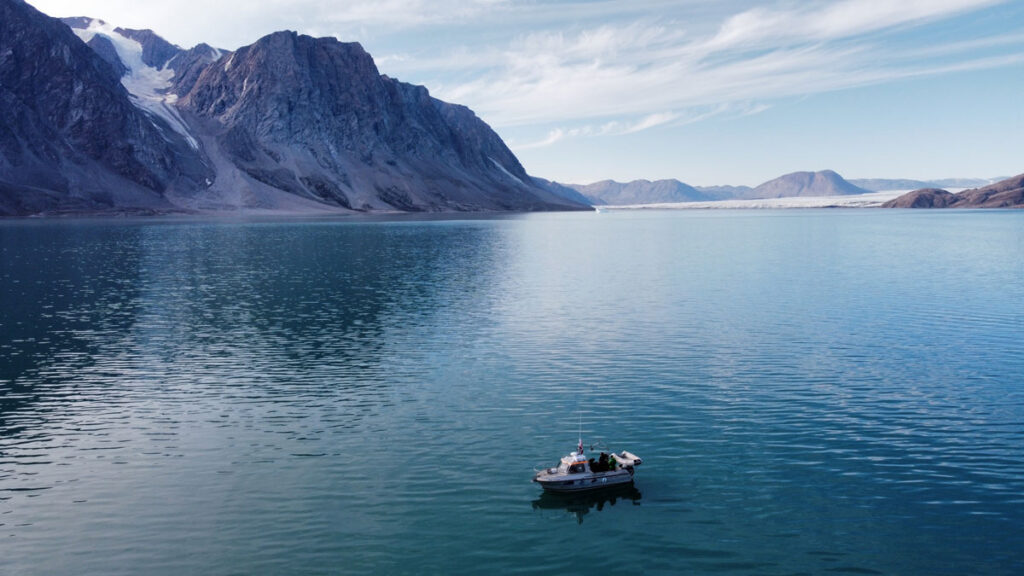
Aerial view of a small research boat sitting in blue-green water in front of glaciated mountains that rise steeply from the shoreline.

When we picture the effects of melting glaciers, many of us think of rising seas and retreating ice streams. But along Greenland’s coastline, a quieter transformation is underway, one that is affecting how the ocean breathes and how it reacts to and buffers itself against change.

In Young Sound, a fjord carved into Greenland’s remote northeastern coast, decades of monitoring have revealed that glacial meltwater does not simply dilute the salt in seawater. As fresh water enters the ocean, it weakens the ocean’s natural chemical resistance to swings in acidity. This so-called buffering capacity keeps seawater pH in balance. The loss of buffering due to freshwater runoff leaves these coastal waters unusually sensitive to even small biological and environmental shifts.

Atmospheric warming is accelerating fastest in the Arctic, and with it come longer glacial melt seasons and increased freshwater runoff. The result is a coastal ocean that is both a frontline witness to climate change and a laboratory for understanding how the chemistry of the seas can change in unexpected ways.

The Ocean’s Chemical Safety Net

Seawater chemistry is naturally buffered by dissolved ions that act as chemical shock absorbers.

Globally, the ocean absorbs about a quarter of carbon dioxide (CO2) emissions each year. That uptake helps to slow climate change, but at a cost. The more CO2 that water absorbs, the more acidic it becomes. Thankfully, seawater chemistry is naturally buffered by dissolved ionsβ€”particularly carbonate, bicarbonate, and hydroxideβ€”that act as chemical shock absorbers. These negatively charged ions, collectively called alkalinity, bind to the positive hydrogen ions released when carbonic acid forms, keeping the ocean’s pH relatively stable compared with the more variable conditions in freshwater rivers and lakes.

The polar oceans play a special role in this balance and in the global carbon cycle because cold waters at high latitudes take up carbon from the atmosphere faster than warm tropical waters. Yet these regions are also changing the most rapidly.

When Meltwater Meets the Sea

For 20 years, our team at Aarhus University has measured salinity, temperature, and carbon chemistry in Young Sound. Each August, we make the 2-day journey to northeast Greenland, where we spend the month sailing down the 90-kilometer-long fjord to capture these valuable measurements (Figure 1).

Satellite view over the glaciated islands and land of part of the northeastern Greenland coast. A red line maps the route of an August 2023 research cruise, and an inset map shows the location within Greenland.
Fig. 1. The red line, running from the Greenland Ice Sheet (y) to the Greenland Sea (z), maps the route taken by researchers in August 2023 during their annual transect of Young Sound in northeast Greenland. Credit: Adapted from Henson et al., 2025, https://doi.org/10.1038/s43247-025-02685-4, CC BY-NC-ND 4.0

During the time we have monitored this ecosystem, the melt season has lengthened, with sea ice–free conditions now lasting 8 days longer than 20 years ago. Glaciers feeding the fjord are also thinning and retreating, discharging about 5.5 million cubic meters more water into the fjord each year. These changes have freshened the coastal ocean and subtly, but significantly, altered its chemistry.

Fjords like these have long been known as major CO2 sinks. Surface waters near glaciers often have very low CO2 concentrations, creating a disequilibrium between CO2 levels in the surface ocean and the atmosphere that draws carbon out of the air. But how or why these glacial ecosystems act as carbon sinks and what mechanisms are at play haven’t been thoroughly described. We have also been deeply curious about what else happens when fresh water enters the sea. What are the hidden consequences of this change?

To find out, we paired our long-term field observations with controlled lab experiments in which we mixed glacial meltwater with seawater. Controlled experiments allow us to dig into the nuances of chemical changes that are impossible to measure in the field. We also ran mixing models that allowed us to estimate how the chemistry of those mixed waters responds to small shifts in biological activity or mineral interactions.

The results were striking. When meltwater mixes with seawater, it not only reduces salinity but also dilutes alkalinity, the measure of how well water can neutralize acid and buffer against pH change. This weakening of buffering capacity means that even small changes in photosynthesis or respiration can drive much larger swings in CO2 uptake and acidity than they would in more saline waters.

Aerial view looking across braided river streams and channel bars toward mountains, a glacier, and hills of glacial deposits in the distance. In the foreground, two researchers stand in the gray, sediment-filled waters of one of the streams.
Two researchers wade into a meltwater river in Tyrolerfjord in Northeast Greenland National Park in 2023 to collect samples bearing the chemical fingerprints of climate change in the region. Credit: Henry C. Henson

We found that in the freshened waters of Young Sound, these processes have 2–3 times the influence on carbon uptake that they do farther out at sea. In effect, meltwater primes the coastal ocean to overreact, amplifying any ecosystem changes that might occur.

Measurements from around Greenland show that this is not just a theoretical risk. Surface waters are measurably more acidic where meltwater inputs are high. The biological consequences of this trend are still uncertain, but species living at the edge of their tolerance, such as shell-forming plankton and Arctic cod larvae, could face growing stress as the chemistry of their habitat fluctuates more widely.

A Fragile Balance in the Freshening Arctic

The findings confirm that fjords absorb carbon as a result of biological activity and glacial input but indicate that they do so in a fragile, easily tipped state.

Our study adds nuance to conventional perceptions of carbon cycling in fjords, long seen as places where atmospheric CO2 is drawn down. The findings confirm that fjords absorb carbon as a result of biological activity and glacial input but indicate that they do so in a fragile, easily tipped state. Slight shifts in the processes that pull CO2 out of the air could tip the scales in either direction: toward even more uptake and the accompanying acidification or toward a release of CO2 to the atmosphere.

This chemical sensitivity explains why Arctic fjords can show such strong seasonal and spatial swings in carbon chemistry and why predicting their long-term role in the carbon cycle is difficult. As glaciers retreat and meltwater inputs grow, those sensitivities are likely to intensify.

At first glance, changes in how seawater in the narrow, remote fjords of Greenland reacts to glacial melt might sound like a local concern. But the chemical processes at play have global resonance.

  • A glacial tongue of the Greenland Ice Sheet curves through mountainous tundra.
    A tongue of the Greenland Ice Sheet retreats along the tundra as temperatures across the Arctic warm. Credit: Henry C. Henson
  • Ridges in the Greenland Ice Sheet tell a story of movement and melt. Credit: Henry C. Henson
    Ridges in the Greenland Ice Sheet tell a story of movement and melt. Credit: Henry C. Henson
  • Ground-level view of gray-colored water rippling through a shallow river in a rocky valley between mountains.
    Glacial meltwater from the Greenland Ice sheet flows into Tyrolerfjord and Young Sound and in Northeast Greenland National Park in August 2023. Credit: Henry C. Henson

The Arctic Ocean as a whole is freshening, driven by accelerating ice melt as well as by increasing river discharge and changing weather bringing more precipitation to the region. Although river water, which arrives from the six great Arctic rivers of North America and Eurasia, is more alkaline than glacial melt, its alkalinity is only about half that of seawater. In other words, river runoff also increases the ocean’s chemical sensitivity. Fresh water also delivers organic matter from permafrost, fine sediments from glaciers, and tannin-rich runoff from tundra soils, each of which can influence carbon cycling and further compound changes already underway.

Similar patterns of increased rainfall and runoff reducing surface salinity are emerging around the Antarctic Peninsula, the Gulf of Alaska, and the North Atlantic. Almost everywhere that fresh water enters the ocean, it lowers alkalinity and limits the ocean’s ability to buffer change.

A Window into Climate Intervention

Our results also carry lessons for researchers and companies contemplating ocean chemistry interventions as ways to remove CO2 from the atmosphere. One proposed approach, ocean alkalinity enhancement, involves adding crushed minerals such as lime, olivine, and basalt to seawater to both counteract acidification and increase the ocean’s capacity to take up CO2.

Glacial systems already perform a natural version of this experiment by grinding rock into fine sediment and discharging it into the ocean. Minerals in this sediment react with seawater and shape its carbon chemistry.

Our study suggests that such reactions are especially potent in freshwater-influenced coastal regions, where reduced buffering capacity may amplify chemical responses not only from natural biological processes but also from potential human attempts to alter seawater chemistry. Thus, understanding the balance between carbon uptake and chemical vulnerability will be essential before any large-scale interventions are attempted.

Consequences Locally and Globally

Coastal communities from Greenland to Alaska to northern Eurasia depend on Arctic waters as part of their cultural identity and, by way of fisheries and tourism, for their economic and food security. As chemical buffering capacity declines, coastal ecosystems may become more susceptible to acidification and other environmental stresses. Small changes in temperature, ecosystem metabolism, or nutrient inputs could then have outsized effects on the marine life that supports these communities.

As coastal glaciers retreat and meltwater rivers carve new paths to the sea, they are doing more than raising sea level and reshaping coastlines. They are rewiring ocean chemistry.

At the same time, changing conditions in coastal Arctic ocean regions complicate scientific modeling of carbon cycling and climate feedbacks, which typically relies on averaged estimates of the ocean’s chemical reactivity. With meltwater making the coastal ocean more reactive, these seas may absorb or release CO2 more variably than how global predictions would suggest. In addition to the real effects on local ecosystems, seawater chemical variability could also affect the accuracy of modeled global carbon budgets, which we use to inform future climate projections and guide international policy goals.

As coastal glaciers retreat and meltwater rivers carve new paths to the sea, they are doing more than raising sea level and reshaping coastlines. They are rewiring ocean chemistry, leaving it fresher and more easily disturbed.

The chemical sensitivity we see in Greenland’s fjords today may be a preview of what is to come in many coastal regions. If so, then we must be concerned with not only how much CO2 the ocean can absorb but also how stably it can hold that CO2 in a rapidly changing world.

Author Information

Henry C. Henson (hch@ecos.au.dk), Aarhus University, Denmark
Citation:Β Henson, H. C. (2026), Melting glaciers make the coastal ocean more sensitive,Β Eos, 107, https://doi.org/10.1029/2026EO260116. Published on 16 April 2026.
Text Β© 2026. The authors.Β CC BY-NC-ND 3.0
Except where otherwise noted, images are subject to copyright. Any reuse without express permission from the copyright owner is prohibited.
  • βœ‡Eos
  • Oysters Clean Up More Nitrogen Pollution Than We Thought Lisa S. Gardiner
    After centuries of overharvesting and environmental degradation reduced the world’s oyster reefs by 85%, restoration is bringing the conglomerations of thick-shelled mollusks back to coastal waters. And their return may have more benefits than scientists realized, new research suggests. β€œOysters build the foundation of an entire ecosystem.” Oysters were initially restored to boost depleted fisheries, according to Rachel Smith, a marine ecologist at the University of California, Santa Barb
     

Oysters Clean Up More Nitrogen Pollution Than We Thought

4 June 2026 at 12:47
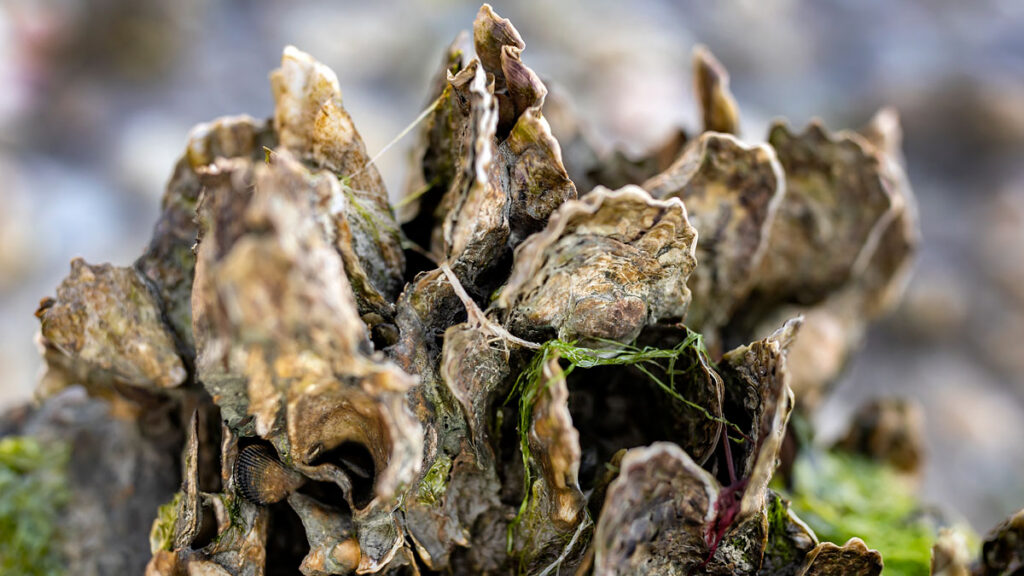
Close-up view of a cluster of living eastern oysters

After centuries of overharvesting and environmental degradation reduced the world’s oyster reefs by 85%, restoration is bringing the conglomerations of thick-shelled mollusks back to coastal waters. And their return may have more benefits than scientists realized, new research suggests.

β€œOysters build the foundation of an entire ecosystem.”

Oysters were initially restored to boost depleted fisheries, according to Rachel Smith, a marine ecologist at the University of California, Santa Barbara. As oysters cement their shells together into reefs, they create habitats for myriad species, including fish. β€œOysters build the foundation of an entire ecosystem,” Smith said.

These days, oyster reefs are restored for reasons extending beyond ecology, including to rid coastal water of excess nutrients such as nitrogen. This pollutant enters coastal waters when wastewater, sewage, and fertilizer wash into the sea.

Past studies of nitrogen removed by oyster reefs largely looked at denitrification, a process in which microbes transform organic nitrogen in dead oysters and their excrement into inert gas. If organic nitrogen evades these microbes, it can be buried in reefs, but measurements of this mechanism are few.

Two researchers stand atop an oyster reef that is exposed above water. They hold either side of a jackhammer that is pushing a metal tube into the reef to collect a core.
Researchers collected cores from 20 oyster reefs in coastal North Carolina. Credit: Antonio Rodriguez/Institute of Marine Sciences, UNC-Chapel Hill

β€œ[Burial] is definitely much less explored,” said Smith.

A study published in PLoS One looked beyond denitrification and found significant amounts of nitrogen become sequestered within oyster reefs as they grow, offering evidence that restored oyster reefs actually remove far more nitrogen than we thought.

Before she started this research, Anne Margaret Smiley, lead author of the new paper and a biogeochemist at the University of North Carolina (UNC) at Chapel Hill, suspected that the amount of nitrogen buried in oyster reefs would be small because organisms at the surface transform so much of it, leaving little left to bury. She was pleasantly surprised by the results.

β€œWe’ve been looking at denitrification all this time, and now we found out that [oysters themselves] are really good at doing this too,” she said. β€œWhat an amazing thing to know.”

In Search of Buried Nitrogen

To explore how nitrogen is buried over time, scientists turned to 20 oyster reefs in the Rachel Carson National Estuarine Research Reserve near Beaufort, N.C., that were restored nearly 3 decades ago by UNC scientists.

Using a jackhammer and metal pipe, they extracted cores from the oyster reefs in 2011. About 10 centimeters in diameter, the cores sampled the full thickness of each reef, which ranged from 10 to 55 centimeters. Shortly after they were collected, the cores were sectioned off into 5-centimeter increments, sealed, and stored in a walk-in freezer. In the years since, the samples have proved useful for studying oyster reef growth during sea level rise and how much carbon the reefs sequester and in other areas of research. Recently, Smiley measured the nitrogen levels in each of these 5-centimeter sections.

Below the top 10 centimeters or so, where microbes break down organic matter, nitrogen levels increased. Looking at all samples, Smiley found that on average, a square meter of reef buried more than 6 grams of nitrogen each year, which is similar to the rate of nitrogen transformed by denitrification at oyster reefs.

β€œThe more they can build up and out, the more [nitrogen] they can bury underneath.”

However, there was a large range in the amount of nitrogen buried, between 1 and 15 grams of nitrogen per square meter. The variability, the researchers found, was related to where the different oyster reefs grew.

For oyster reefs in sand flats, those in intertidal areas (between high and low tide on a shore) buried more than twice as much nitrogen as subtidal reefs, on average. Intertidal reefs grow faster and so bury more nitrogen. β€œThe more they can build up and out, the more [nitrogen] they can bury underneath,” said Smiley.

But intertidal reefs that fringed the edge of salt marshes buried less nitrogen than other intertidal reefs. β€œThey’re not able to grow as quickly,” she said, speculating that sediment from the neighboring marshes may slow reef growth.

Put Your Money Where Your Mollusk Is

A scientist wades at the edge of an oyster reef exposed above water.
Intertidal oyster reefs, like this one in coastal North Carolina, are exposed above water at low tide. Credit: Johanna Rosman/Institute of Marine Sciences, UNC-Chapel Hill

North Carolina’s Department of Environmental Quality places the economic value of each kilogram of nitrogen removed from the environment at $26.39 (in 2024 dollars, which is about $28.50 in 2026). Using this figure, Smiley and her colleagues calculated that nitrogen removed from coastal waters and buried each year by a hectare of oyster reef has a value of $1,700 on average. This finding increases previous estimates of the value of oysters’ nitrogen removal services by 25% to 42%.

β€œA really valuable part of the study is not just taking those measurements, but then also translating that into valuation,” said Smith, who was not involved with the new study. The value of nitrogen burial can be added to oyster reef ecosystem servicesβ€”the monetary value of benefits that humans gain from oyster reefs, such as clean water, food, and flood control. β€œ[Buried nitrogen] is definitely an ecosystem service that I think is underappreciated,” she said.

Looking more broadly at the county that is home to the Rachel Carson Reserve, Smiley and her colleagues found that all the oyster reefs countywide bury about 120,000 kilograms of nitrogen each yearβ€”more than $3 million of value in the county’s shallow sounds and bays.

β€”Lisa S. Gardiner (@lisasgardiner.bsky.social), Science Writer

Citation:Β Gardiner, L. S. (2026), Oysters clean up more nitrogen pollution than we thought,Β Eos, 107, https://doi.org/10.1029/2026EO260182. Published on 4 June 2026.
Text Β© 2026. The authors.Β CC BY-NC-ND 3.0
Except where otherwise noted, images are subject to copyright. Any reuse without express permission from the copyright owner is prohibited.

β€˜Beaches’ Sets Early Broadway Closing Date After Tony Award Noms Shutout

20 May 2026 at 01:15
The ebb tide is nigh for Broadway’s Beaches. The musical based on the 1988 Garry Marshall movie has set an early closing date after getting blanked at the Tony Awards nominations a couple of weeks ago. The last day at this beach will be May 24. The show starring Jessica Vosk and Kelli Barrett had […]

  • βœ‡Eos
  • How to Study Coastal Evolution Saima May Sidik
    Source: Earth’s Future Coastal landscapes are constantly being reshaped by natural forces, and as climate change causes more frequent storms and sea level rise, that change will only intensify. Because these areas are densely populated with homes, tourist destinations, and industries, understanding how and where the coast will change is a pressing issue. However, reliable predictions that lead to actionable knowledge are rare. Lentz et al. describe the state of knowledge regarding coastal
     

How to Study Coastal Evolution

15 April 2026 at 13:00
A dense urban development is seen on a shoreline. Ominous clouds herald the onset of a storm, and waves lap against the shore.
Source: Earth’s Future

Coastal landscapes are constantly being reshaped by natural forces, and as climate change causes more frequent storms and sea level rise, that change will only intensify. Because these areas are densely populated with homes, tourist destinations, and industries, understanding how and where the coast will change is a pressing issue. However, reliable predictions that lead to actionable knowledge are rare.

Lentz et al. describe the state of knowledge regarding coastal evolution, highlight gaps in scientists’ understanding, and describe opportunities for integrating information from various models, data sources, and end users.

Current coastal evolution predictions are often focused on too specific a location and are therefore hard to generalize or analyze too large a region and therefore lack detail, the authors say. In addition, it’s challenging for researchers to link the effects of acute events, such as storms, with long-term trends like sea level rise.

Improving these simulations will likely require combining many different types of models, including physics-based numerical models, models based on empirical measurements, and statistical models that include machine learning. To fully understand potential changes, the authors note that it is also essential to consider both coastal processes and human actions.

The researchers recommend several ways to improve consistency and collaboration in the field of coastal change forecasting. First, standardizing approaches and outcomes would make it easier to produce national-scale predictions. Right now, the variety of tools used across different locations makes it difficult for scientists to compare results and communicate effectively. They also emphasize the need for using coordinated research approaches. Stronger transdisciplinary collaboration, accompanied by essential training and support, would also enable scientists to make better predictions, the researchers say.

Comparing predictions to real-world observations of coastal landscape change could also help untangle this multifaceted challenge. By studying how coastlines have already changed, researchers can validate models and choose those that are performing best. Such comparisons require datasets that adequately capture coastal landscape change across both time and space. Remote sensing data and the use of artificial intelligence (AI) for data processing may help provide these improved datasets, the researchers suggest.

Engaging end users during the project planning process is also helpful because only end users truly know what kind of information they need to adapt to landscape change. Knowing how to engage end users can be difficult for physical scientists, but various tools and specialized personnel exist who can help coordinate these interactions, the authors say. (Earth’s Future, https://doi.org/10.1029/2024EF005833, 2026)

β€”Saima May Sidik (@saimamay.bsky.social), Science Writer

The logo for the United Nations Sustainable Development Goal 13 is at left. To its right is the following text: The research reported here supports Sustainable Development Goal 13. AGU is committed to supporting the United Nations 2030 Agenda for Sustainable Development, which provides a shared blueprint for peace and prosperity for people and the planet, now and into the future.
A photo of a telescope array appears in a circle over a field of blue along with the Eos logo and the following text: Support Eos’s mission to broadly share science news and research. Below the text is a darker blue button that reads β€œdonate today.”
Citation:Β Sidik, S. M. (2026), How to study coastal evolution,Β Eos, 107, https://doi.org/10.1029/2026EO260115. Published on 15 April 2026.
Text Β© 2026. AGU.Β CC BY-NC-ND 3.0
Except where otherwise noted, images are subject to copyright. Any reuse without express permission from the copyright owner is prohibited.
  • βœ‡Eos
  • Mangroves May Be Losing Their Grip on Carbon Storage as Sea Levels Rise Sarah Derouin
    Source: Earth’s Future Mangrove forests straddle the edge of land and sea along some tropical and subtropical coastlines. These trees and shrubs have distinctive tangles of roots that trap sediment and produce organic matter, forming dense soils and efficiently storing carbon. Though mangroves cover only 1% of Earth’s surface, they store a whopping 15% of global ocean carbon in their trapped soils. Their location along coastlines means mangroves are at the mercy of changing sea levels and
     

Mangroves May Be Losing Their Grip on Carbon Storage as Sea Levels Rise

5 June 2026 at 12:04
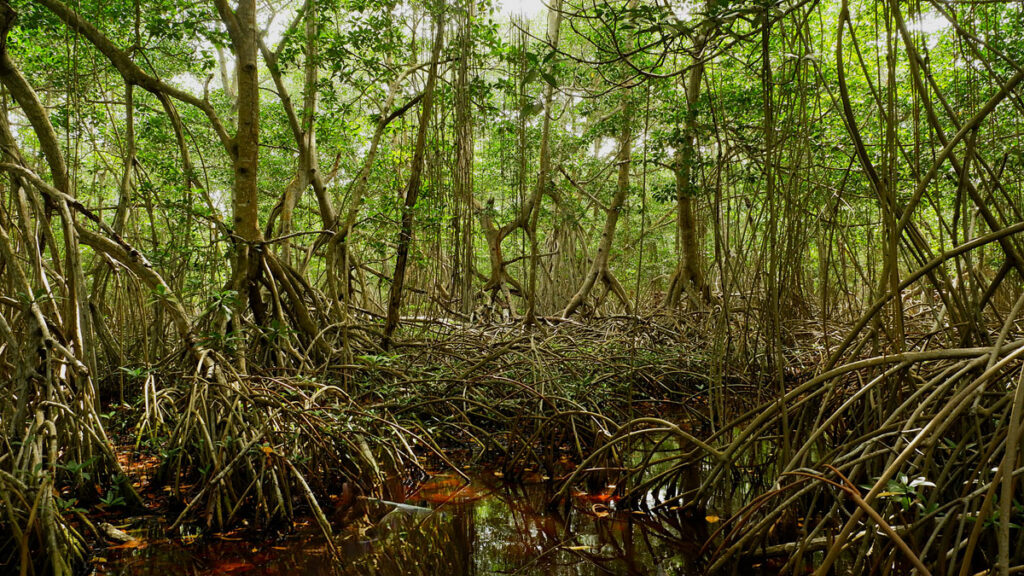
Sunlight streams through the canopy of a mangrove forest.
Source: Earth’s Future

Mangrove forests straddle the edge of land and sea along some tropical and subtropical coastlines. These trees and shrubs have distinctive tangles of roots that trap sediment and produce organic matter, forming dense soils and efficiently storing carbon. Though mangroves cover only 1% of Earth’s surface, they store a whopping 15% of global ocean carbon in their trapped soils.

Their location along coastlines means mangroves are at the mercy of changing sea levels and sediment availability. Rising sea levels can drown mangroves or push them landward. At the same time, sediment supplies, belowground root growth, and organic matter accumulation can help build up mangrove soils, allowing forests to keep pace with sea level rise. So over time, will mangroves keep locking carbon into their soils, or will they start losing it?

Iwantoro et al. created a new model that examines the links between coastal processes to investigate vegetation growth and carbon accumulation in mangrove forests.

The researchers modeled a simplified tidal embayment to explore how different rates of sea level rise and sediment supplies would affect the mangroves. In these experiments, they found that carbon accumulation can increase at specific locations as waters rise because the increased water can lead to more mangrove growthβ€”a result that matches existing data. However, when looking at landscape scales, they found sea level rise generally reduces total carbon sequestration through mangrove loss and soil erosion. The results showed that rising sea levels can alter mangroves from carbon storage sinks to carbon emitters.

The findings demonstrate that local trends in carbon sequestration may not be representative of larger-scale outcomes in mangrove forests. The study shows that understanding coastal landscapes as an interconnected system is crucial to understanding how mangroves can respond to climate and human-induced pressures, the researchers say. However, new assessments and approaches are needed to better understand future mangrove vulnerabilities. (Earth’s Future, https://doi.org/10.1029/2025EF006984, 2026)

β€”Sarah Derouin (@sarahderouin.com), Science Writer

The logo for the United Nations Sustainable Development Goal 14 is at left. To its right is the following text: The research reported here supports Sustainable Development Goal 14. AGU is committed to supporting the United Nations 2030 Agenda for Sustainable Development, which provides a shared blueprint for peace and prosperity for people and the planet, now and into the future.
A photo of a telescope array appears in a circle over a field of blue along with the Eos logo and the following text: Support Eos’s mission to broadly share science news and research. Below the text is a darker blue button that reads β€œdonate today.”
Citation:Β Derouin, S. (2026), Mangroves may be losing their grip on carbon storage as sea levels rise,Β Eos, 107, https://doi.org/10.1029/2026EO260144. Published on 5 June 2026.
Text Β© 2026. AGU.Β CC BY-NC-ND 3.0
Except where otherwise noted, images are subject to copyright. Any reuse without express permission from the copyright owner is prohibited.
❌
Subscriptions