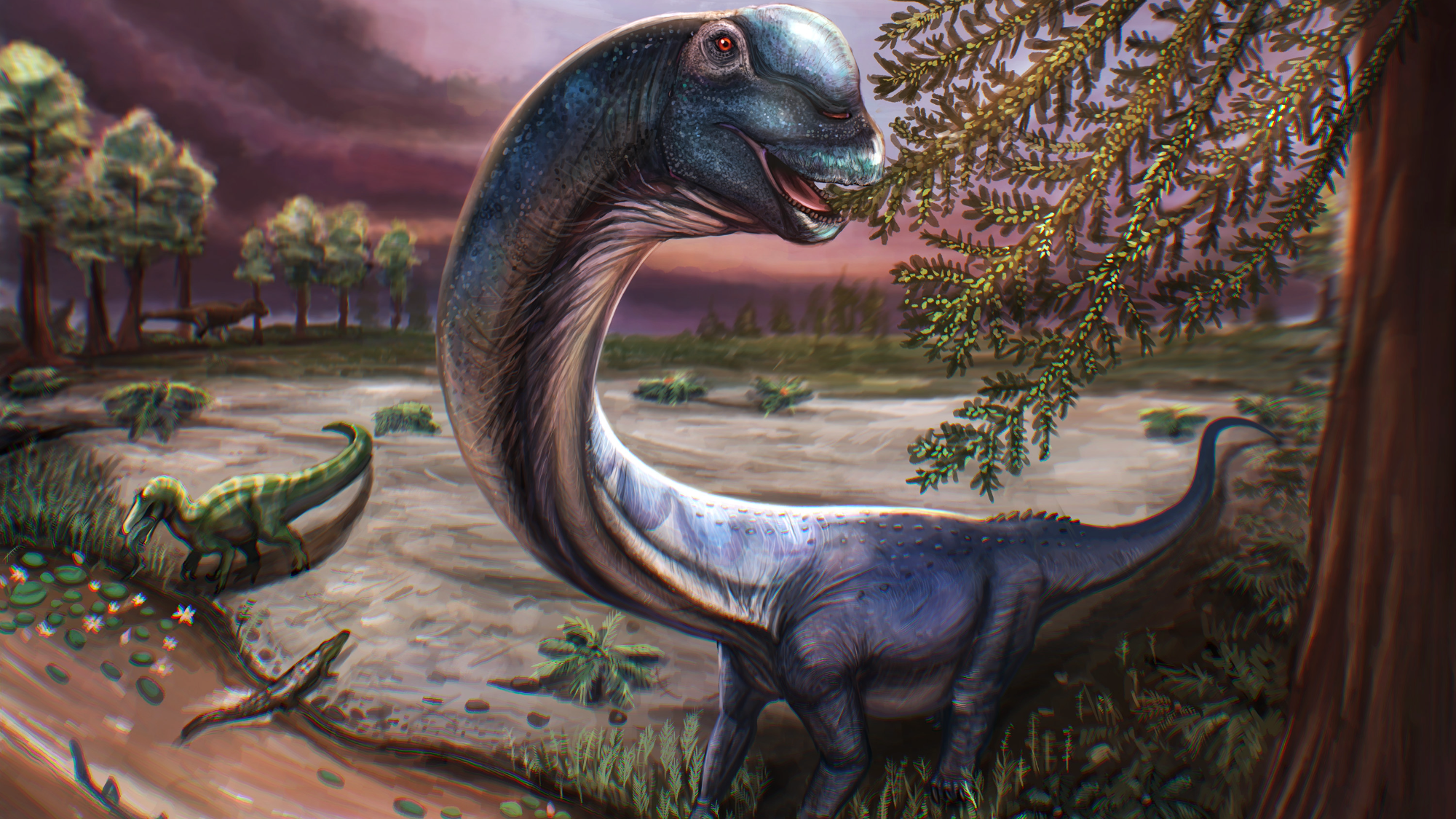
Not long before an asteroid crashed into Earth and wiped out most of the dinosaurs, a long-necked dinosaur the size of nine adult Asian elephants may have been near a windy river peacefully eating plants. The bones of the Nagatitan chaiyaphumensis (aka Nagatitan) would rest there for millions of years, until paleontologists digging near a pond in northeastern Thailand found them. This newly discovered herbivore is the largest ever found in Southeast Asia and is described in a study published tod
Not long before an asteroid crashed into Earth and wiped out most of the dinosaurs, a long-necked dinosaur the size of nine adult Asian elephants may have been near a windy river peacefully eating plants. The bones of the Nagatitan chaiyaphumensis (aka Nagatitan) would rest there for millions of years, until paleontologists digging near a pond in northeastern Thailand found them. This newly discovered herbivore is the largest ever found in Southeast Asia and is described in a study published today in the journal Scientific Reports.
Paleontologists found Nagatitan’s spine, rib, pelvis, and leg bones about 10 years ago. Its front leg bone alone was about as long as a human and the team believes that Nagatitan weighed 27 tonnes (or about 5,950 pounds) and was 88.5-feet long. It was a member of the sauropod family of dinosaurs, the long-necked, long-tailed plant-eaters that includes Brontosaurus.
“Our dinosaur is big by most people’s standards—it likely weighed at least 10 tonnes more than Dippy the Diplodocus (Diplodocus carnegii),” Thitiwoot (Perth) Sethapanichsakul, a study co-author and PhD student originally from Thailand and studying at University College London, said in a statement. “However, it is still dwarfed by sauropods like Patagotitan (60 tonnes) or Ruyangosaurus (50 tonnes).”
The first part of its genus name “Naga” refers to a mythological aquatic serpent in Thai and Southeast Asian folklore, while “Titan” is a reference to the giants of Greek mythology. Its species name chaiyaphumensis means “from Chaiyaphum,” the Thai province where the fossils were first discovered.
Study co-author Thitiwoot Sethapanichsakul standing with the Nagatitan’s front leg bone (humerus). Image: Thitiwoot Sethapanichsakul.
“We refer to Nagatitan as ‘the last titan’ of Thailand. That is because it was discovered in Thailand’s youngest dinosaur-bearing rock formation,” Sethapanichsakul said. “Younger rocks laid down towards the end of the time of the dinosaurs are unlikely to contain dinosaur remains because the region by then had become a shallow sea. So this may be the last or most recent large sauropod we will find in Southeast Asia.”
Nagatitan lived between 100 and 120 million years ago during the Early Cretaceous period. At this time, northeastern Thailand would have been arid to semi-arid—perfect for sauropods. These gentle giants used the surface area of their long necks and tails to shed heat and regulate their body temperature.
The bones were also found in what may have been a meandering river system, which would have been home to fish, crocodiles, and even freshwater sharks. Nagatitan would have lived with smaller plant-eating dinosaurs, including iguanodontians, some cousins of the Triceratops called ceratopsians, as well as large carnivores, and flying pterosaurs.
Interestingly, the team found that Nagatitan belongs to a narrower group of sauropods called Euhelopodidae, which have only been found in Asia. It is distinct from the other species within this group due to a combination of unique features on its spine, pelvis, and legs. Nagatitan is also the 14th dinosaur to be named in Thailand and a life-size reconstruction is now on display at the Thainosaur Museum at Asiatique in Bangkok.
“I’ve always been a dinosaur kid,” said Sethapanichsakul. “This study doesn’t just establish a new species but also fulfils a childhood promise of naming a dinosaur.”
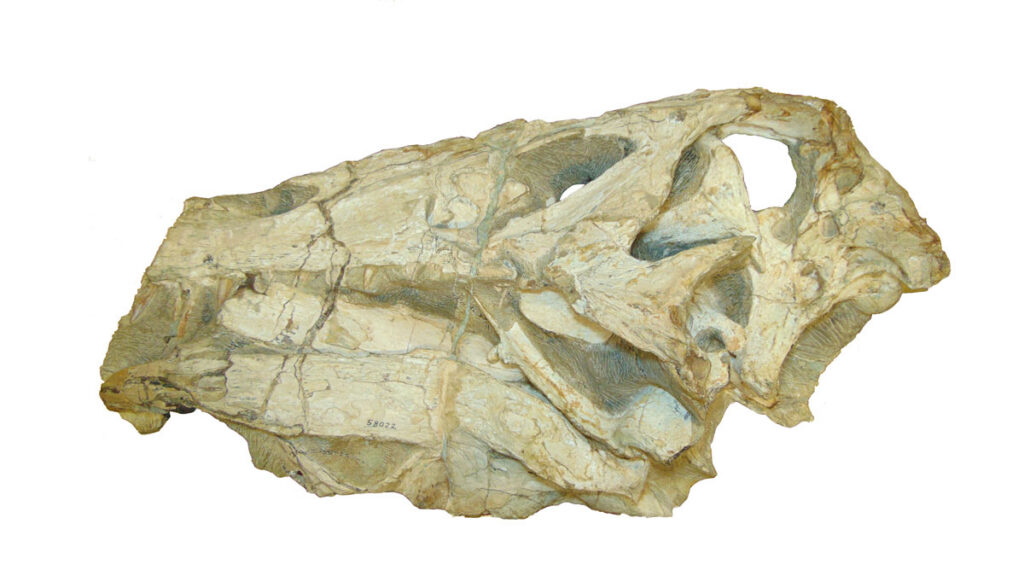
For many years a source of irritation, a fossil of the Brazilian spinosaurid Irritator challengeri is now bringing some joy to paleontologists in its homeland.
Following a successful public campaign for restitution, the piece is returning to Brazil from the collection of Germany’s State Museum of Natural History Stuttgart (SMNS), where it has been kept for the past 30 years—a situation that Brazilian paleontologists and lawmakers deemed illegal.
Representatives of both countries made the
For many years a source of irritation, a fossil of the Brazilian spinosaurid Irritatorchallengeri is now bringing some joy to paleontologists in its homeland.
Following a successful public campaign for restitution, the piece is returning to Brazil from the collection of Germany’s State Museum of Natural History Stuttgart (SMNS), where it has been kept for the past 30 years—a situation that Brazilian paleontologists and lawmakers deemed illegal.
Representatives of both countries made the announcement last month during Brazilian President Luiz Inácio Lula da Silva’s visit to Germany. In a joint statement, they announced the German museum’s “willingness” to “hand over” the fossil to Brazil and start a new, more transparent era of international collaboration.
“It is a very expected and cherished move because it represents a huge scientific and social victory for the Global South and for Brazil.”
“Finally, the Irritator will be back to its original place,” said paleontologist Allysson Pontes Pinheiro, director of the Plácido Cidade Nuvens Paleontology Museum.
The museum, located in northeastern Brazil where the fossil was discovered in the 1990s, will host the Irritator when it returns to Brazil. “It is a very expected and cherished move because it represents a huge scientific and social victory for the Global South and for Brazil,” Pinheiro said, highlighting that the return will allow local scientists and the population to have access to a heritage that would be difficult and expensive to access abroad.
Martill and Frey named the newly discovered species in reference to their irritation upon learning that the skull had been manipulated by fossil dealers to get a better price. Little did the researchers know that the fossil would irritate many other scientists, especially those from the animal’s homeland.
“This campaign showed us that it is worth continuing to fight for our fossils.”
The restitution request is based on Brazilian legislation passed in 1942 that determined that fossils found in the country are the state’s property and cannot be traded or exported without explicit authorization. In addition, a more recent Brazilian ordinance (dating to 1990) mandates that any holotype (a fossil used to describe a new species, such as the contested Irritator specimen) must remain in the country. Regardless, SMNS maintained the fossil had been legally purchased from a private dealer in Germany in 1991.
“We are very happy the Brazilian law is now being respected,” said Aline Ghilardi, a paleontologist at the Federal University of Rio Grande do Norte who was at the forefront of the repatriation campaign. “This campaign showed us that it is worth continuing to fight for our fossils.”
At the time of publication, SMNS had not responded to requests for comment.
A Long Process of Decolonization
But Ghilardi is not entirely satisfied. She didn’t like the wording of the announcement, which used the expression “hand over” rather than return, repatriate, or restitute.
“The statement was a missed opportunity to demonstrate the German government’s willingness to decide in favor of a restitution process,” she explained. “It seems there is resistance to making these restitutions as actual restitutions. It appears as if it is theirs by right and that they will hand over the fossil to Brazil as part of scientific cooperation.”
Ghilardi expressed that she will believe the repatriation will actually happen only when a specific return date is announced. (As of publication, it has not.) She also hopes that the Irritator case is not an isolated incident, but part of an ongoing trend of restitutions intended to break the pattern of neocolonialism in science.
A 2025 study published by Ghilardi and colleagues in the journal Palaeontologia Electronica showed that of nearly 500 invertebrate species described from fossils found in the Araripe Basin—one of Brazil’s richest and most threatened regions of geodiversity—about half have holotypes stored in institutions across Europe, Asia, and North America, violating Brazilian law.
Most of these smuggled fossils are hosted in Germany. “Some foreign colleagues complained about our campaign, saying that it looked like we were persecuting Germany,” Ghilardi said. “But that is not the case. It is just the numbers.”
It is possible, she noted, that other countries hold even more specimens that were not described in the scientific literature and therefore could not be counted.
The same study also found that more than 200 species were described in publications that did not include any Brazilian scientists as coauthors, despite Brazilian legislation requiring foreign research on Brazilian fossil material to be conducted in partnership with local institutions.
Wave of Repatriation
Paleontologist Serjoscha Evers at the Universität Freiburg, who authored the 2023 study on the Irritator fossil, wrote in an email to Eos that he welcomed the news of the dinosaur’s return.
However, he also wondered whether the decision is just “a diplomatic favor that resulted from the public pressure, or foreshadowing a broader wave of repatriations based on a legal conclusion that the fossils are unlawfully in German custody.”
Paleontologists involved in the Irritator restitution efforts said that since the campaign began, they have been receiving emails from museums and institutions worldwide seeking information on the procedures for returning fossils to Brazil.
Germany recently said it would “hand over” the Irritator challengeri fossil to Brazil. This illustration suggests what the dinosaur would have looked like before it was a fossil, about 110 million years ago. Credit: PaleoGeekSquared/Wikimedia Commons, CC BY-SA 4.0
The Plácido Cidade Nuvens Paleontology Museum, the final destination of the Irritator, has received several restitutions itself, including 45 fossils originally collected from the Araripe Basin and previously held by the University of Zurich in Switzerland, the fossil of a crustacean that was in the possession of the Universidad Nacional del Nordeste in Argentina, and a fish fossil seized in Italy.
According to Pinheiro, the museum’s director, paleontologists and the Brazilian government have listed at least 90 Brazilian holotypes still held in Germany. And the Brazilian Ministry of Foreign Affairs confirmed to Eos that it is currently negotiating the return of nine fossils held in undisclosed countries.
“We have been talking with colleagues from the museums where these materials are hosted, and they seem very favorable to returning them,” Pinheiro observed. “It is a huge advancement and a great change of behavior from important museums that have been holding heritage from the Global South.”
Citation: Moutinho, S. (2026), Germany to return contested dinosaur fossil to Brazil, Eos, 107, https://doi.org/10.1029/2026EO260167. Published on 22 May 2026.
This article was originally featured on The Conversation.
Exactly how did birds evolve from dinosaurs? It’s a mystery that has been with us for more than 150 years, and palaeontologists are still hunting for pieces of the puzzle today.
Among them is the University of Edinburgh’s Professor Steve Brusatte, whose latest book, The Story of Birds, tells the whole fascinating story. We caught up with him recently to find out more.
Of all the great dinosaur subjects, why this story?
I’ve al
Exactly how did birds evolve from dinosaurs? It’s a mystery that has been with us for more than 150 years, and palaeontologists are still hunting for pieces of the puzzle today.
Among them is the University of Edinburgh’s Professor Steve Brusatte, whose latest book, The Story of Birds, tells the whole fascinating story. We caught up with him recently to find out more.
Of all the great dinosaur subjects, why this story?
I’ve always been fascinated by birds. They are all around us and there’s such a stunning diversity and variety. As a palaeontologist I specialised early in the theropod (two-legged) dinosaurs. This is the group that includes T.rex and Velociraptor – and gave rise to birds.
The more I studied theropods, the more I became more curious about the modern-day animals that descended from them. Back in the early 2010s my PhD was about the origin of birds. Its core involved building a big new family tree of theropod dinosaurs to understand where birds slot in, how they evolved from dinosaurs, and how their body features came together.
I wrote about the dinosaur bird connection in my first book, The Rise and Fall of the Dinosaurs (2018), but that was just one chapter. It made me think it would be really fun to do an entire book on the subject. That was how my new book, The Story of Birds, came together.
Is there still any debate about birds evolving from dinosaurs?
I think people have generally heard that birds descended from dinosaurs. In the newer Jurassic World films you even see feathers on some of them. And yet it hasn’t really broken through to the public consciousness that today’s birds really are dinosaurs. They are part of the dinosaur family tree. They just happen to be a peculiar group of dinosaurs that got small and evolved wings, took to the skies and have survived until today.
It was Charles Darwin’s great disciple, Thomas Henry Huxley, in the 1860s who first noted similarities between the skeletons of some dinosaurs starting to be found in Europe and those of modern birds. This was back before anybody knew what DNA was, for instance.
Huxley’s idea did enter the public consciousness, at least in Victorian Britain. Darwin added it to the later editions of On the Origin of Species. But then it went out of favour. This was the great era of exploration, especially in the US and Canada. The frontier was being pushed westwards, and all these new dinosaurs were being found – Stegosaurus, Brontosaurus and later Brachiosaurus and T.rex.
None look anything like birds. I think dinosaurs obtained this stereotype as giant reptilian monsters, and this still largely dominates the public consciousness today.
Yet there were also a lot of smaller dinosaurs. Many had feathers and wings, and many were very bird-like. It’s really only in the past few decades that the idea that birds evolved from dinosaurs has become scientific consensus. The discovery of feathers on dinosaurs in the 1990s really sealed the deal on that.
What mysteries remain?
There are of course still things we don’t know, like how dinosaurs started to fly. How did they start to move their wings in a way that generated enough lift and thrust to get them airborne? Did they run on the ground and use their wings to defy gravity? Did they do it from the trees down, using these wings as a way to manipulate gravity? That’s one of the biggest mysteries.
Another area of uncertainty is which dinosaurs were the closest relatives of birds. The more fossils we find, especially feathered dinosaurs in China and other places, the more it’s clear there was a whole bunch of small dinosaurs with feathers. A lot had wings, some had wings only on arms, some on arms and legs. Some had wings of feathers. Some had wings of skin like a bat.
There was a huge diversity of them right around that point in the family tree where proper modern-style birds evolved with big arm wings that they flap to keep airborne. Each new fossil gives us more information but also another layer of complexity. It makes it just a little trickier to untangle the knot of exactly which dinosaurs were the closest rivals of birds. You still see new discoveries being made every year.
You say in the book that wings evolved not to fly?
The fossils tell us clearly that feathers evolved long before any of these animals were flying. Many dinosaurs had simple feathers; they looked like little strands of hair. In fact most dinosaurs probably had them – they just don’t normally preserve because they decay away so quickly. It’s in spectacular fossil sites where lots of dinosaurs were buried quickly, usually by volcanic eruptions, where you see a lot of these feathers (Liaoning province in north-eastern China is a good example).
But these feathers were not used for flying. There’s clear evidence from the fossil record that feathers evolved in a simpler form for other reasons. Our best hypothesis is they evolved for insulation, to help them stay warm – just like hair in mammals.
Later on, these feathers evolved on some dinosaurs into quills that made up wings. But the fossil record shows that the first wings that show up in dinosaurs between the sizes of sheep and horses. Those wings were only about the size of laptop screens, and by the laws of physics, those could not keep an animal of that size in the air.
That hints that wings probably also evolved for another reason and were only later co-opted for flying. We can tell a lot of these feathers had flamboyant colours and patterns, so one leading idea is that wings first evolved for display, to attract mates; to intimidate rivals. This is still true today, of course.
You can imagine if those wings got bigger over time, more flamboyant, more ornate, at some point the laws of physics would take over and they would generate some of those aerodynamic forces. It’s not like we have fossils of the exact dinosaurs that were the first to flap their wings, but that is at least what the fossil record is telling us.
Did dinosaurs have to get smaller for flying birds to evolve?
This is a big part of the story. Some dinosaurs, such as T.rexes, got bigger over time, but the dinosaurs that evolved into birds had been getting smaller for tens of millions of years. We don’t know why exactly, but there’s all kinds ecological niches where it pays to be small: it’s easier to hide, you can grow more quickly, and so on.
So it seems you had this group, that their bodies were getting smaller, and their wings were getting bigger. At some point you had a wing that was big enough to keep a body that was small enough in the air. At that point, natural selection could take over and start refining these dinosaurs into ever better flyers.
Is it an accident of evolution that flying creatures the size of elephants don’t exist?
Animals that need to flap wings to fly can’t be that big. The biggest flapping flyers today are wandering albatrosses, and their maximum wingspan is about 3.5 metres. We have fossils of birds that were bigger: the Pelagornithids were giant soaring birds that went extinct right before the ice age. They had wingspans that were something like 7 metres long. But beyond that, I think it would be very hard to flap wings to fly.
It makes total sense to me that it was probably a crow-sized to lapdog-sized raptor dinosaur that first started to flap as opposed to some dinosaur the size of an albatross. It’s just that the stereotype of dinosaurs being huge makes it harder to envision some small dinosaurs flapping and flying.
How did birds survive the asteroid?
That was a big mystery for a long time. There were proper birds at least 150 million years ago, which means they lived alongside their dinosaur cousins for some 80 million years. Then the asteroid comes down around 66 million years ago and all the dinosaurs die except the birds – why is that?
The reality is that lots of birds went extinct at the same time as the other dinosaurs. Many birds were still quite primitive and would have looked a lot like their dinosaur cousins. The only ones to survive were very modern-style birds. They had beaks instead of teeth, big wings and large chest muscles, and could grow really quickly like birds today.
A lot of recent research has clarified why they survived. What it comes down to is: the asteroid was a shot out of the darkness of outer space, a six-mile wide rock that smashed into the Earth one day. It changed everything instantaneously. There were earthquakes and tsunamis and wildfires. There was dust blocking out the sun, giving rise to a nuclear-style winter that lasted several years. Natural selection can’t work on that timeframe, so when the asteroid hit, all the animals had to confront the situation with the features they already had.
Most of the dinosaurs were big, and nothing bigger than a husky dog survived on land. With all these fires and acid rain and storms, simply being outside and exposed to the elements would have been bad. If you were smaller you could hide away more easily.
Also, modern-style birds had a bunch of features that turned out to be beneficial. They grew to adult within year, so it didn’t take too long for them to nurture the next generation. They could fly away from danger. But crucially they also had beaks, which could have allowed them to eat seeds.
When the Earth went cold for many years, ecosystems collapsed. Plants did not have sunlight to photosynthesise. So plant-eaters died, which meant meat-eaters died. Seeds were probably the last foods that survived. If you could eat them, it could probably have got you through those lean years.
We have gut content of birds from the Cretaceous period (145 to 66 million years ago) and we can tell a lot of them did eat seeds. So the modern-style birds had a good hand of cards just as the world became this fickle casino and survival was a matter of the odds.
Which bird species appeared after the asteroid?
Bird fossils from the Cretaceous (meaning before the asteroid) are limited because it’s hard to fossilise birds. They’re small and their bones are really delicate. But we do know there’s birds like Vegavis and Asteriornis that lived in that period and were respectively members of the modern groups of ducks and chickens.
It doesn’t mean other modern species like owls or falcons weren’t there, but certainly they were not a major component of the ecosystems at the time. Then the asteroid hit and we start to see in the Paleocene (66 to 55 million years ago) fossils of things like penguins, mouse birds and multiple other modern groups.
Yet the really strong evidence about what happened is from the DNA of modern birds. Researchers are using whole genomes now. They can compare the similarities and back-calculate to predict when two groups would have diverged. When you do this, it predicts there was a big bang of bird evolution right around that time – including species like owls, parakeets, falcons and hawks.
It makes sense that if you have a mass extinction that kills 75% of species, there would have been abundant opportunity for whatever survived. But we’re still waiting for fossils to confirm this directly. It’s a real target for people doing fieldwork to confirm this story by finding the fossils of birds up to 5 to 6 million years after the asteroid.
You write that great birds have come and gone – talk us through some of those
There are more than 10,000 species of birds today, basically double the number of mammal species, so in that sense we’re still in a dinosaur world. But there are even more incredible extinct birds, some of which went extinct quite recently because of us, as we’ve spread around the world and changed the environment very quickly.
A lot of these fantastic birds got their start in the ecological vacuum after the asteroid. There were birds that became basically born-again T.rex and Triceratops – filling the top predator/top plant-eater role in a lot of ecosystems.
In South America were the “terror birds” (Phorusrhacidae). They stood taller than a person, had a head the size of a horse head and a massive hooked gnarly beak. They were the top predators there for tens of millions of years. South America was an island for lot of that time; only later did jaguars and big dogs arrive.
South America’s terror bird, once the apex predator on the continent. Harper Collins, CC BY-SA
In many places, birds were the biggest plant-eaters. Australia had birds called demon ducks (Dromornithidae) that lived for tens of millions of years. Think of the modern duck and super-size it by 100. Some were heavier than cows.
Elsewhere there was New Zealand’s moa and Madagascar’s elephant bird. Elephant birds were maybe the heaviest birds of all time. They laid eggs the size of watermelons. Many of these birds couldn’t fly. They gave up that ability as a trade-off to allow them to become really big.
The Pelagornithids also really fascinate me – the birds that were double the wingspan of an albatross. They lived for tens of millions of years, sailing the world’s thermals like giant kites. They would have been utterly spectacular animals.
Pelagornithids had twice the wingspan of the modern wandering albatross. Harper Collins, CC BY-SA
We only know about most of these birds because of fossils – except for some like the moas and elephant birds and demon ducks, which did meet humans but didn’t last long, unfortunately.
Is it surprising birds never became as intelligent as humans?
When I was growing up in the late 1980s and through the 1990s, it was an insult to say “you’re a bird brain”. It’s such an unfair biological slur, because birds are very smart.
It’s just that they have small brains – I don’t know how many hummingbirds could fit into the head of an elephant. But when it comes to the size of the brain relative to the size of the body, which is largely what matters for cognition, problem-solving and so on, birds are right up there with mammals.
Song birds learn intricate songs. Similar to a human language, they learn them from tutors, they babble when they’re young and make mistakes, then master their avian language later on.
Parrots can mimic human speech. And whereas plenty of animals use tools in a rudimentary way, some crows can make their own tools. It’s really only crows and humans and maybe some close primate relatives that do that. Crows take sticks and branches and twist and turn them. They make hooks out of them and use them to probe for food.
Since the asteroid, there were probably long stretches where it was actually birds that were the cognitive superstars. It was maybe only a few million years ago when some primates eclipsed birds in having the biggest brain relative to body size.
When did birds start singing?
Sound doesn’t fossilise, of course. But we can look at the family tree of modern birds. We can look at the songbird group and use DNA to predict when they would have originated. We can then look at the fossil record of the skeletons of birds, and see if they more or less match up with what the DNA suggests.
This tells us that song birds go back in Australia as long as 50 million years ago. Songbird evolution then probably went into overdrive about 27 million years ago. This was probably triggered by tectonic events such as little microplates, and islands moving around and forming new corridors and environments in South East Asia.
It’s only in the past 20 million years or so where you’ve had songbirds moving around the world. Nowadays, more than half of birds are song birds.
Anything else that is a priority?
The very first birds in the fossil record – proper flapping flight birds like Archaeopteryx – are from about 150 million years ago. Archaeopteryx had big feathered wings that could flap, but also teeth in its jaws, as well as big claws and a long tail. It’s the quintessential evolutionary link in transitional species, and has been known since the 1860s, when Huxley and Darwin wrote about them. Archaeopteryx was integral to their idea that birds evolved from dinosaurs.
We still haven’t discovered anything much older. We have some new fossils from China that are about the same age. Yet these birds must have had ancestors that were a bit more primitive, that could only fly in more of a rudimentary way. That’s one thing we’re waiting for, maybe from the Late Jurassic (162 to 143 million years ago) or even Middle Jurassic (174 to 162 million years). Those fossils would give us proper insight into how flapping flight really originated.
The Story of Birds US edition publishes on April 28, while the UK edition publishes on June 11 and is available for pre-order.
This article features references to books that have been included for editorial reasons, and may contain links to bookshop.org. If you click on one of the links and go on to buy something from bookshop.org The Conversation UK may earn a commission.
The Changma Basin in northwest China’s Gansu province is famous for its many ancient bird fossils. Or, at least, pieces of fossils. Paleontologists have documented over 100 prehistoric avian dinosaur remains buried across the region, many resembling the digestive pellets regurgitated by owls living today. For years, researchers suspected that a similar predator was responsible for the fossil fragments, but lacked a convincing candidate.
Experts now have a plausible suspect. According to a stu
The Changma Basin in northwest China’s Gansu province is famous for its many ancient bird fossils. Or, at least, pieces of fossils. Paleontologists have documented over 100 prehistoric avian dinosaur remains buried across the region, many resembling the digestive pellets regurgitated by owls living today. For years, researchers suspected that a similar predator was responsible for the fossil fragments, but lacked a convincing candidate.
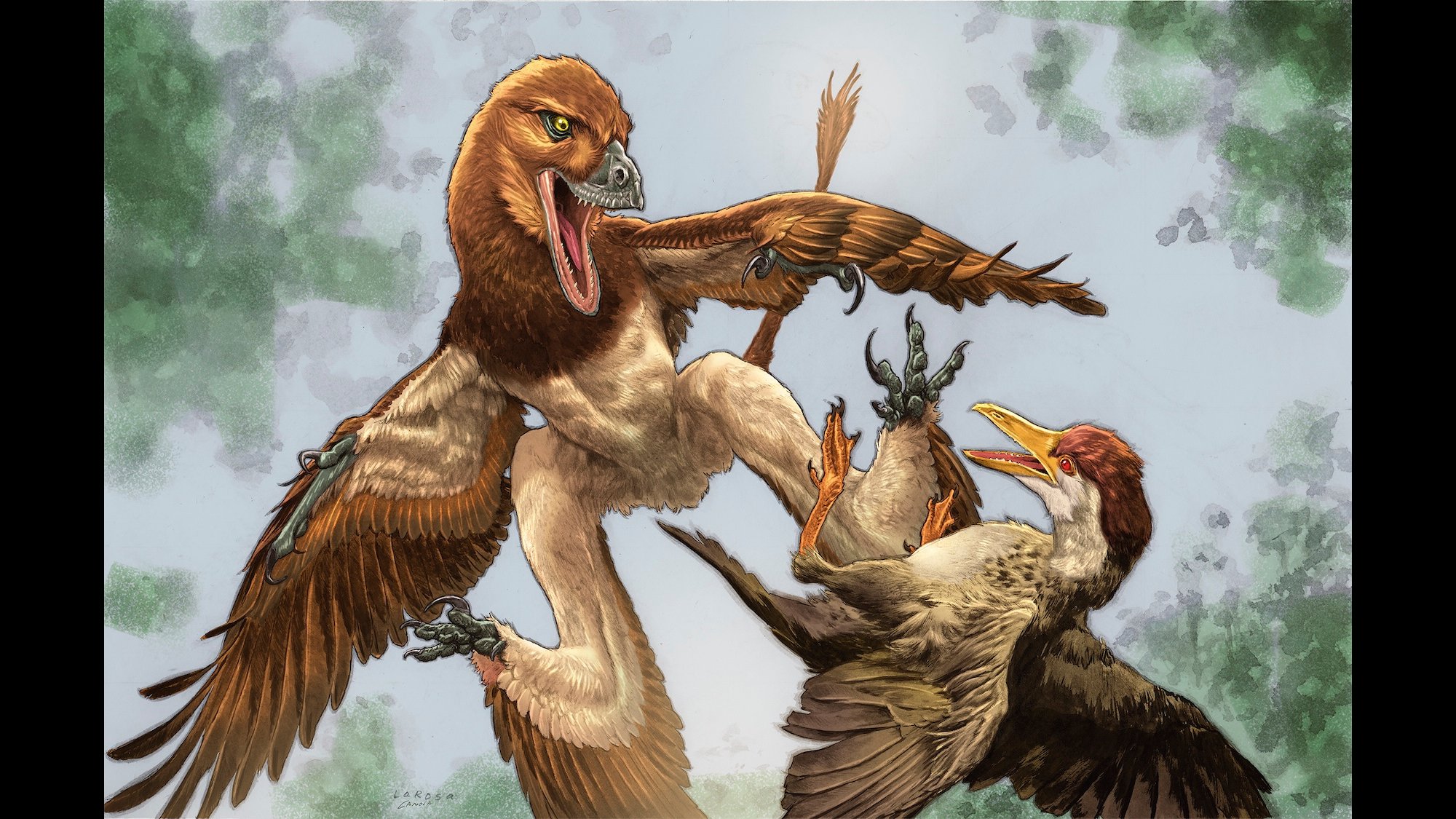
Experts now have a plausible suspect. According to a study published today in the Annals of Carnegie Museum, a cousin of the fearsome Velociraptor stalked the Changma Basin around 120 million years ago. But with its long feathers and four “wings,” Jian changmaensis didn’t ambush its prey from high in the air like a falcon. Instead, it more likely swooped in like a flying squirrel.
“It’s the only dinosaur found at this site that wasn’t a bird, it was a carnivore, and it was much bigger than everything else that we’ve found there,” Jingmai O’Connor, a study co-author and Field Museum associate curator of fossil reptiles, explained in a statement.
Paleontologists theorized the dinosaur’s anatomy based on its upper arm fossil. Credit: O’Connor et al.
Named after a winged mythological creature from Chinese folklore, J. changmaensis belongs to a dinosaur subgroup known as microraptors. These feathered predators were speedy and small, often only about the size of a crow. J. changmaensis was comparatively large, however. While O’Connor’s team has so far only recovered a portion of its upper arm, they believe the dinosaur likely featured a roughly four-foot wingspan. That puts it at about the size of a barn owl.
Although larger than its fellow microraptors, paleontologists believe J. changmaensis physically resembled its relatives. This means the dinosaur likely featured both forearm wings as well as rudimentary “wings” on its hind legs. Microraptors couldn’t soar through the skies, but their feathers served a purpose
“Jian and the other microraptors probably weren’t capable of true, powered flight, but they could probably glide like a flying squirrel,” explained O’Connor.
Matt Lamanna, a study co-author and Carnegie Museum’s curator of vertebrate paleontology, said the team’s discovery offers “critical new insight” into the Changma region’s biological history while helping contextualize today’s avian dinosaur descendents.
“For decades, the Changma site has been renowned among paleontologists for its extraordinary bird fossils,” Lamanna added. “Now, with the discovery of Jian, we finally know what was eating them.”
Tyrannosaurus rex is iconic for its ferocity and big teeth, as well as those teeny-tiny arms. The Cretaceous Period apex predator wasn’t the only carnivore with underdeveloped forelimbs, however. At least five groups of two-legged, mostly meat-eating theropod dinosaurs experienced a shortening of the upper arms over the course of their evolutionary journey. But why did they have such comically small claws? One team of researchers believes the answer is simple.
“It’s a case of ‘use it or lose
Tyrannosaurus rex is iconic for its ferocity and big teeth, as well as those teeny-tiny arms. The Cretaceous Period apex predator wasn’t the only carnivore with underdeveloped forelimbs, however. At least five groups of two-legged, mostly meat-eating theropod dinosaurs experienced a shortening of the upper arms over the course of their evolutionary journey. But why did they have such comically small claws? One team of researchers believes the answer is simple.
“It’s a case of ‘use it or lose it,’” University College London paleontologist Charlie Scherer said in a statement.
Scherer and his colleagues recently examined the data for 82 theropod species, including those in T. rex’s tyrannosaurid family. Their study published today in the Proceedings of the Royal Society B Biological Sciences argues a combination of massive skulls and crushing jaws—coupled with increasingly large prey—had many theropods relying increasingly less on their forearms.
“We sought to understand what was driving this change and found a strong relationship between short arms and large, powerfully built heads,” explained Scherer. “The head took over from the arms as the method of attack.”
The team based their conclusions on a new system of assessing dinosaur skull strength based on attributes like overall dimensions, how tightly bones were joined in the head, and bite force. Unsurprisingly, T. rex came in first place for bite force, followed by the Tyrannotitan. Almost as large as a T. rex, the Tyrannotitan lived in present-day Argentina during the Early Cretaceous over 30 million years before its famous descendent. In each example, the reason for short arms likely coincided with hunting larger and larger dinner targets.
“Trying to pull and grab at a 100–foot–long sauropod with your claws is not ideal. Attacking and holding on with the jaws might have been more effective,” added Scherer.
Overall, the team identified a bigger correlation between skull strength and smaller arms than with either skull or body size. This conclusion is further supported by some theropod dinosaurs with strong heads, tiny forelimbs, and a relatively small stature. For example, Majungasaurus roamed present-day Madagascar 70 million years ago while weighing about 1.75 tons—around a fifth the size of T. rex.
Not every dinosaur’s limbs shrank in the same way, either. Abelisaurids like Majungasaurus exhibited smaller arms past their elbows as well as their hands, while tyrannosaurid arms reduced proportionally. In each case, it seems that the theropods initially had far more success latching onto prey with their powerful jaws, then evolution did the rest of the work.
As to which dinosaur had the teeniest forearms, the answer according to Scherer is clear.
“The Carnotaurus had ridiculously tiny arms, smaller than the T. rex,” he said.
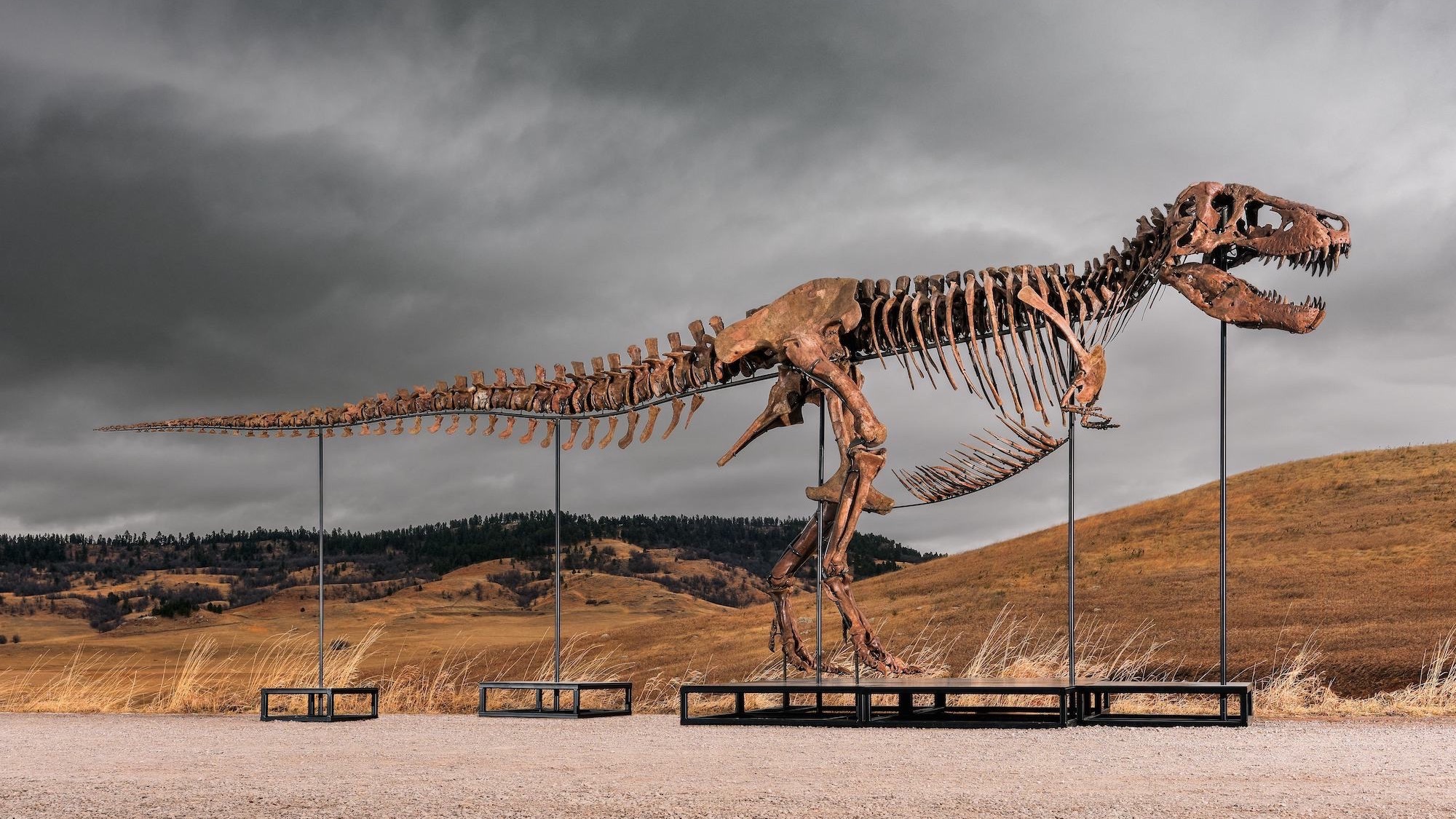
Dinosaur enthusiasts with deep pockets will have their chance to buy one of the largest and most complete Tyrannosaurus rex specimens ever discovered. Meet Gus, a 12.5-foot tall skeleton that took paleontologists three years to excavate. Auction house Sotheby’s values the specimen at $20–30 million, the highest estimate ever placed on a dinosaur.
Late cattle rancher Gary “Gus” Licking found Gus on his land in South Dakota. For years, Licking came across teeth and small bone fragments on his r
Dinosaur enthusiasts with deep pockets will have their chance to buy one of the largest and most complete Tyrannosaurus rex specimens ever discovered. Meet Gus, a 12.5-foot tall skeleton that took paleontologists three years to excavate. Auction house Sotheby’s values the specimen at $20–30 million, the highest estimate ever placed on a dinosaur.
Late cattle rancher Gary “Gus” Licking found Gus on his land in South Dakota. For years, Licking came across teeth and small bone fragments on his ranch, and realized more bones may be lurking beneath the soil. To find out, he recruited Thomas Heitkamp and his team from Theropoda Expeditions.
Licking suggested that the team start digging in a 6,500-acre parcel of land. And that’s exactly where Gus was found in 2021. Licking died only one year into the excavation, so he never got to see the complete specimen. The team named the T. rex “Gus” in his honor.
“This specimen took three years to excavate—with the team sometimes working for weeks straight without finding a thing,” Heitkamp said in a press release. “The site was a complex fossil bed and preserved many fossils of the flora and fauna that comprised the larger Cretaceous ecosystem. We documented each stage with quarry maps, inventories, and collection data. In the end, our diligence paid off and we were delighted to discover what turned out to be a huge and incredibly complete T. rex specimen.”
In addition to the three summers it took to excavate, the team also had three years of lab work. In the lab, they carefully extracted the fossil from the rock before the bones could be prepared, cleaned, and identified.
The skeleton is made up of 183 fossil bones representing 82 percent of all of the dinosaur’s bones, including a well preserved skull, furcula (wishbone), and a completely represented pelvis. Its body is roughly 38-feet long and its skull alone is over four-feet long.
“It really does feel like tackling the world’s hardest puzzle, except we have to find all the pieces first,” said Heitkamp. “All those bones separated for 67 million years that we can now, almost magically, fit back together. There’s something deeply satisfying about that.”
Gus will be up for auction on July 14 during Sotheby’s Natural History auction. The fossil will also be on display to the public at Sotheby’s galleries in New York City beginning on July 1.
“For me the added bonus was knowing that Gus was just one of the many pieces of history hidden in the land that Gary and I loved to share,” added Licking’s wife, Dana. “It will be exciting to see how many others will get to enjoy this spectacular discovery.”
There’s also the question of the fees private landowners may receive, meaning that the person with the largest bank account may receive favorable access over scientists. Some countries including South Africa, Brazil, and Canada have gone as far as to place heavy restrictions on significant fossils wherever they are found.

 Login
Login