Scientists agree that to have a chance of keeping the world’s warming below the Paris Agreement limit of 1.5°C (2.7°F), humanity needs most oil, gas, and coal to remain in the ground. This “unburnable” or “unextractable” carbon would not contribute to global carbon emissions.
But where, exactly, should we prioritize shutting down or banning fossil fuel activities? A new study published in PLoS One provides an answer for the Arctic with an atlas showing where oil and gas activities overlap wi
Scientists agree that to have a chance of keeping the world’s warming below the Paris Agreement limit of 1.5°C (2.7°F), humanity needs most oil, gas, and coal to remain in the ground. This “unburnable” or “unextractable” carbon would not contribute to global carbon emissions.
But where, exactly, should we prioritize shutting down or banning fossil fuel activities? A new study published in PLoS One provides an answer for the Arctic with an atlas showing where oil and gas activities overlap with vulnerable ecosystems, important wildlife species, and Indigenous land.
“We’re investigating the idea of unburnable carbon with a geographical perspective,” said Daniele Codato, a geographer at the Università de Padova in Italy and lead author of the new study. “We focus on where to keep oil and gas underground.”
The atlas is meant to help decisionmakers prioritize areas where it is essential to avoid opening new frontiers or where current oil and gas extraction should be halted because of social, cultural, ecological, or climate justice criteria, he said.
Overlaps, Mapped
Codato and a team of researchers created their Arctic atlas with dozens of public datasets from five Arctic polities known to have oil and gas activities (Alaska (United States), Canada, Greenland (Denmark), Norway, and Russia). Though various geographic definitions of the Arctic exist, the team chose a boundary used to evaluate wildlife and conservation by the Conservation of Arctic Flora and Fauna (the biodiversity working group of the Arctic Council, an intergovernmental organization focused on Arctic governance) to include the largest possible portion of vulnerable ecosystems.
The resulting maps revealed more than 512,000 square kilometers—an area about the size of Spain—of Arctic territory with existing or planned fossil fuel activities, including leases, areas under bid, exploration licenses, and infrastructure. Within those areas, the researchers counted 44,539 active wells and nearly 40,000 kilometers (about 25,000 miles) of pipelines.
Oil and gas wells in the Arctic are highly concentrated in northwestern Canada, northern Alaska, and northern Russia. The CAFF boundary identifies the Arctic region as defined by the Conservation of Arctic Flora and Fauna (the biodiversity working group of the Arctic Council). Click image for larger version. Credit: Codato et al., 2026, https://doi.org/10.1371/journal.pone.0345775
Next, the researchers determined how oil and gas activities overlapped with protected areas defined by the International Union for Conservation of Nature and conservation priority areas defined by three other nongovernmental organizations. Fossil fuel activities threaten wildlife by altering habitats, disrupting migratory routes, and releasing pollutants.
Of the area containing oil and gas activities, more than 7% overlapped with ecologically protected areas, and more than 13% overlapped with the ranges of all of the three key Arctic species considered in the study: polar bears, yellow-billed loons, and caribou. The highest concentrations of oil and gas activities were in the Yamal Peninsula of Russia, northwestern Canada, and the North Slope of Alaska, all home to fragile ecosystems.
Seven percent of Arctic fossil fuel extraction areas mapped by the research team overlapped with ecologically protected areas. In some cases, such as in the Yamal`skij Nature Reserve in Russia (top right), protected area borders have been cut or delimited to avoid overlapping with protected area boundaries, possibly indicating that protected areas have been downsized or redesigned to accommodate fossil fuel infrastructure. ANWR = Arctic National Wildlife Refuge. Click image for larger version. Credit: Codato et al., 2026, https://doi.org/10.1371/journal.pone.0345775
Mapping revealed that 87.21% of leases in Alaska and more than 13% of total Arctic concessions for fossil fuel activities overlapped with the ranges of all three of the key Arctic species considered in the study (polar bears (Ursus maritimus), caribou (Rangifer tarandus), and yellow-billed loons (Gavia adamsii)). Click image for larger version. Credit: Codato et al., 2026, https://doi.org/10.1371/journal.pone.0345775
The researchers also discovered that 73% of land with oil and gas activities overlapped with Indigenous Peoples’ lands, defined in the study as lands where Indigenous communities maintain significant influence over land management. Fossil fuel activities can threaten Indigenous communities’ health and ways of life, though the authors note that overlaps between Indigenous Peoples’ lands and fossil fuel activities do not necessarily indicate an opposition between the two.
Oil and gas concessions cover more than 4% of Indigenous Peoples’ lands (IPLs) in the Arctic. Click image for larger version. Credit: Codato et al., 2026, https://doi.org/10.1371/journal.pone.0345775
“It’s a really interesting idea to create an atlas of unburnable carbon and try to make visible where tensions might occur between Indigenous land, ecosystems, [and fossil fuel activities],” said Mariel Kieval, a researcher at the Arctic Institute, a nonprofit research organization. The overlaps noted in the atlas are an “initial indicator” providing opportunities for further research that zooms in on specific areas, she said.
Kieval also said the atlas could be helpful for local communities trying to identify where extraction activities are occurring nearby.
Policy Paradigm
The atlas’s effort to express the urgency of action to the public and policymakers is useful, said Paul Ekins, an economist at University College London who was part of the team that coined the term “unburnable carbon.” “Any way in which atlases or discussions or slogans can up the political ante so that politicians become braver in seeking to address this issue is to be welcomed.”
In particular, Codato hopes the atlas will fuel a “paradigm shift” in global policy that would ultimately ban the proliferation of fossil fuel activities in the Arctic.
The need for an intergovernmental ban on fossil fuel activities is evidenced by the Arctic National Wildlife Refuge in Alaska, Codato said: The refuge received temporary protections against drilling under the Biden administration, but the Trump administration plans to open the refuge for oil and gas leases this summer. “We need something stronger” to avoid such administration-by-administration changes in Arctic protections, he said.
“If we don’t start to ban fossil fuels in the Arctic now, it could become another sacrifice zone.”
Such a paradigm shift will be more important than ever as warming in the Arctic provides new access to resources and opportunities for trade that may accelerate ecological and cultural disruptions. “If we don’t start to ban fossil fuels in the Arctic now, it could become another sacrifice zone,” like some parts of the Amazon rainforest, Codato said.
Policy actions have fallen far behind the science, Ekins said. “There should have been an agreement not to exploit fossil fuels in the Arctic well before the ice had melted to a sufficient extent to make that a practical possibility.”
In 2023, the research team published a similar atlas identifying unburnable carbon in the Ecuadorian Amazon and plans to continue to expand their atlas to include the rest of the world. The team is currently working on projects that cover Brazil, Italy, Nigeria, and the United Kingdom.
Citation: van Deelen, G. (2026), This Arctic atlas shows where oil and gas activities overlap with wildlife and Indigenous communities, Eos, 107, https://doi.org/10.1029/2026EO260139. Published on 7 May 2026.
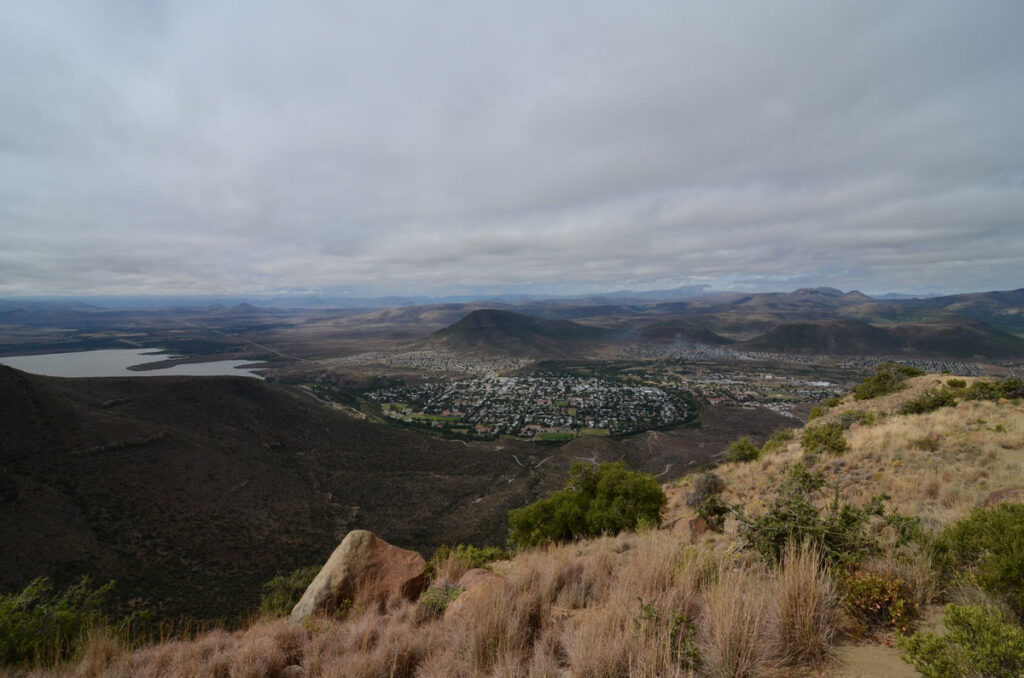
Roughly the size of Texas, the Karoo Basin of central western South Africa is brutally dry, sparsely populated, and known in part for its potentially “massive” hydrocarbon deposits.
South Africa, which consumes more energy than any other country in sub-Saharan Africa, has shown a growing interest in commercial fracking for shale gas and oil across the Karoo hinterland, with the country moving in late 2025 to lift a 13-year ban on shale gas exploration in the area.
However, a recent study
Roughly the size of Texas, the Karoo Basin of central western South Africa is brutally dry, sparsely populated, and known in part for its potentially “massive” hydrocarbon deposits.
South Africa, which consumes more energy than any other country in sub-Saharan Africa, has shown a growing interest in commercial fracking for shale gas and oil across the Karoo hinterland, with the country moving in late 2025 to lift a 13-year ban on shale gas exploration in the area.
However, a recent study from the University of Cape Town, published in Seismological Research Letters, cautioned that the Karoo might not be as seismologically calm as it appears, meaning fracking efforts could have the potential to induce earthquakes in the region.
A Swarm of Earthquakes
The researchers observed 66 earthquakes in this cluster between 2007 and 2022, ranging from 0.7 to 4.8 in magnitude.
The researchers investigated what they call a sudden swarm of earthquakes that occurred in the Leeu Gamka cluster, a region of the Karoo that was previously considered seismically stable. They observed 66 earthquakes in this cluster between 2007 and 2022, ranging from 0.7 to 4.8 in magnitude.
“The individual earthquakes here are very small,” said Alastair Sloan, a tectonics and structural geologist at the University of Cape Town.
Using ambient noise tomography, previous geophysical surveys, and information about the locations of past earthquakes, the researchers identified a critically stressed fault underlying the region. The fault appears to extend for at least 30 kilometers roughly west-northwest to east-northeast.
Looking at South Africa more generally, there are other places where there have been “fairly large” earthquakes with a similar orientation, Sloan said. He cited a series of large earthquakes in the early 20th century in a place called Koffiefontein, north of the study area, and the disastrous 1969 Tulbagh earthquake, west of the team’s study area.
Both of those earthquakes occurred in regions that are geologically similar to the Karoo, though they’re outside of the area being considered for shale gas exploration, Sloan said.
Fracking Risks?
In other parts of the globe, such as Oklahoma in the United States, processes related to oil and gas extraction have led to “induced earthquakes.” Most of these earthquakes have been triggered by wastewater disposal associated with oil production, not by fracking directly.
Researchers are unsure if industrial fluid injection in the Karoo, as is applied in shale gas fracking processes, could trigger significant seismic action in the region’s existing faults.
“Some locations which undergo shale gas development don’t see very much seismicity, and there is a catalog of things which need to be present for [seismicity] to be something that you would particularly worry about,” Sloan said.
For instance, if faults are only within the crystalline basement and therefore separated from the sedimentary layers where the fracking occurs, then it’s not likely they’ll be reactivated, because there’s no way for the fracking fluid to get down to the fault zone itself. Another factor, Sloan added, is that for significant earthquakes to occur, large faults that are already critically stressed need to be present in the region undergoing fracking.
The new study showed that both of these conditions may be met in the Karoo: Microseismicity does extend to the depths at which the carbonaceous shale is present. And this microseismicity is occurring on a reasonably extensive structure with a similar orientation to larger earthquakes that have already occurred in the region.
However, Sloan stressed, this isn’t a cause for immediate panic.
“I don’t want to be too alarmist; the size of the structure revealed by the microseismicity is not huge, and so we do not have evidence to expect an earthquake much larger than the damaging historical earthquakes that we have already seen in the wider region,” he said. “Globally, large earthquakes triggered by fracking (rather than associated deep wastewater exposure) are very rare, but the study suggests the necessary preconditions are present. And so the possibility needs to be considered and monitored carefully.”
Not Unique
Raymond Durrheim, a geoscientist and the South African Research Chair in Exploration, Earthquake and Mining Seismology at the University of the Witwatersrand, and who also examined the Ph.D. thesis on which the new study is based, said no area is perfectly seismically quiet.
“We know the way seismicity works in this whole area of southern Africa is that swarms occur,” he said. “They’ll last for years or even decades, and then they’ll die away. This is not a unique occurrence.”
This study was “useful,” though, Durrheim added, especially with the possibility of shale gas development in the Karoo. “It’s very important that we understand this because we know that when you inject fluid under high pressure, there’s always a chance you could trigger an earthquake,” he said, noting examples of fluid injection triggering earthquakes in places such as Canada. “It’s always a risk.”
To mitigate risks, Sloan suggested it would be useful to have a much denser network of seismometers within this region of South Africa.
Citation: Mwareya, R. (2026), A swarm of earthquakes in South Africa’s Karoo Basin poses questions for oil and gas development, Eos, 107, https://doi.org/10.1029/2026EO260159. Published on 20 May 2026.
It’s been more than a decade since Michael Gollner and his colleagues first watched a viral YouTube video of a fire tornado fueled by Jim Beam bourbon.
A warehouse in Kentucky had just been struck by lightning, funneling almost a million gallons of the flammable spirit into a nearby retention pond. As the flames whipped across the surface of the water, however, something in the atmospheric stars aligned: The flames coalesced into a towering fire whirl, more commonly known as a fire tornado.
It’s been more than a decade since Michael Gollner and his colleagues first watched a viral YouTube video of a fire tornado fueled by Jim Beam bourbon.
A warehouse in Kentucky had just been struck by lightning, funneling almost a million gallons of the flammable spirit into a nearby retention pond. As the flames whipped across the surface of the water, however, something in the atmospheric stars aligned: The flames coalesced into a towering fire whirl, more commonly known as a fire tornado.
“We saw that and went, ‘Wow, that would be a neat application’” for cleaning up oil spills, said Gollner, a mechanical engineering professor at the University of California, Berkeley Fire Research Lab. “I wonder if we could do that on purpose.”
They could, in fact. As Gollner and his collaborators recently reported in Fuel, fire whirls offer the potential to clean up oil spills more quickly and cleanly than existing methods.
Oil spill responses depend on fast, immediate action. After just 24 hours, crude oil naturally absorbs water and begins to sink beneath the waves, wreaking havoc on marine life.
Alongside other major techniques, such as containment and recovery and chemical dispersal, in situ burning via “fire pools” has been adopted as an imperfect but unavoidable tool for addressing oil spills. Fire pools stop the spread of an oil spill but send clouds of smoke into the atmosphere and leave behind a layer of tar that sinks to the seafloor.
The European Space Agency’s Envisat satellite captured an image of the Deepwater Horizon oil spill 1 week after the accident. Credit: European Space Agency, CC BY-SA 3.0 IGO
Fire Away
If it’s far from shore, there are few methods other than basically corralling it up and burning it.”
Environmental agencies like the Bureau of Safety and Environmental Enforcement (BSEE) “were very excited about the concept of putting a change to what had been the standard for cleanup since the Exxon Valdez,” Gollner said. “There’s good knowledge, there’s an oil spill conference every year.…But if it’s far from shore, there are few methods other than basically corralling it up and burning it.”
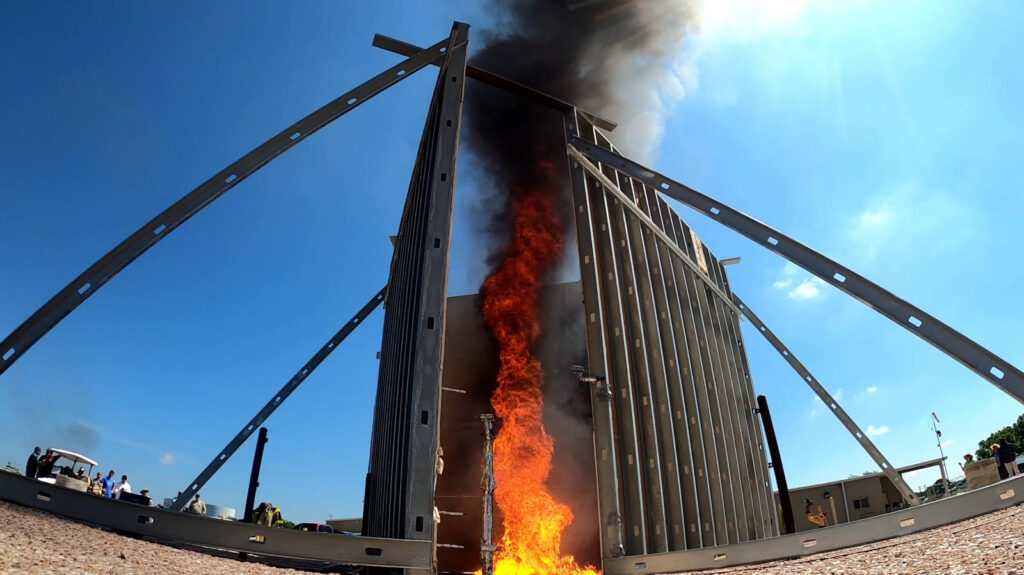
In May 2023, Gollner, Texas A&M aerospace engineering professor Elaine Oran, and two dozen others congregated at the Texas A&M Engineering Extension Service’s (TEEX) Brayton Fire Training Field in collaboration with BSEE. The team erected a trio of 5-meter walls that would channel air flow above a central pool of water, about 3 meters square and 1.2 meters deep, topped by either a 15- or 40-millimeter layer of oil. The scale of the setup was a far cry from traditional fire whirl experiments, which take place mostly in laboratories.
“Everything’s bigger in Texas,” Gollner said.
The three walls, constructed with gaps in just the right places, caused air drawn in by the flames to spiral into a swirling, combusting tower. The intense whirlwinds effectively acted as a vortex furnace, increasing burning rates by 40% compared to traditional fire pools while also vaporizing many of the particles that would have polluted the air: Emissions of PM2.5, or particles smaller than 2.5 micrometers across that can be harmful to human health, were 40% lower in the fire whirl experiments than in pool fires.
A team built fire tornadoes like this one in a custom-built, three-walled chamber at the TEEX Brayton Fire Training Field. Credit: Wuquan Cui/Michael Gollner
Cameras recording the fire whirl did their best to survive the experiment. Credit: Wuquan Cui/Michael Gollner
Why these soot reductions occur is still largely a mystery; probing this question would require building a novel laboratory apparatus to take measurements from within the flame itself, Gollner explained. In the field experiments, meanwhile, one of the fire whirls managed to consume 95% of the available fuel, though the remaining tests extinguished prematurely, lowering the overall rates. Ambient wind conditions on the days of the experiments may also have had some effect.
Summoning a fire whirl in even semi-ideal conditions on the outskirts of College Station, Texas, remains a far simpler task than manifesting one in the thick of a disaster: Towing a three-walled tornado generator onto open water becomes as much a question of marine and naval engineering as of fire science. In the experiment at TEEX, the captive firenado rose to the full length of the 5-meter walls; lower walls could make a floating rig easier to transport, but the resulting mix of oxygen and fuel could actually make subsequent air pollution worse, not better.
Years ago, while attending a fire safety conference, Michael Gollner received a frantic call: An experiment back in Maryland had resulted in boilover, splashing the walls and burning up a piece of lab equipment. Gollner has kept the charred remnant ever since, and on his computer, a photo of it is labeled “Don’t let your research go up in flames.” Credit: Michael Gollner
Ali Rangwala, a professor of fire protection engineering at Worcester Polytechnic Institute (WPI) who was not involved with the project, also encourages scientific due diligence. A fire whirl “works very well if the boundary conditions are fixed and well-engineered,” he said in an email to Eos, adding that these whirls have yet to be tested on open water with waves and that the required infrastructure may be costly. (Rangwala helped conduct fire whirl experiments with Gollner at WPI but has not maintained a relationship with the project.)
“The honest fact is that this is a disaster-driven field,” Gollner said. One of the largest oil spills in history, the Deepwater Horizon spill, unleashed more than 750 million liters (200 million gallons) into the Gulf of Mexico. That was in 2010. “We haven’t seen a big oil spill for a long time, and interest in it has wavered.…We require a more interdisciplinary team and more testing. Does anyone have the appetite? Unfortunately, I think it will come with time, when we have another accident.”
Blazing a Trail
Gollner stressed the critical value of fundamental research—of lines of inquiry driven by fascination, not just application. What started as a pure appreciation of a natural wonder has the potential to change fields in ways that researchers have yet to imagine.
“Swirling or not, flames are beautiful,” Gollner said. “It is a natural flow tracer. I can see the fluid mechanics and the combustion interacting.…All the physics, all in one: It’s just beautiful.”
—Jonathan Feakins, Science Writer
Citation: Feakins, J. (2026), The fiery tornadoes that could mop up oil spills, Eos, 107, https://doi.org/10.1029/2026EO260158. Published on [DAY MONTH] 2026.
They closed the night with The Killers, vegan rock, but there were no fatalities: no athlete burst a vein or had artificially hypertrophied muscles split open mid-effort; ligaments and tendons held up in the Las Vegas parking lot where, in 35 days, organizers had installed an elevated 100-meter, six-lane sprint track, a 50-meter pool with four lanes, a weightlifting stage and a long platform to seat thousands of spectators. Giant screens and lots of LEDs ran from 6.00 pm to 1.00 am, prime time i
They closed the night with The Killers, vegan rock, but there were no fatalities: no athlete burst a vein or had artificially hypertrophied muscles split open mid-effort; ligaments and tendons held up in the Las Vegas parking lot where, in 35 days, organizers had installed an elevated 100-meter, six-lane sprint track, a 50-meter pool with four lanes, a weightlifting stage and a long platform to seat thousands of spectators. Giant screens and lots of LEDs ran from 6.00 pm to 1.00 am, prime time in the city of vice, the hour when life wakes up.
Fred Kerley (EE. UU.) se impone a Emmanuel Matadi (LBR) y gana los 100 metros con un tiempo de 9,97 segundos en los 'Enhanced Games', celebrados en Resorts World Las Vegas.
A Las Vegas woman has pleaded guilty to manslaughter after her photographer friend was shot dead as he was taking pictures on a Polaroid camera of her and a friend toting guns.
[Read More]
A Las Vegas woman has pleaded guilty to manslaughter after her photographer friend was shot dead as he was taking pictures on a Polaroid camera of her and a friend toting guns.
I’ve often observed here that it’s tough to do multi-panel political cartoons because the news rarely cooperates by producing enough examples to fit the format. Granted, Tom Tomorrow generally does better than average at it anyway, but here’s an example of the subject matter cooperating with plenty of material that only needed a clever twist […]
I’ve often observed here that it’s tough to do multi-panel political cartoons because the news rarely cooperates by producing enough examples to fit the format. Granted, Tom Tomorrow generally does better than average at it anyway, but here’s an example of the subject matter cooperating with plenty of material that only needed a clever twist […]
Vanesa Rodríguez Valdés, based in Las Vegas, and her best friend, Liuddibet Calzadilla, in Barcelona, Spain, talked almost daily about their lives and their families back in Cuba, where they were both from. They talked about how much Valdés missed her teenage daughter and the diminutive size of the bedsit in the United States. On Sunday, May 26, Calzadilla wrote to her to ask how she was. She also asked if her husband Roelmer Sánchez Garrido was at home. If he was not, it meant they could talk f
Vanesa Rodríguez Valdés, based in Las Vegas, and her best friend, Liuddibet Calzadilla, in Barcelona, Spain, talked almost daily about their lives and their families back in Cuba, where they were both from. They talked about how much Valdés missed her teenage daughter and the diminutive size of the bedsit in the United States. On Sunday, May 26, Calzadilla wrote to her to ask how she was. She also asked if her husband Roelmer Sánchez Garrido was at home. If he was not, it meant they could talk freely.
ALOR GAJAH, June 3 — A man suffered burns to about 50 per cent of his body after being hit by an explosion believed to have been caused by a liquefied petroleum gas (LPG) leak at a house in Taman Baiduri, Kuala Ina here today.Melaka Fire and Rescue Department (JBPM) zone 2 chief, Assistant Fire Superintendent Zulkhairani Ramli said his department received an emergency call about the incident at about 10.26 am before a team of personnel from the Alor Gajah Fire a
ALOR GAJAH, June 3 — A man suffered burns to about 50 per cent of his body after being hit by an explosion believed to have been caused by a liquefied petroleum gas (LPG) leak at a house in Taman Baiduri, Kuala Ina here today.
Melaka Fire and Rescue Department (JBPM) zone 2 chief, Assistant Fire Superintendent Zulkhairani Ramli said his department received an emergency call about the incident at about 10.26 am before a team of personnel from the Alor Gajah Fire and Rescue Station (BBP) was dispatched to the location.
“Upon arrival at the location, the fire brigade found a 29-year-old man who was a tenant of the house injured after a sudden explosion in the kitchen.
“The JBPM Emergency Rescue and Treatment Service (EMRS) team provided initial treatment to the victim before handing him over to the Ministry of Health (MOH) medical team and taking him to Tampin Hospital for further treatment,” he said in a statement today.
Explaining further, Zulkhairani said it was understood that before the incident, the victim, who had just returned from his village in Pahang, noticed a sound believed to be caused by a gas leak in the house before inspecting the cooking gas cylinder.
He said that while the victim was inspecting, a sudden explosion occurred which caused him to suffer burn injuries and serious damage to the house.
“The explosion caused damage to the roof of the house in addition to affecting the building structure including doors and windows, ceiling and electrical wiring.
“Monitoring and safety inspections are also being carried out to ensure there is no risk of a subsequent gas leak, in addition to assisting with investigations into the incident,” he said.
He said the incident was suspected to have been caused by a leak of LPG gas that had accumulated in the house before the explosion and further investigations were still being carried out to determine the exact cause of the incident. — Bernama
The Alberta government's efforts to attract data centres by touting access to an abundant supply of cheap fossil fuels threatens to undermine Canada's clean power goals.
The Alberta government's efforts to attract data centres by touting access to an abundant supply of cheap fossil fuels threatens to undermine Canada's clean power goals.
Federal environment department says Black Mountain Energy has provided insufficient data as it seeks to drill 20 gas wells in the Kimberley regionFollow our Australia news live blog for latest updatesGet our breaking news email, free app or daily news podcastThe federal government has repeatedly raised concerns about an American company’s bid to frack for gas in Western Australia’s Kimberley region, part of the world’s largest and most intact tropical savanna.Texas-based Black Mountain Energy, t
The federal government has repeatedly raised concerns about an American company’s bid to frack for gas in Western Australia’s Kimberley region, part of the world’s largest and most intact tropical savanna.
Texas-based Black Mountain Energy, through its subsidiary Bennett Resources, is seeking federal approval to drill 20 gas wells for its Valhalla project west of Fitzroy Crossing.
 Login
Login